Facts
The Trial Court directed the revisionist, in proceedings under Section 12 of the Protection of Women from Domestic Violence Act, 2005 (“DV Act”), to furnish a personal bond of ₹50,000 and undertake not to commit violence against his wife and minor child.
Source reference: p. 1The revisionist appealed, but the appellate court affirmed the order. He did not execute the bond or furnish the undertaking. A recovery warrant was subsequently issued against him on the ground of breach of the undertaking.
Source reference: pp. 1–3In the revision, he challenged the recovery warrant, maintaining that an unexecuted bond could not be forfeited or recovered. The High Court condoned the 28-day delay in filing the revision.
Source reference: pp. 1–3Issues
1. Whether the amount specified in a bond directed under Section 19(3) of the DV Act could be recovered for an alleged breach when the revisionist had never executed the bond.
Source reference: pp. 2–52. Whether Section 28(2) of the DV Act independently authorised recovery of the amount of an unexecuted bond.
Source reference: pp. 3, 5Law Applied
Section 19(3) of the DV Act empowers a Magistrate to require a respondent to execute a bond, with or without sureties, to prevent domestic violence; under Section 19(4), an order under Section 19(3) is deemed to be an order under Chapter VIII of the Code of Criminal Procedure, 1973, or Chapter IX of the Bharatiya Nagarik Suraksha Sanhita, 2023, and must be dealt with accordingly.
Source reference: p. 3Where an executed bond is allegedly breached, Section 446 Cr.P.C./Section 491 BNSS governs forfeiture and recovery: the court must determine and record the grounds of forfeiture, give the person bound an opportunity to pay the penalty or show cause, and may recover the penalty as a fine only if it remains unpaid and sufficient cause is not shown.
Source reference: pp. 3–4Section 28(2) permits the court to lay down its own procedure for specified DV Act applications, but does not dispense with the statutory requirements for forfeiture of a bond.
Source reference: pp. 3, 5Reasoning
The revisionist’s assertion that he had never executed the bond was undisputed. The Court therefore held that no bond existed that could be forfeited for breach, and the ₹50,000 stated in the Trial Court’s order was the amount of a bond to be furnished—not, by itself, a recoverable monetary liability.
Source reference: pp. 4–5The statutory forfeiture procedure presupposes an executed bond and a subsequent finding of forfeiture; Section 28(2) could not independently validate recovery of the amount where those requirements were absent.
Source reference: pp. 4–5Accordingly, the recovery warrant could not be sustained.
Source reference: p. 5Holding
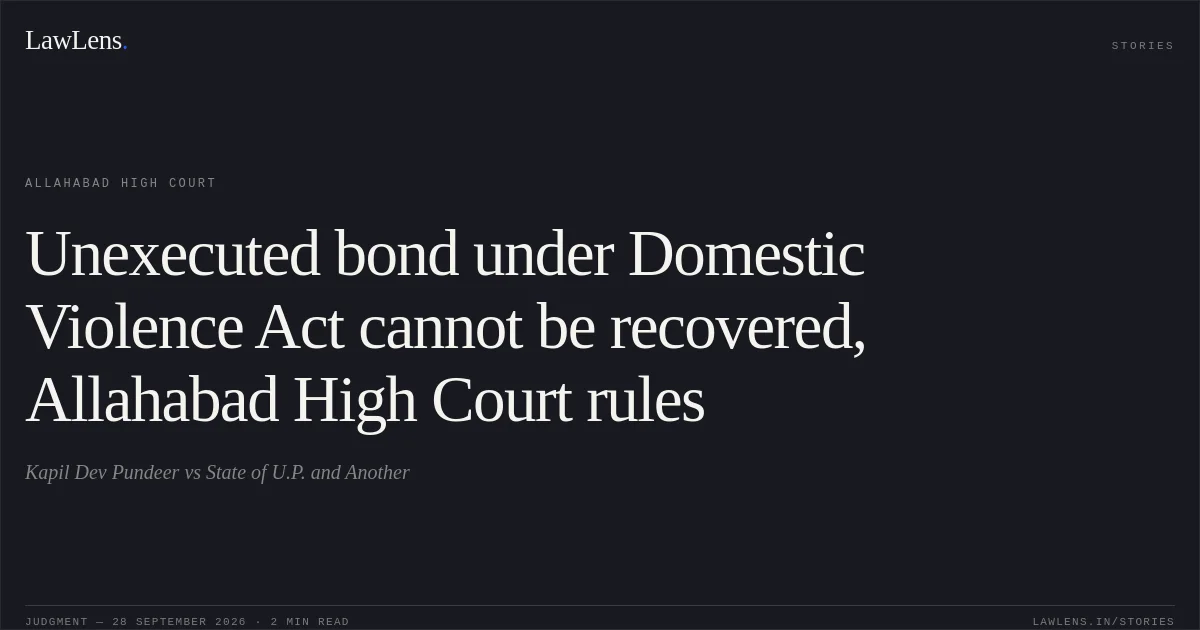
The High Court held that the ₹50,000 could not be recovered because the revisionist had not executed the bond, and the recovery warrant was unsustainable.
The revisionist was granted 20 days to furnish the bond and undertaking required by the Trial Court.
Source reference: pp. 5–6The Trial Court was directed to endeavour to conclude the Section 12 proceedings within six months, without unnecessary adjournments and after giving all concerned an adequate opportunity to be heard.
Source reference: pp. 5–6Any breach after execution of the bond was to be dealt with under the applicable statutory forfeiture procedure. The revision was disposed of with these directions.
Source reference: pp. 5–6Acts & Sections Cited
12 provisions across 3 statutes referred to in this judgment. Each provision opens on LawLens.
Protection of Women from Domestic Violence Act, 2005
Code of Criminal Procedure, 19731
Bharatiya Nagarik Suraksha Sanhita, 20231
Original Court PDF
Kapil Dev PundeervsState of U.P. and Another
Click to open original judgment
Original judgment, available to read, download and summarize on LawLens.in