Facts
The petitioner was detained under Section 8 of the Jammu and Kashmir Public Safety Act, 1978 (“PSA”) pursuant to detention order No. PSA/176 dated 08.12.2025 passed by the District Magistrate, Kathua.
Source reference: para. 1The detention proposal was submitted by the Senior Superintendent of Police, Kathua on 30.10.2025, relying on four FIRs, two DDR entries, and allegations that the petitioner had circulated provocative videos and delivered inflammatory speeches prejudicial to communal harmony and public order.
Source reference: paras. 2–5At the hearing, however, the challenge was confined to: (i) the 38-day delay between the sponsoring authority’s recommendation and the detention order; and (ii) suppression of the fact that the petitioner had been granted anticipatory bail by the High Court on 04.12.2025 in the last FIR, namely FIR No. 486/2025.
Source reference: para. 13The respondents contended that the detention was based on a proper consideration of the dossier and that the grounds and supporting documents had been supplied and explained to the petitioner.
Source reference: paras. 8–11Issues
1. Whether the unexplained delay of 38 days between the sponsoring authority’s recommendation dated 30.10.2025 and the detention order dated 08.12.2025 snapped the “live and proximate link” between the petitioner’s alleged activities and the necessity for preventive detention.
Source reference: paras. 13–16, 23–262. Whether the failure of the sponsoring and detaining authorities to disclose and consider the petitioner’s anticipatory-bail order dated 04.12.2025 vitiated the detention order for non-application of mind and violation of Article 22(5) of the Constitution.
Source reference: paras. 13, 27–37Law Applied
The Court applied Section 8 of the PSA, under which preventive detention must be based on a genuine and legally sustainable necessity to prevent conduct prejudicial to public order.
Source reference: para. 1Article 22(5) of the Constitution requires communication of the grounds of detention and preservation of the detenue’s effective right to make a representation.
Source reference: paras. 29, 34The Court applied the “live and proximate link” doctrine, holding that preventive detention must maintain a strong, immediate, and unbroken connection between past conduct and the imperative need for detention; unexplained delay may sever that link.
Source reference: paras. 16, 21–22Relying principally on Olia Mallick v. State of West Bengal, (1974) 1 SCC 594, Sk. Nizamuddin v. State of West Bengal, (1975) 3 SCC 395, Suresh Mahato v. District Magistrate, Burdwan, (1975) 3 SCC 554, Bhawarlal Ganeshmalji v. State of Tamil Nadu, (1979) 1 SCC 465, Rajendra Kumar Natvarlal Shah v. State of Gujarat, 1988 SCC (3) 153, and Sushanta Kumar Banik v. State of Tripura, AIR 2022 SC 4715, the Court held that delay must be satisfactorily explained and that material facts capable of influencing subjective satisfaction, including bail orders, cannot be withheld or ignored.
Source reference: paras. 17–22, 29–30The Court further held that preventive detention cannot be used to circumvent or nullify an existing bail order without considering its terms and effectiveness.
Source reference: paras. 35–37Reasoning
The Court found that the sponsoring authority made its recommendation on 30.10.2025, but the District Magistrate passed the detention order only on 08.12.2025, resulting in an unexplained delay of 38 days.
Source reference: paras. 23–24Although the allegations against the petitioner were serious, the Court held that the alleged threat to public order was inconsistent with the detaining authority’s failure to act promptly; if the threat were immediate and genuine, the petitioner would not have been allowed to remain at large for that period.
Source reference: paras. 25–26The delay therefore raised doubt about the genuineness of the subjective satisfaction and severed the live and proximate link.
Source reference: paras. 25–26Independently, the Court noted that the petitioner had obtained anticipatory bail on 04.12.2025 in the last FIR, four days before the detention order, but the bail order was neither placed before nor considered by the detaining authority.
Source reference: paras. 27, 31–34This omission deprived the authority of a complete and current factual basis for its satisfaction and impaired the petitioner’s right to make an effective representation under Article 22(5).
Source reference: paras. 29–30, 34The timing of the detention, immediately after the grant of bail, also suggested that the PSA order operated to circumvent the effect of the bail order.
Source reference: paras. 35–37Holding
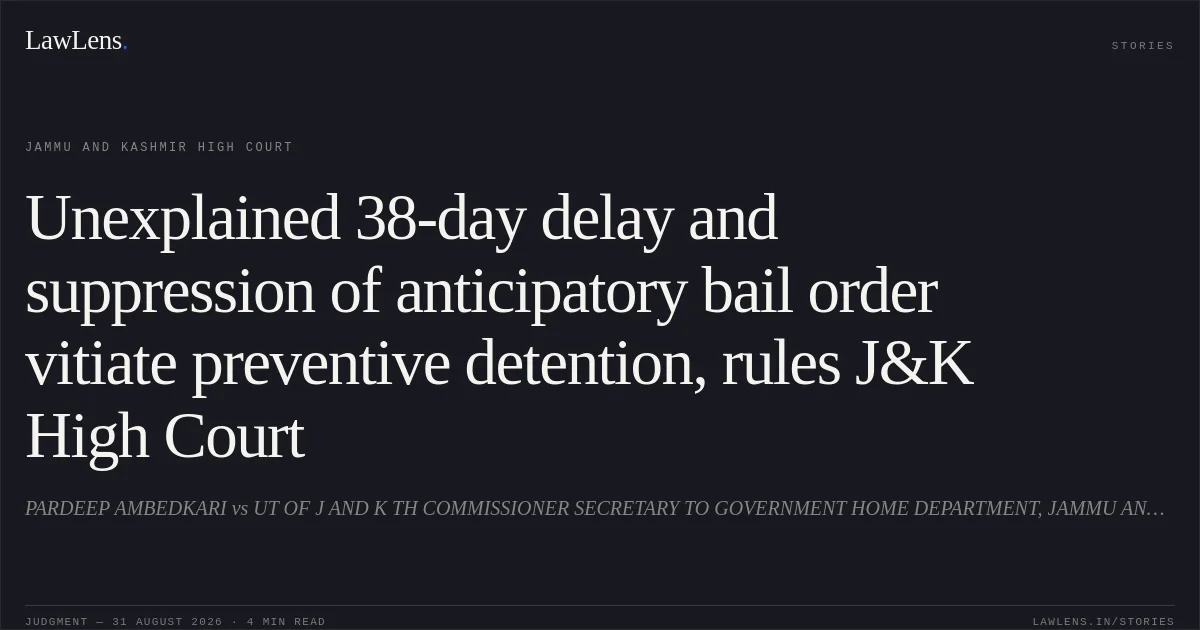
The Court answered both issues in favour of the petitioner. It held that the unexplained 38-day delay invalidated the detention by snapping the live and proximate link, and that suppression of the anticipatory-bail order vitiated the detaining authority’s subjective satisfaction and infringed Article 22(5).
The petition was allowed, detention order No. PSA/176 dated 08.12.2025 was quashed, and the respondents were directed to release the petitioner immediately, unless he was required in connection with any other offence.
Source reference: para. 38Acts & Sections Cited
6 provisions across 1 statute referred to in this judgment. Each provision opens on LawLens.
Bharatiya Nyaya Sanhita, 20236
Original Court PDF
PARDEEP AMBEDKARIvsUT OF J AND K TH COMMISSIONER SECRETARY TO GOVERNMENT HOME DEPARTMENT, JAMMU AND OTHERS
Click to open original judgment
Original judgment, available to read, download and summarize on LawLens.in