01Facts
The land was granted to the "original grantee" in 1961–62. The first alienation occurred in 1973, followed by further alienations.
¶ 5 · p. 5The petitioners' family purchased the subject property in 2018.
¶ 5 · p. 5In 2020, the Assistant Commissioner initiated suo motu resumption proceedings (PTCL 14/2020-21) and ordered resumption of the land by order dated 18.09.2024 (Annexure-Q).
¶ 2 · pp. 3–4 · ¶ 5 · p. 5The Deputy Commissioner affirmed the Assistant Commissioner's order in appeal (PTCL 1/2025) (Annexure-R).
¶ 2 · p. 4 · ¶ 7 · p. 7The petitioners challenged both orders under Articles 226 and 227, seeking quashing and restoration of revenue entries in their name.
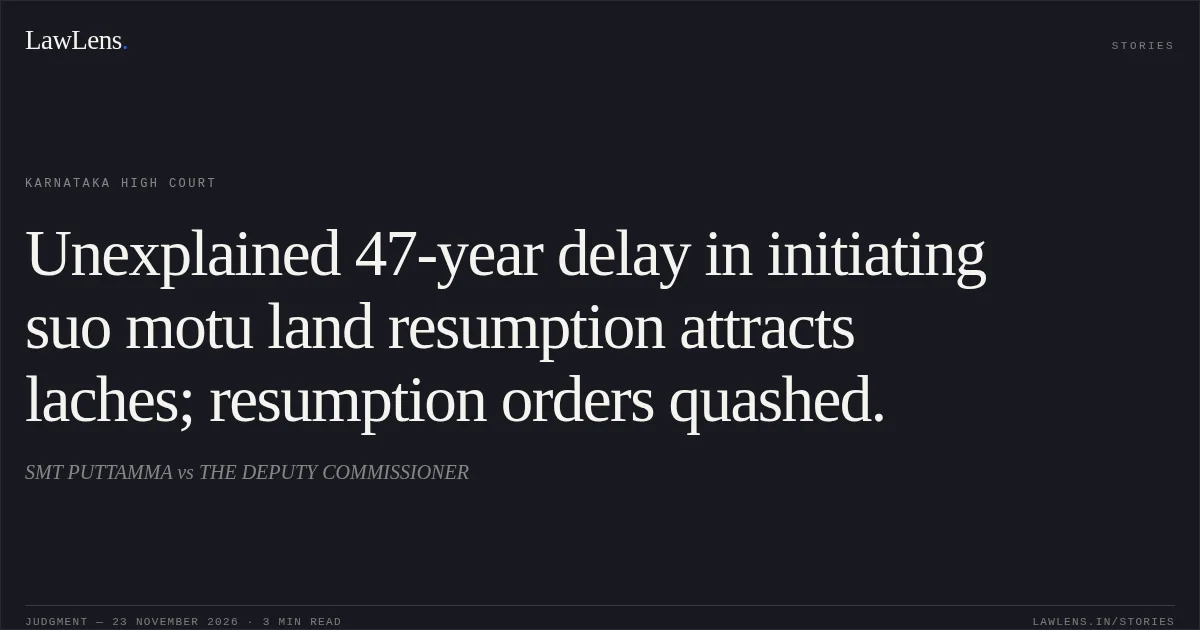
¶ 2 · pp. 3–4The authorities did not consider the delay of nearly 47 years between the first alienation and the initiation of proceedings, or whether that delay was unexplained and unreasonable.
¶ 5 · pp. 5–6The court noted recurring discrepancies in the impugned orders regarding grantee names, grant and alienation dates, and survey numbers, and used the descriptors "original grantee" and "relevant years" for convenience.
¶ 3 · pp. 4–502Issues
i.1. Whether the Assistant Commissioner and the Deputy Commissioner erred in ordering resumption of the land without examining whether the proceedings were barred by inordinate delay and laches, given the approximately 47-year gap from the first alienation.
¶ 5 · pp. 5–6ii.2. Whether the resumption orders dated 18.09.2024 and the appellate order dated 11.09.2025 can be sustained in law.
¶ 5 · p. 6 · ¶ 6–7 · p. 703Law Applied
The Court relied on the principle, drawn from a Division Bench decision that it summarised without naming, that laches is a primary requirement in land resumption proceedings and that restoration action filed after significant delay may be barred by laches.
¶ 5 · p. 6 · Division Bench decision: no citationThe resumption authorities must adjudicate delay and laches as a vital and relevant aspect before ordering resumption, particularly where rights in the land have passed through successive transfers.
¶ 5 · pp. 5–6The writ of certiorari under Articles 226 and 227 is the remedy to quash orders that fail to consider such a vital issue.
¶ 7 · p. 7 · ¶ 2 · p. 304Reasoning
Neither the Assistant Commissioner nor the Deputy Commissioner addressed whether resumption after a delay of about 47 years from the first alienation was reasonable or explained. Applying the Division Bench principle that laches is a primary consideration in resumption, the Court held that the omission was not a minor procedural lapse but a failure to adjudicate a vital and relevant issue.
¶ 5 · pp. 5–6The Court emphasised that the land had changed hands several times since 1973 and that the petitioners' 2018 purchase was part of this chain, which made the delay material to the equities of the resumption. Because the defect went to the foundation of the orders, the Court concluded that the orders could not be legally sustained and did not need to examine the merits of the resumption grounds. The Court's reasoning on Issue 1 is directed at the procedural failure to consider delay, not at a substantive finding that the proceedings were time-barred.
¶ 5 · pp. 5–6 · ¶ 5 · p. 605Holding
Issue 1: Yes. The authorities erred by ordering resumption without considering the inordinate, unexplained delay and laches.
¶ 5 · pp. 5–6Issue 2: The resumption orders cannot be sustained and are liable to be set aside.
¶ 5 · p. 6 · ¶ 6 · p. 7The Court issued a writ of certiorari quashing the Assistant Commissioner's order dated 18.09.2024 (Annexure-Q) and the Deputy Commissioner's order (Annexure-R). The concerned authority is directed to mutate or restore the petitioners' names in the subject land in the revenue records.
¶ 7 · p. 7The writ petition is allowed, and any interim orders stand discharged.
¶ 8 · p. 7Original Court PDF
SMT PUTTAMMAvsTHE DEPUTY COMMISSIONER
Click to open original judgment
Original judgment, available to read, download and summarize on LawLens.in