Facts
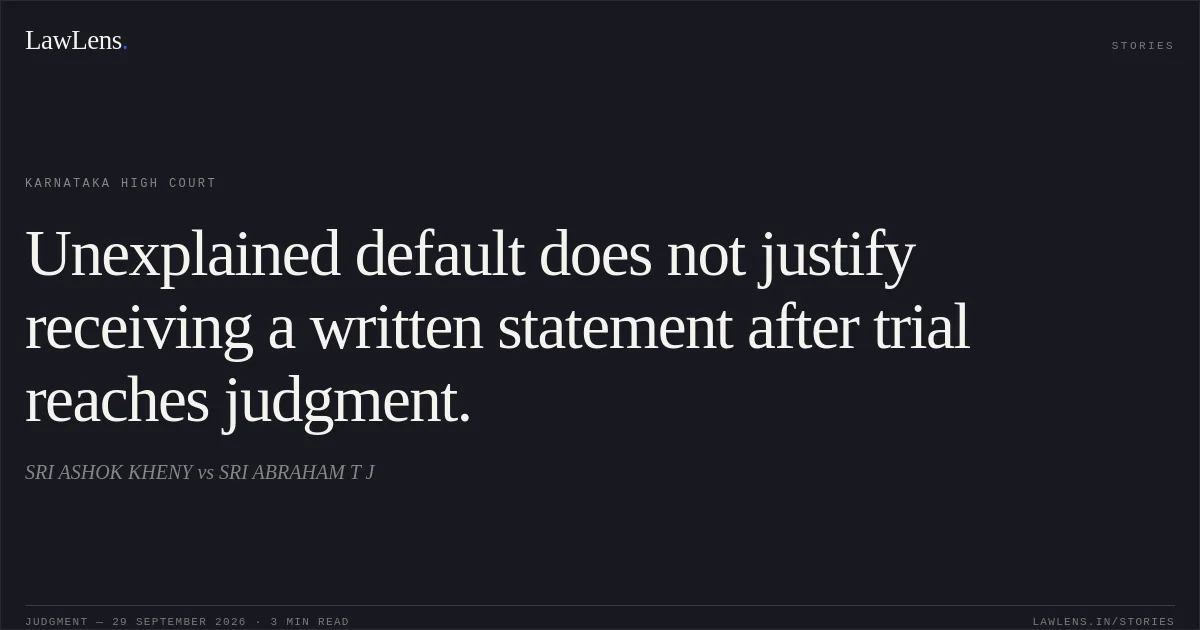
The petitioner, plaintiff in O.S. No. 8591/2013, brought a suit concerning allegedly defamatory statements made by the respondent.
Source reference: para. 1–2The respondent had entered appearance and received five opportunities to file a written statement, but did not do so; the trial court recorded it as “Nil” on 13 January 2015.
Source reference: para. 1–2, 10The plaintiff thereafter testified as PW-1, but the respondent did not cross-examine him or lead evidence, and the suit was posted for judgment.
Source reference: para. 3–4, 11At that stage, the respondent applied under Section 151 CPC to reopen the proceedings, recall the “Nil” order, condone the delay, and receive his written statement.
Source reference: para. 4–7The trial court allowed the applications subject to costs, prompting the plaintiff’s petition under Article 227 of the Constitution.
Source reference: para. 4–7Issues
1. Whether the trial court was justified in allowing the respondent to reopen the proceedings, recall the order recording the written statement as “Nil,” condone the delay, and receive the written statement after the plaintiff’s evidence and the respondent’s evidence had closed and the suit had been posted for judgment.
Source reference: para. 9Law Applied
Order VIII Rule 1 CPC is directory in an ordinary civil suit, and a court has limited discretion to receive a written statement beyond the prescribed period; that discretion must be exercised judicially, considering the explanation for delay, the party’s conduct, prejudice to the opposite party, and the stage of proceedings (*Kailash v. Nanhku*; *Salem Advocate Bar Association (II) v. Union of India*; *Desh Raj v. Balkishan*).
Source reference: para. 13–14Section 151 CPC preserves inherent powers to secure the ends of justice and prevent abuse of process, but does not permit a party to circumvent the Code or revive a stage closed through its own default.
Source reference: para. 19In an ordinary civil suit, the court is not invariably powerless to act after a matter is posted for judgment, but an application seeking to reopen proceedings at that stage requires a compelling and legally sustainable basis; costs alone do not justify reopening a trial after prolonged, unexplained delay.
Source reference: para. 21–24*SCG Contracts India Pvt. Ltd. v. K.S. Chamankar Infrastructure Pvt. Ltd.* concerned the mandatory regime for commercial suits and did not impose that regime on this non-commercial suit.
Source reference: para. 20Reasoning
The respondent knew of the suit, had five opportunities to file a defence, and offered no satisfactory explanation for failing to do so.
Source reference: para. 10–12, 23His Order VII Rule 11 application neither substituted for a written statement nor stayed the proceedings or extended time to file one.
Source reference: para. 18By the time he sought relief, the plaintiff’s evidence was complete, the respondent had not cross-examined PW-1 or led evidence, and the suit had reached the judgment stage; receiving a new defence would therefore unsettle the trial and materially prejudice the plaintiff.
Source reference: para. 15–17The trial court’s imposition of costs did not cure the absence of sufficient cause or justify reopening the proceedings, and its order failed to address the relevant circumstances.
Source reference: para. 23–29Holding
The Court answered the issue in the negative and allowed the writ petition.
It set aside the trial court’s order allowing I.A. Nos. IV to VII, dismissed those applications, and left in force the order recording the respondent’s written statement as “Nil”.
Source reference: para. 30(i)–(iii)The trial court was directed to proceed on the evidence already recorded and pronounce judgment; the respondent could not, pursuant to those applications, reopen the trial or introduce a written statement at that stage.
Source reference: para. 30(iv)The Court clarified that its decision was confined to the facts and did not establish an absolute bar on receiving a late written statement in an ordinary civil suit.
Source reference: para. 30(v)–(vi)Acts & Sections Cited
1 provisions across 1 statute referred to in this judgment. Each provision opens on LawLens.
Code of Civil Procedure, 19081
Original Court PDF
SRI ASHOK KHENYvsSRI ABRAHAM T J
Click to open original judgment
Original judgment, available to read, download and summarize on LawLens.in