Facts
The petitioner’s elder brother, Ishwarlal, a Safai Karmchari employed with Nagar Parishad, Rajsamand, died in harness on 22 January 2017, leaving behind his mother and the petitioner, who was then a minor aged about 12 years.
Source reference: para. 2No application for compassionate appointment was submitted during the petitioner’s minority. She attained majority on 25 January 2023 and had already passed Class XII in 2022, but applied for compassionate appointment only on 16 December 2024.
Source reference: paras. 3, 7The Commissioner, Nagar Parishad, rejected the application on 28 May 2025 on the ground that it was not filed within the prescribed period under Rule 10(3) of the Rajasthan Compassionate Appointment of Dependents of Deceased Government Servants Rules, 1996.
Source reference: para. 2The petitioner challenged the rejection and sought a direction to forward her case to the Department of Personnel for relaxation of the prescribed time limit.
Source reference: paras. 1, 3–4Issues
Whether the petitioner was entitled to consideration of her delayed application for compassionate appointment under the relaxation proviso to Rule 10(3) of the 1996 Rules, merely because she was a minor when the deceased employee died?
Source reference: paras. 7, 10, 14Whether the Circular dated 22 June 2015 applied to the petitioner’s case and required the respondents to forward her application to the Department of Personnel for consideration?
Source reference: paras. 5, 8, 14Whether the rejection order dated 28 May 2025 was arbitrary or warranted interference under Article 226 of the Constitution?
Source reference: paras. 1, 15–16Law Applied
The Court applied Rule 10(3) of the Rajasthan Compassionate Appointment of Dependents of Deceased Government Servants Rules, 1996, which requires an application for compassionate appointment within the prescribed period and permits the Department of Personnel to relax that requirement only in an exceptional case where strict application of the rule causes financial hardship and relaxation is necessary in the interests of justice.
Source reference: para. 9The power of relaxation is discretionary and exceptional, not automatic; the claimant must establish extraordinary circumstances explaining the delay.
Source reference: para. 10The Court relied on State of Himachal Pradesh v. Shashi Kumar, (2019) 3 SCC 653, for the principles that compassionate appointment is intended to provide immediate financial assistance, that delay and laches may defeat a stale claim, and that reconsideration should not be ordered where it would serve no useful purpose.
Source reference: para. 11The Circular dated 22 June 2015 was held to concern cases involving relaxation of the minimum age from 18 to 16 years and not unexplained delay after attaining majority.
Source reference: para. 8Reasoning
The Court held that the petitioner’s minority explained why she could not apply at the time of her brother’s death, but that justification ended when she attained majority on 25 January 2023.
Source reference: para. 10Since she had already acquired the requisite educational qualification in 2022, she was legally capable of applying immediately after attaining majority; however, she waited approximately twenty months without pleading or proving any medical incapacity, legal disability, financial impossibility, or other unavoidable circumstance.
Source reference: paras. 7, 10, 14Mere financial hardship was insufficient to constitute an exceptional circumstance warranting relaxation, as treating it otherwise would make the prescribed limitation period meaningless.
Source reference: para. 10The Circular dated 22 June 2015 was inapplicable because the petitioner had not applied before attaining majority or sought relaxation of the minimum age.
Source reference: para. 8The decision in Bharat Kumar was distinguished because, unlike the present petitioner, the family in that case had promptly informed the employer of the minor children’s position and had otherwise demonstrated diligence.
Source reference: paras. 12–13Applying the principles of immediacy, delay, and exceptional relaxation, the Court found no arbitrariness in the rejection order.
Source reference: paras. 14–15Holding
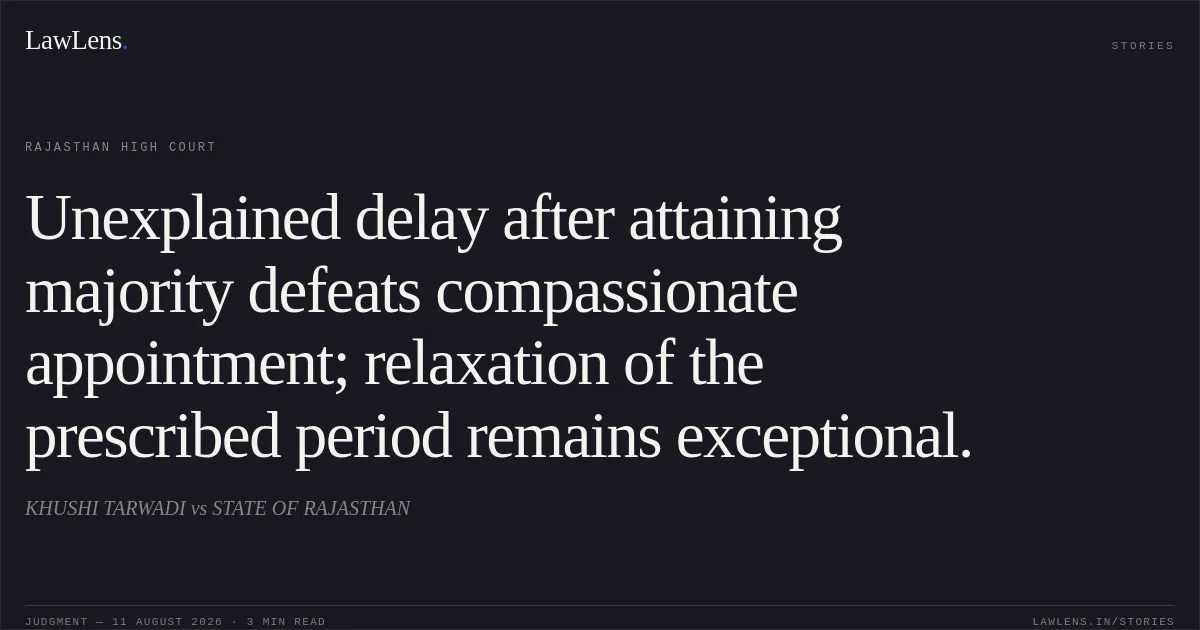
The Court answered the issues against the petitioner. It held that the unexplained twenty-month delay after attaining majority did not justify relaxation under the proviso to Rule 10(3), that the Circular dated 22 June 2015 was inapplicable, and that Bharat Kumar did not assist her.
The rejection order dated 28 May 2025 was upheld, the writ petition was dismissed, and the stay application and all pending applications were disposed of.
Source reference: paras. 15–16Original Court PDF
KHUSHI TARWADIvsSTATE OF RAJASTHAN
Click to open original judgment
Original judgment, available to read, download and summarize on LawLens.in