Facts
The appellant/applicant challenged the judgment dated 06.12.2025 of the Family Court, Agartala, in T.S. (DIV) No. 169 of 2023, by which his divorce petition was dismissed, inter alia, for failure to pay maintenance ordered by the court and for non-compliance with an imposed cost.
Source reference: p.1; para. 11He filed an application under Section 5 of the Limitation Act, 1963, seeking condonation of 171 days’ delay in filing the matrimonial appeal.
Source reference: p.1; para. 1The appellant contended that the appeal was otherwise subject to a 90-day limitation period under Section 28(4) of the Hindu Marriage Act, 1955, read with Section 19 of the Family Courts Act, 1984.
Source reference: p.2; para. 3He also claimed that 79 days were attributable to the time taken in obtaining the certified copy: the copy was applied for on 30.04.2026 and delivered on 18.07.2026.
Source reference: p.2; paras. 3–4He further asserted that his trial counsel had not informed him of the judgment and that, being a layperson, he was unaware of the outcome of the proceedings.
Source reference: p.2; para. 5The respondents did not appear, and no notice had been issued to them.
Source reference: p.2; para. 2Issues
Whether the appellant had established sufficient cause under Section 5 of the Limitation Act, 1963, for condonation of the delay in filing the matrimonial appeal?
Source reference: pp.1–5; paras. 1, 8–17Whether the delay attributable to obtaining the certified copy and the alleged failure of counsel to inform the appellant of the judgment constituted a satisfactory explanation warranting condonation?
Source reference: p.2; paras. 4–5; p.3, paras. 8–12Whether the connected matrimonial appeal could be entertained after refusal to condone the delay?
Source reference: p.5; para. 18Law Applied
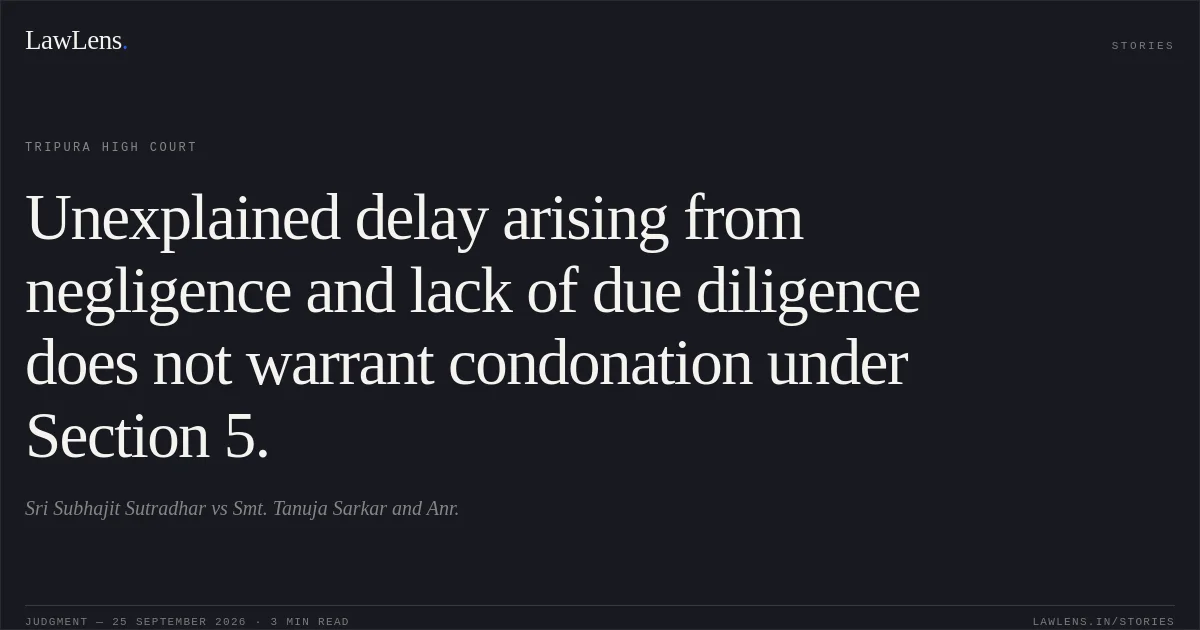
The Court applied Section 5 of the Limitation Act, 1963, under which delay may be condoned only upon the applicant demonstrating “sufficient cause”; the discretion must be exercised judicially and not where delay results from negligence, carelessness, or lack of due diligence.
Source reference: p.5; para. 15The Court treated the appeal as governed by the 90-day limitation period under Section 28(4) of the Hindu Marriage Act, 1955, read with Section 19 of the Family Courts Act, 1984.
Source reference: p.2; para. 3Relying on Thirunagalingam v. Lingeswaran & Anr., 2025 SCC OnLine SC 1093, the Court held that the bona fides of the explanation for delay must first be examined and that delay cannot be condoned merely as an act of generosity or at the cost of prejudice to the opposing party.
Source reference: p.4; para. 13It further relied on H. Guruswamy v. A. Krishnaiah, 2025 SCC OnLine SC 54, for the principles that the length of delay is relevant, limitation rules are founded on public policy and equity, and the court must first assess the bona fides and due diligence of the applicant before considering the merits of the underlying case.
Source reference: p.4; para. 14Reasoning
The Court found that the appellant had not applied for a certified copy during the prescribed 90-day limitation period but applied only on 30.04.2026, several months after the judgment dated 06.12.2025.
Source reference: p.3; para. 8It rejected as unconvincing the claim that the appellant was unaware of the judgment because his counsel had not informed him, holding that it was his duty to remain informed about the result of litigation initiated by him.
Source reference: p.3; paras. 9–10The Court also considered the appellant’s conduct in the original proceedings, including his alleged deliberate non-payment of court-ordered maintenance, failure to pay costs, and admission that he was living with his second wife.
Source reference: p.3; para. 11Applying the requirement that the delay be explained with adequate particulars and due diligence, the Court held that the appellant had merely stated dates and pleaded ignorance of the judgment without placing sufficient supporting material before it.
Source reference: p.4; para. 12Since the explanation did not establish bona fide sufficient cause and disclosed negligence or lack of diligence, the Court declined to exercise its discretionary power under Section 5 of the Limitation Act.
Source reference: pp.4–5; paras. 15–17Holding
The Court answered the limitation issue against the appellant and held that the explanation for the delay was neither satisfactory nor sufficient under Section 5 of the Limitation Act, 1963.
The application for condonation of delay was rejected, and consequently the connected matrimonial appeal was also dismissed. All pending applications were directed to stand closed.
Source reference: p.5; para. 18Acts & Sections Cited
3 provisions across 3 statutes referred to in this judgment. Each provision opens on LawLens.
Limitation Act, 19631
Hindu Marriage Act, 19551
Family Courts Act, 19841
Original Court PDF
Sri Subhajit SutradharvsSmt. Tanuja Sarkar and Anr.
Click to open original judgment
Original judgment, available to read, download and summarize on LawLens.in