Facts
The Central Selection Board of Constable, Bihar (“CSBC”) issued Advertisement No. 1 of 2017 for recruitment to the post of Constable (Police). The appellant applied, passed the written examination held on 15 October 2017 and the physical test held on 20 March 2018, and was provisionally recommended for appointment.
Source reference: paras. 2, 8The CSBC thereafter sent the handwriting specimens and examination materials of 235 candidates to the Police Laboratory, CID, Bihar, for verification. The handwriting of 229 candidates was found not to tally with the relevant examination records; the appellant’s name was initially not included in that group, pending receipt of her report.
Source reference: paras. 3, 8Subsequently, the Police Laboratory reported that the appellant’s handwriting did not tally with the handwriting on her OMR sheet. The CSBC cancelled her selection by letter dated 4 June 2019 and treated her as a non-FIR accused in Gardanibagh P.S. Case No. 500 of 2018, alleging forgery in the recruitment examination.
Source reference: paras. 4, 8The appellant sought information regarding her candidature on 3 August 2019 and 21 November 2019, and was informed by letters dated 26 August 2019 and 4 December 2019 that her selection had been cancelled.
Source reference: paras. 3, 6She thereafter filed C.W.J.C. No. 3453 of 2023 challenging the cancellation. The learned Single Judge dismissed the writ petition on 1 August 2023 as barred by delay and laches. The present Letters Patent Appeal challenged that dismissal.
Source reference: paras. 5–7Issues
Whether the learned Single Judge was justified in dismissing the writ petition solely on the ground of delay and laches, where the appellant approached the Court approximately three and a half years after being informed of the cancellation of her selection?
Source reference: paras. 6, 9–13Whether the appellant’s explanation based on unavoidable circumstances and the COVID-19 pandemic constituted sufficient justification for condoning the delay and examining the legality of the cancellation of her selection on merits?
Source reference: para. 7Law Applied
The Court applied the settled doctrine that relief under Article 226 of the Constitution is discretionary, equitable and extraordinary, and may be refused where an aggrieved person approaches the Court after an unreasonable and unexplained delay.
Source reference: no citationIt relied on P.S. Sadasivaswamy v. State of Tamil Nadu, (1975) 1 SCC 152, which states that, ordinarily, a person aggrieved in a service or promotion matter should approach the Court within six months or, at most, one year.
Source reference: para. 11The Court further relied on State of Tamil Nadu v. Seshachalam, (2007) 10 SCC 137; C. Jacob v. Director of Geology & Mining, AIR 2009 SC 264; State of Uttarakhand v. Shiv Charan Singh Bhandari, 2013 AIR SCW 6627; Chennai Metropolitan Water Supply & Sewerage Board v. T.T. Murali Babu, (2014) 4 SCC 108; State of Jammu & Kashmir v. R.K. Zalpuri, AIR 2016 SC 3006; and Union of India v. C. Girija, (2019) 15 SCC 633, for the principle that delay and laches should not be lightly disregarded, particularly where belated litigation may prejudice settled rights or affect other candidates.
Source reference: paras. 10–12The maxim “equity aids the vigilant and not those who slumber on their rights” was also applied.
Source reference: para. 13Reasoning
The Court held that the appellant had knowledge of the cancellation at least by 26 August 2019, when the CSBC’s Public Information Officer communicated the cancellation letter dated 4 June 2019 to her.
Source reference: paras. 6, 9Nevertheless, she filed the writ petition only in 2023, after a delay of more than three and a half years. The writ petition contained no cogent explanation for this delay.
Source reference: para. 13The general assertion of unavoidable circumstances and the COVID-19 pandemic was not treated as an adequate justification for the entire period of delay.
Source reference: para. 7Applying the principles governing discretionary relief under Article 226, the Court concluded that the appellant’s prolonged inaction disentitled her to invoke the writ jurisdiction, without requiring adjudication of the substantive allegation concerning handwriting forgery or the cancellation of her selection on merits.
Source reference: paras. 9–13Holding
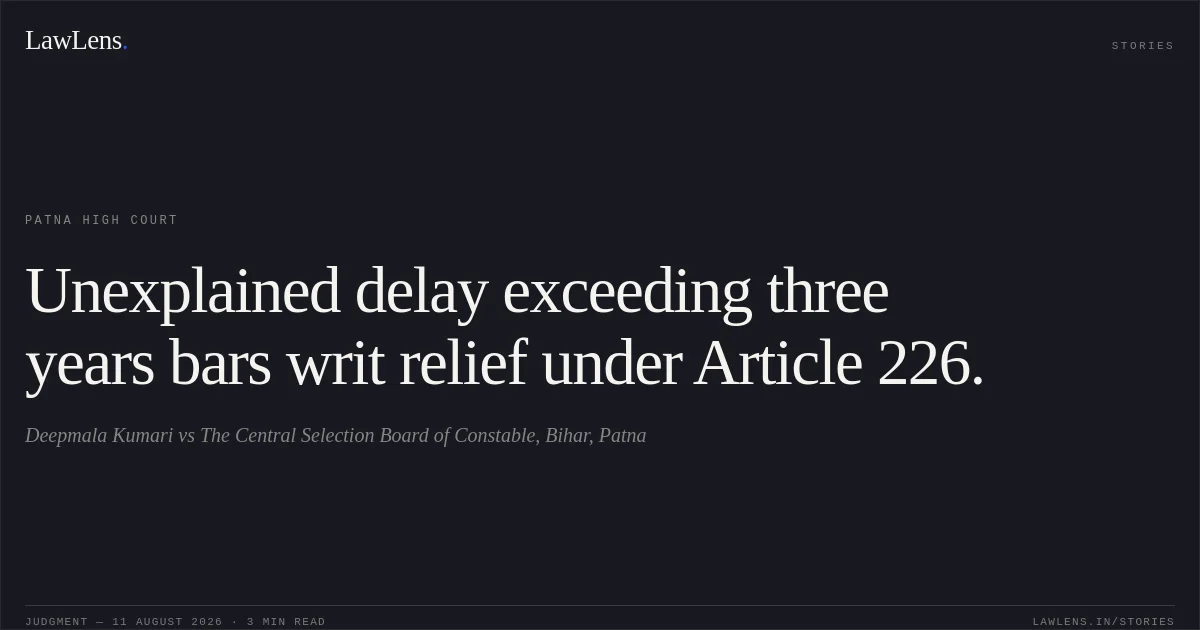
The Division Bench answered the issues against the appellant. It held that the writ petition was rightly dismissed as barred by unexplained delay and laches, since the appellant had approached the Court more than three and a half years after receiving information regarding cancellation of her selection.
Finding no infirmity in the learned Single Judge’s order dated 1 August 2023, the Court dismissed the Letters Patent Appeal.
Source reference: para. 13Original Court PDF
Deepmala KumarivsThe Central Selection Board of Constable, Bihar, Patna
Click to open original judgment
Original judgment, available to read, download and summarize on LawLens.in