Facts
The applicant, an Additional Commissioner of Income Tax, challenged a minor penalty order dated 16.01.2023, which withheld his next increment for a specific period without cumulative effect.
Source reference: p. 2, 8.1The penalty stemmed from a 2021 memorandum regarding an incident in 2007, where the applicant allegedly accepted hotel accommodation worth ₹11,000/- sponsored by an assessee (M/s VHAI) during scrutiny proceedings.
Source reference: p. 4-5Although the CBI found no criminal conspiracy, the department initiated disciplinary action for violation of Conduct Rules.
Source reference: p. 2The applicant contended that he had reimbursed the amount via cheque in 2007 and cash in 2008.
Source reference: p. 2-3He further argued that the 14-year delay in initiating proceedings, during which he received several promotions, should be treated as a condonation of the alleged misconduct.
Source reference: p. 6, 5.1Issues
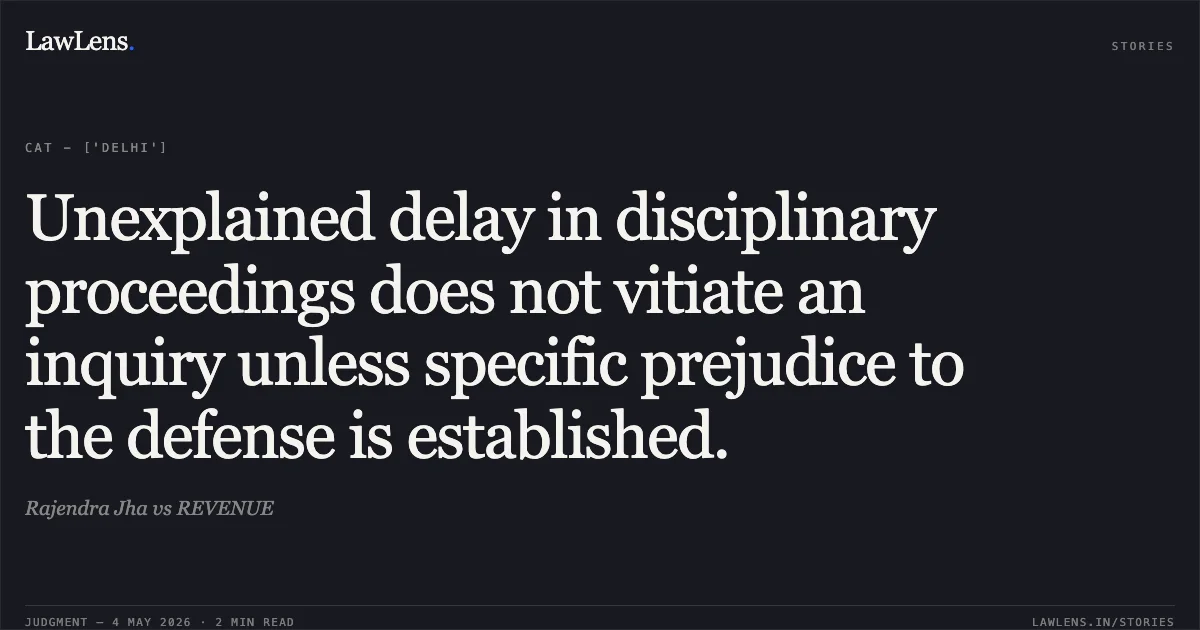
1. Whether an inordinate and unexplained delay in initiating disciplinary proceedings, coupled with interim promotions, vitiates the penalty order and amounts to deemed condonation of misconduct?
Source reference: p. 6 / para. 5.1-5.22. Whether the absence of a finding of criminality by the CBI precludes the department from imposing a minor penalty for service misconduct under the CCS (Conduct) Rules?
Source reference: p. 5 / para. 3.3Law Applied
Rules 3(1)(iii) and 13(1) of the CCS (Conduct) Rules, 1964, regarding the maintenance of integrity and the prohibition against accepting gifts or hospitality from interested parties.
Source reference: p. 4, 5The principle established in State of Madhya Pradesh v. Akhilesh Jha (2021), which holds that delay alone does not vitiate an inquiry unless specific prejudice is demonstrated.
Source reference: p. 8, para. 8.3The doctrine from S. Janaki Iyer v. Union of India (2024), stating that unexplained delay is only a ground for interference if it hampers the delinquent’s ability to defend themselves.
Source reference: p. 9, para. 8.4Departmental proceedings and criminal trials operate in distinct fields with different standards of proof.
Source reference: p. 5, para. 3.3Reasoning
The Tribunal found that the applicant failed to prove how the 14-year delay caused him specific legal prejudice, as he was able to provide a detailed defense and documentary evidence during the inquiry.
Source reference: p. 8, para. 8.2The court noted that the vigilance process was continuous, involving CBI inputs and consultations with the CVC and UPSC, thus explaining the timeline.
Source reference: p. 8, para. 8.2Regarding the promotions, the Tribunal held that granting regular promotions does not automatically result in the "deemed condonation" of a prior misconduct if the disciplinary authority follows due process later.
Source reference: p. 8, para. 8.2On the merits, the Tribunal observed that the act of accepting hospitality from an assessee—even if later reimbursed—constituted a technical infraction of service rules, and the evaluation of such evidence falls within the domain of the Disciplinary Authority rather than judicial review.
Source reference: p. 9-10, para. 8.6Holding
The Tribunal answered the issues in the negative and dismissed the Original Application.
It held that the disciplinary proceedings were procedurally sound, and the applicant's rights were not prejudiced by the delay.
Source reference: p. 9, para. 8.5The final holding confirmed that the minor penalty of withholding an increment was legally valid, and the Tribunal declined to substitute its judgment for that of the Disciplinary Authority. All pending applications were disposed of with no order as to costs.
Source reference: p. 10, para. 8.6, 9.2Acts & Sections Cited
4 provisions across 2 statutes referred to in this judgment. Linked provisions open on LawLens.
Central Civil Services (Classification, Control & Appeal) Rules, 19652
Central Civil Services (Conduct) Rules, 19642
Original Court PDF
Rajendra JhavsREVENUE
Click to open original judgment
Original judgment, available to read, download and summarize on LawLens.in