Facts
The State appealed an acquittal order dated 07.08.2012 regarding an incident on 04.11.2010.
Source reference: no citationThe complainant (P.W.1) alleged that Accused No. 1 ignited firecrackers near her house, assaulted a neighbor (P.W.4), and subsequently, along with other accused, assaulted the complainant and her husband while using caste-based slurs.
Source reference: p. 1-2The trial court acquitted the respondents, citing a lack of evidence beyond reasonable doubt.
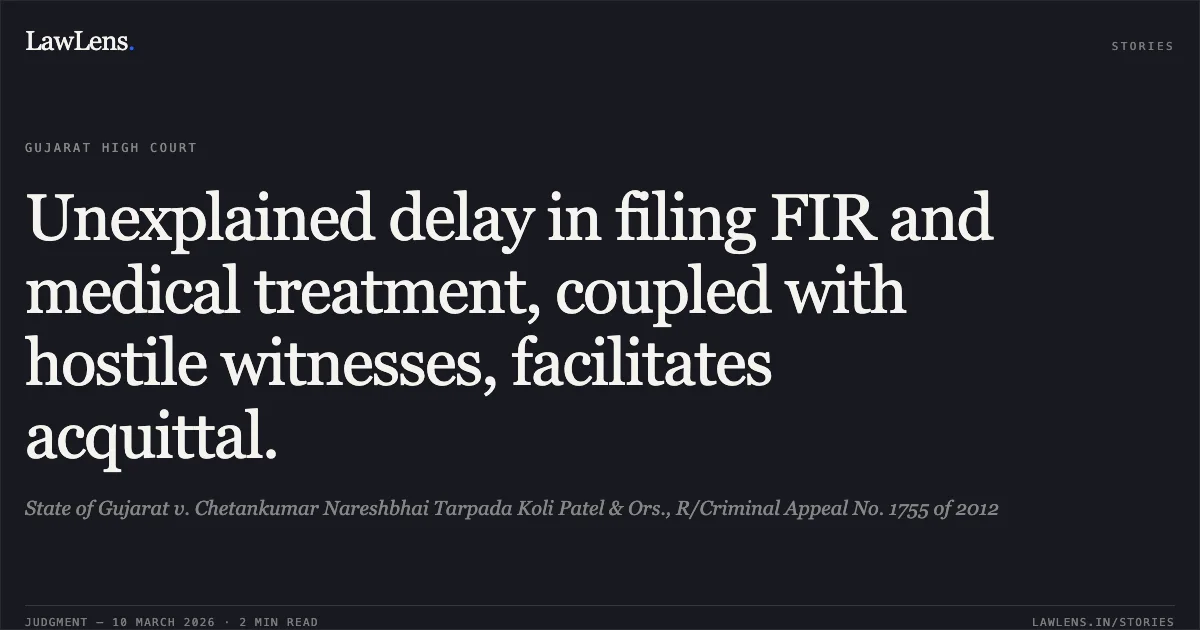
Source reference: no citationThe prosecution's case was marked by a significant delay in filing the FIR (14.11.2010), delayed medical treatment (10.11.2010), and key witnesses—including the neighbor allegedly protected by the complainant—turning hostile.
Source reference: p. 5-7Issues
1. Whether the prosecution proved the charges under Sections 323, 504, 114 of the IPC and Section 3(1)(x) of the SC/ST Act beyond reasonable doubt.
Source reference: p. 1, 82. Whether the trial court’s judgment of acquittal was perverse or suffered from manifest illegality requiring interference by the appellate court.
Source reference: p. 10, 15Law Applied
The Court applied Section 378 of the CrPC regarding appeals against acquittal.
Source reference: p. 11It relied on the principle from *Sajan Sakhariya v. State of Kerala* (2024) that mere insult does not constitute an SC/ST Act offence unless directed specifically because the victim is a member of a protected class.
Source reference: p. 9Procedurally, the Court adhered to the "double presumption of innocence" for acquitted defendants as established in *Chandrappa v. State of Karnataka* (2007) and *Constable 907 Surendra Singh v. State of Uttarakhand* (2025), which dictates that appellate courts should not disturb an acquittal if two reasonable views are possible.
Source reference: p. 13-16Reasoning
The High Court found the prosecution failed to explain the 10-day delay in lodging the FIR and the 6-day delay in seeking medical attention.
Source reference: p. 8Notably, P.W.4 (Natvarbhai), the central figure the complainant allegedly rescued, turned hostile and denied the incident entirely.
Source reference: p. 7The medical certificate (Exh. 17) omitted the names of the accused, and the prosecution failed to examine crucial witnesses like the social worker or the initial police officer involved.
Source reference: p. 8-9The Court observed that the trial court’s view was a "possible view" based on these evidentiary gaps.
Source reference: p. 10Since the prosecution could not demonstrate that the findings were perverse or based on a misreading of material evidence, the High Court determined that the presumption of innocence reinforced by the acquittal must stand.
Source reference: p. 15-16Holding
The High Court dismissed the appeal and upheld the acquittal.
The Court held that the prosecution failed to prove the accused's guilt beyond reasonable doubt and found no patent perversity in the trial court's reasoning.
Source reference: p. 16The judgment and order of the Special Judge, Bharuch, dated 07.08.2012, were confirmed.
Source reference: p. 17Acts & Sections Cited
6 provisions across 3 statutes referred to in this judgment. Each provision opens on LawLens.
Indian Penal Code, 18603
Scheduled Castes and the Scheduled Tribes (Prevention of Atrocities) Act, 19891
Code of Criminal Procedure, 19732
Original Court PDF
State of Gujarat v. Chetankumar Nareshbhai Tarpada Koli Patel & Ors., R/Criminal Appeal No. 1755 of 2012
Click to open original judgment
Original judgment, available to read, download and summarize on LawLens.in


![Subsequent exoneration does not retrospectively invalidate a finalized promotion select list.. UNNIKRISHNAN M vs M/o Environment And Forests. CAT - ['Ernakulam']. LawLens](/stories/thumbnails/subsequent-exoneration-does-not-retrospectively-invalidate-a-finalized-promotion-select-li-ce80a0e84f2f4887857271e8b4341c42.webp)