Facts
The Petitioner (a manufacturer) and Respondent (a marketing agent) entered into an agency agreement on 30.04.1999, purportedly modified on 31.03.2000, for export sales.
Source reference: p. 2Upon the Petitioner's refusal to renew the arrangement beyond 30.04.2004, disputes arose regarding unpaid commissions.
Source reference: p. 3The Respondent invoked arbitration under the 1999 Agreement via FICCI.
Source reference: p. 3The Petitioner challenged the Tribunal’s jurisdiction under Sections 12 and 16 of the Arbitration and Conciliation Act, 1996 ("A&C Act"), arguing the 1999 Agreement was unsigned and thus non-existent, and that the 2000 Agreement was an independent, non-arbitrable contract.
Source reference: p. 5The Sole Arbitrator rejected these objections and issued an Award on 04.05.2013, directing the Petitioner to pay ₹17.76 lakhs plus interest and costs.
Source reference: p. 2, 4The Petitioner moved the High Court under Section 34 of the A&C Act to set aside the Award.
Source reference: p. 2Issues
1. Whether the Arbitral Tribunal lacked jurisdiction due to the alleged non-existence of a signed 1999 Agreement and a valid arbitration clause.
Source reference: p. 5 / para. 192. Whether the Award was vitiated by patent illegality due to an 18-month delay in pronouncement and the failure to adjudicate specific framed issues (Issue IV and VII).
Source reference: p. 10-12 / para. 40, 443. Whether the Arbitrator erroneously reversed the burden of proof, thereby violating the fundamental policy of Indian law.
Source reference: p. 9 / para. 33Law Applied
The Court applied Section 34 of the A&C Act, emphasizing the restricted scope of judicial review post-2015 Amendment.
Source reference: para. 44-47It relied on Associate Builders v. DDA and Ssangyong Engg. & Construction Co. Ltd. v. NHAI to define "patent illegality" and "fundamental policy of Indian law".
Source reference: para. 41, 68The principle that an arbitrator is the "ultimate master of the quantity and quality of evidence" was applied.
Source reference: para. 70The "business efficacy doctrine" from Nabha Power Ltd. v. Punjab SPCL was noted regarding contract interpretation.
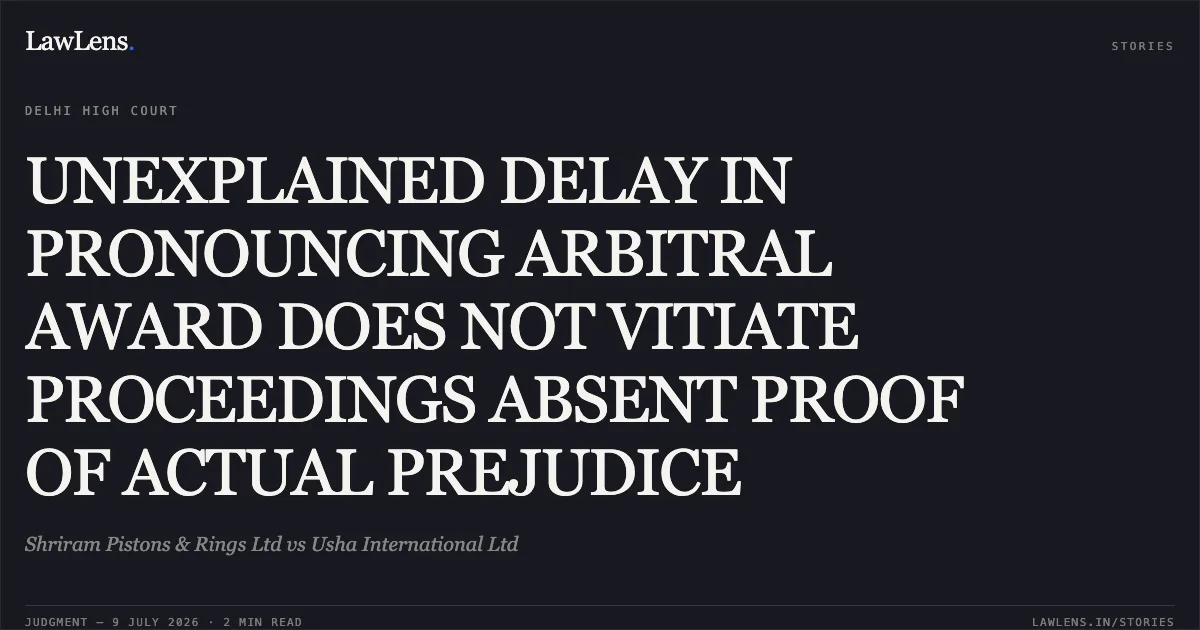
Source reference: para. 87Finally, it reaffirmed that delay in an award does not per se invalidate it unless prejudice is proved.
Source reference: para. 101Reasoning
The Court found the Arbitrator's conclusion—that the 1999 Agreement was valid based on the parties' conduct and subsequent signed modifications—to be a "possible view".
Source reference: para. 79-80It noted that the Petitioner participated in the proceedings for years and failed to demonstrate any actual bias or ineligibility under Section 12(5) of the A&C Act.
Source reference: para. 86-89Regarding the burden of proof, the Court observed that the Arbitrator first evaluated the Respondent's documentary evidence (TDS certificates, commission statements) before noting the Petitioner's failure to rebut it; thus, there was no reversal of the legal burden.
Source reference: para. 92-95The Court dismissed the challenge regarding procedural delays and stamp paper dates as "conjecture," noting the Award’s detailed reasoning dispelled any claim that the Arbitrator forgotten the evidence.
Source reference: para. 103-104Finally, it held that while the Arbitrator did not use separate headings for Issues IV and VII, the substance of those issues was effectively adjudicated within the holistic assessment of the claims.
Source reference: para. 108-110Holding
The Court dismissed the Petitioner’s Section 34 application, holding that the Award did not suffer from patent illegality or jurisdictional error.
The Court affirmed that it cannot act as a court of appeal to re-appreciate evidence or substitute its interpretation of the contract for that of the Arbitrator. No costs were awarded.
Source reference: para. 112, 119Acts & Sections Cited
9 provisions across 2 statutes referred to in this judgment. Each provision opens on LawLens.
Arbitration and Conciliation Act, 19968
Indian Contract Act, 18721
Original Court PDF
Shriram Pistons & Rings LtdvsUsha International Ltd
Click to open original judgment
Original judgment, available to read, download and summarize on LawLens.in


![Subsequent exoneration does not retrospectively invalidate a finalized promotion select list.. UNNIKRISHNAN M vs M/o Environment And Forests. CAT - ['Ernakulam']. LawLens](/stories/thumbnails/subsequent-exoneration-does-not-retrospectively-invalidate-a-finalized-promotion-select-li-ce80a0e84f2f4887857271e8b4341c42.webp)