Facts
The deceased, Md. Munawar, was reported missing on the evening of 28 June 2005.
Source reference: p. 2His father lodged the Fardbayan the following morning, after the body—bearing multiple injuries—had been found.
Source reference: p. 6The prosecution alleged that the appellant committed the murder and caused the disappearance of evidence.
Source reference: no citationThe trial court convicted him under Sections 302 and 201 of the Indian Penal Code (IPC), sentencing him to life imprisonment and four years’ rigorous imprisonment respectively, to run concurrently.
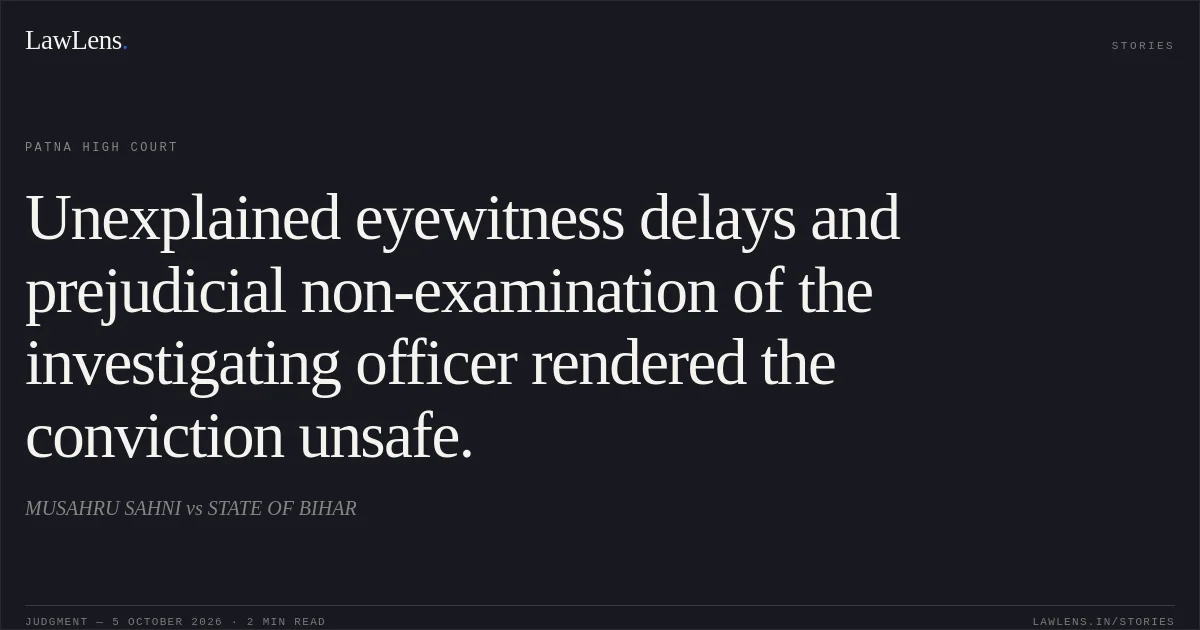
Source reference: pp. 1–2On appeal, the High Court considered, among other matters, inconsistencies in the purported eyewitness accounts, delays in recording witness statements, the medical evidence, and the non-examination of the investigating officer (IO).
Source reference: pp. 6–11Issues
Whether the prosecution proved the appellant’s guilt beyond reasonable doubt in light of the delayed FIR, delayed recording of material witness statements, and doubts concerning the alleged eyewitnesses
Source reference: pp. 6–9Whether the non-examination of the IO caused prejudice to the appellant and materially weakened the prosecution case
Source reference: pp. 9–11Law Applied
The appellant had been charged under Sections 302 and 201 IPC.
Source reference: pp. 2–3Under the principles discussed in Ganesh Bhavan Patel v. State of Maharashtra, (1978) 4 SCC 371, and Shahid Khan v. State of Rajasthan, (2016) 4 SCC 96, unexplained delay in recording the statements of witnesses who claim to have seen the occurrence may cast serious doubt on their credibility, particularly where the surrounding circumstances suggest that witnesses may have been introduced during investigation.
Source reference: pp. 7–9Non-examination of the IO is not, by itself, fatal; however, under Lahu Kamlakar Patil v. State of Maharashtra, (2013) 6 SCC 417, it may create a material lacuna where the IO’s evidence was needed to clarify disputed matters and the omission causes prejudice to the accused.
Source reference: pp. 9–11Reasoning
The Court found that the FIR was lodged only after the body was recovered, and that material witnesses’ statements were recorded after substantial delays: PW-3’s after 12 days and PWs 10 and 11’s after more than two months.
Source reference: pp. 6–8It also noted that PW-1’s account conflicted with the FIR’s assertion that the deceased had gone out alone, while the medical evidence placed the likely time of death before the time alleged in the prosecution case and indicated that the injuries could have resulted from a fall.
Source reference: pp. 6–8The IO’s absence left unexplained the delayed examination of witnesses and prevented clarification of the place of occurrence, the lack of collected physical evidence, and the alleged confession said to have followed police assault.
Source reference: pp. 9–11In combination, these deficiencies undermined the alleged eyewitness evidence and left the prosecution case unproved beyond reasonable doubt.
Source reference: pp. 9–11Holding
The High Court allowed the appeal, set aside the conviction and sentences under Sections 302 and 201 IPC, and acquitted the appellant.
As the appellant was on bail, he was discharged from the liabilities of his bail bond; the trial court records were directed to be returned with a copy of the judgment.
Source reference: p. 12Acts & Sections Cited
4 provisions across 2 statutes referred to in this judgment. Each provision opens on LawLens.
Indian Penal Code, 18602
Code of Criminal Procedure, 19732
Original Court PDF
MUSAHRU SAHNIvsSTATE OF BIHAR
Click to open original judgment
Original judgment, available to read, download and summarize on LawLens.in