Facts
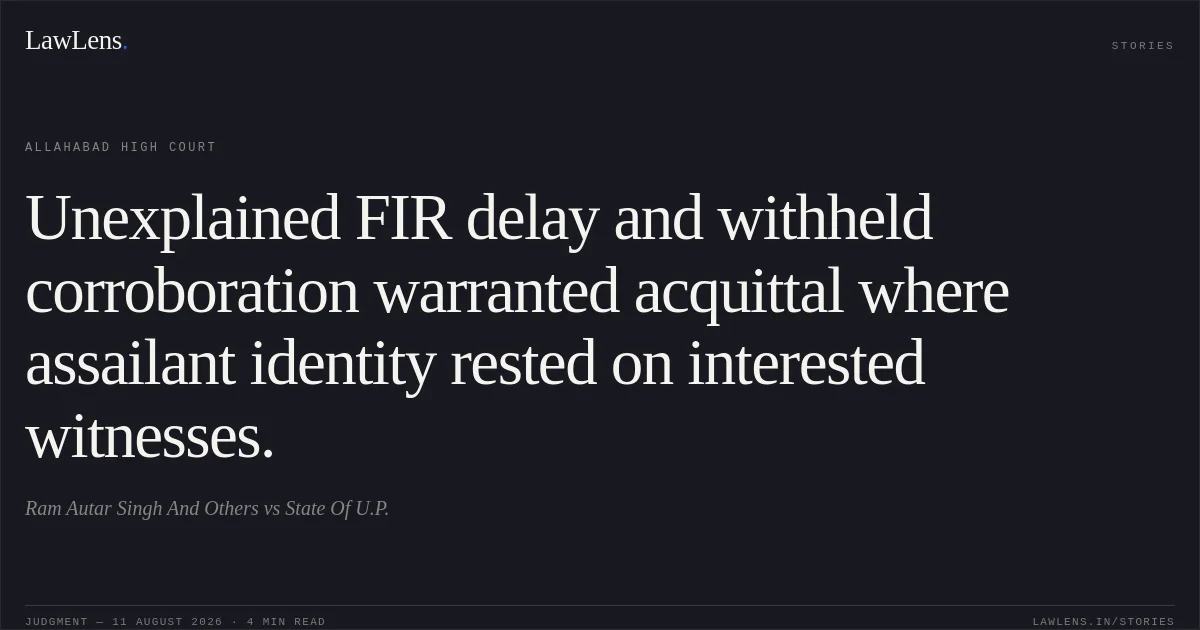
The appellants were convicted by the Special Judge (DAA), Banda, for the murders of Narendra Singh and Chhuttan Dubey. All appellants were sentenced to life imprisonment under Section 302 read with Section 34 IPC and one year’s rigorous imprisonment under Section 201 IPC; Randhir Singh was additionally convicted under Section 404 IPC
Source reference: para. 2The prosecution alleged that, owing to longstanding factional enmity and a recent land-possession dispute, Ram Autar Singh, Balram Singh, Randhir Singh and Drigpal Singh, armed with firearms, shot Narendra Singh near a society house on 27.09.1981 and subsequently pursued and killed Chhuttan Dubey
Source reference: paras. 4–6The FIR was lodged by Arimardan Singh, father of Narendra Singh, at 9:05 a.m. on 28.09.1981, more than fifteen hours after the alleged occurrence
Source reference: paras. 5, 21, 28The prosecution primarily relied upon the eyewitness testimony of PW-1 Arimardan Singh and PW-3 Raju; PW-4 Kishori Lal did not support the prosecution, while Chandrapal Singh, who was allegedly present at the scene and had scribed the FIR, was not examined
Source reference: paras. 10–12, 15, 18, 29During the appeal, Ram Autar Singh, Randhir Singh and Drigpal Singh died, and the appeal abated against them. The appeal consequently survived only in respect of Balram Singh
Source reference: para. 3Issues
Whether the prosecution established the identity and participation of appellant Balram Singh in the murders beyond reasonable doubt, notwithstanding the evidence of the related and allegedly interested eyewitnesses?
Source reference: paras. 23–25, 33–34Whether the unexplained delay in lodging the FIR and the non-examination of Chandrapal Singh materially undermined the prosecution case?
Source reference: paras. 26–30Whether the absence of ballistic or other forensic linkage between Balram Singh’s alleged rifle and the injuries or recovered cartridges created a reasonable doubt regarding his involvement?
Source reference: paras. 22–23, 31–33Whether Balram Singh was entitled to the benefit of doubt in an appeal against conviction under Section 374(2) Cr.P.C.?
Source reference: paras. 2, 33–35Law Applied
The Court applied Sections 302/34 IPC concerning murder committed in furtherance of common intention and Section 201 IPC concerning causing disappearance of evidence
Source reference: paras. 2, 6, 35Under the principles stated in Masalti v. State of U.P., AIR 1965 SC 202, evidence of partisan or related witnesses cannot be rejected solely on that ground but must be scrutinised carefully
Source reference: para. 24State of Rajasthan v. Kalki, (1981) 2 SCC 752, and Dalip Singh v. State of Punjab, AIR 1953 SC 364, distinguish a merely related witness from an “interested” witness having a motive to falsely implicate the accused; such evidence requires heightened scrutiny
Source reference: para. 25Under Thulia Kali v. State of Tamil Nadu, (1972) 3 SCC 393, unexplained delay in lodging an FIR may suggest deliberation, consultation or embellishment and diminishes its value as a spontaneous account
Source reference: para. 26Takhaji Hiraji v. Thakore Kubersing Chamansing, (2001) 6 SCC 145, permits an adverse inference where the prosecution withholds a material witness capable of explaining a significant gap or infirmity in its case
Source reference: paras. 29–32The Court also applied the fundamental criminal-law principle that suspicion, however grave, cannot replace proof and that material reasonable doubt must operate in favour of the accused
Source reference: para. 33Reasoning
Although the medical evidence established that both deceased suffered fatal firearm injuries, it only corroborated the fact that firearms had been used; it did not independently establish the identity of the four assailants or the specific role of Balram Singh
Source reference: paras. 22–23PW-1 was not merely related to the deceased but was involved in longstanding and mutually hostile litigation with the accused faction, while PW-3 was connected with the recent land dispute and was allegedly beholden to the informant’s side. Their testimony therefore required substantial corroboration
Source reference: para. 25The FIR was lodged after a delay of more than fifteen hours, and the explanations of rain and fear were considered inadequate because the informant admitted the availability of a family tractor and firearms, and Chandrapal was capable of travelling to Banda and preparing the report
Source reference: paras. 27–28Chandrapal’s non-examination was particularly significant because he could have corroborated the occurrence, the informant’s account, and the circumstances in which the delayed FIR was prepared
Source reference: paras. 29–30Further, no ballistic examination connected Balram Singh’s alleged rifle with any cartridge or injury, and the physical evidence did not fully corroborate the prosecution’s account of multiple firearms being discharged at the spot
Source reference: paras. 23, 31–32Considering these infirmities cumulatively, the Court held that the prosecution had not proved Balram Singh’s identity and participation with the degree of certainty required for a conviction under Section 302 read with Section 34 IPC
Source reference: para. 33Holding
The appeal was allowed in respect of Balram Singh.
His conviction and sentence under Sections 302/34 and 201 IPC were set aside, and he was acquitted by extending the benefit of reasonable doubt
Source reference: para. 35As he was already on bail, he was not required to surrender, and his bail or personal bonds were discharged
Source reference: para. 35The appeals of Ram Autar Singh, Randhir Singh and Drigpal Singh had already abated because of their deaths, and no further order on merits was passed concerning them
Source reference: paras. 3, 36Acts & Sections Cited
8 provisions across 2 statutes referred to in this judgment. Each provision opens on LawLens.
Code of Criminal Procedure, 19732
Indian Penal Code, 18606
Original Court PDF
Ram Autar Singh And OthersvsState Of U.P.
Click to open original judgment
Original judgment, available to read, download and summarize on LawLens.in