Facts
The petitioner, a Deputy Director in the Handlooms and Textiles Department, was charged with identifying 64 beneficiaries of a cooperative society for loan-waiver benefits without verifying their genuineness.
Source reference: pp. 3–6, paras. 3.1–3.2, 7The alleged misconduct occurred in 2018; a charge memo was issued on 12 April 2023, following a show-cause notice in 2022.
Source reference: pp. 3–6, paras. 3.1–3.2, 7After a departmental inquiry, the State imposed a penalty of withholding four annual increments with cumulative effect under Rule 8(iii) of the Karnataka Civil Services (Classification, Control and Appeal) Rules, 1957.
Source reference: pp. 3–6, paras. 3.1–3.2, 7The petitioner challenged the penalty before the Karnataka State Administrative Tribunal, which dismissed her application. She then filed this writ petition.
Source reference: pp. 3–6, paras. 3.1–3.2, 7The High Court noted that the beneficiaries had repaid the amounts and that the department had suffered no loss
Source reference: pp. 3–6, paras. 3.1–3.2, 7Issues
1. Whether the unexplained delay of approximately five years in issuing the charge memo, considered with the absence of loss to the department, rendered the disciplinary proceedings and resulting penalty unsustainable
Source reference: pp. 6–7, 15–16, paras. 7, 10–112. Whether the Tribunal’s dismissal of the petitioner’s application, without adequately considering the delay and the absence of departmental loss, warranted interference under Articles 226 and 227 of the Constitution
Source reference: pp. 2, 15–16, paras. 10–12Law Applied
Rule 8(iii) of the Karnataka Civil Services (Classification, Control and Appeal) Rules, 1957, permits withholding increments as a disciplinary penalty
Source reference: pp. 4, 6, paras. 3.2, 7Under State of A.P. v. N. Radhakishan (1998) 4 SCC 154 and P.V. Mahadevan v. M.D., T.N. Housing Board (2005) 6 SCC 636, delay does not automatically invalidate disciplinary proceedings; the court must assess the circumstances, including the nature and complexity of the charge, the explanation for the delay, responsibility for it, and prejudice to the employee.
Source reference: pp. 7–15, paras. 8–9Unexplained, inordinate delay may justify quashing proceedings where it causes prejudice.
Source reference: pp. 7–15, paras. 8–9The Court also relied on the application of these principles in Sri M.R. Vaddar v. State of Karnataka, W.P. No. 6116 of 2020, decided on 11 December 2020, and referred to UCO Bank v. Rajendra Singh Shukla (2018) 14 SCC 92
Source reference: pp. 7–15, paras. 8–9Reasoning
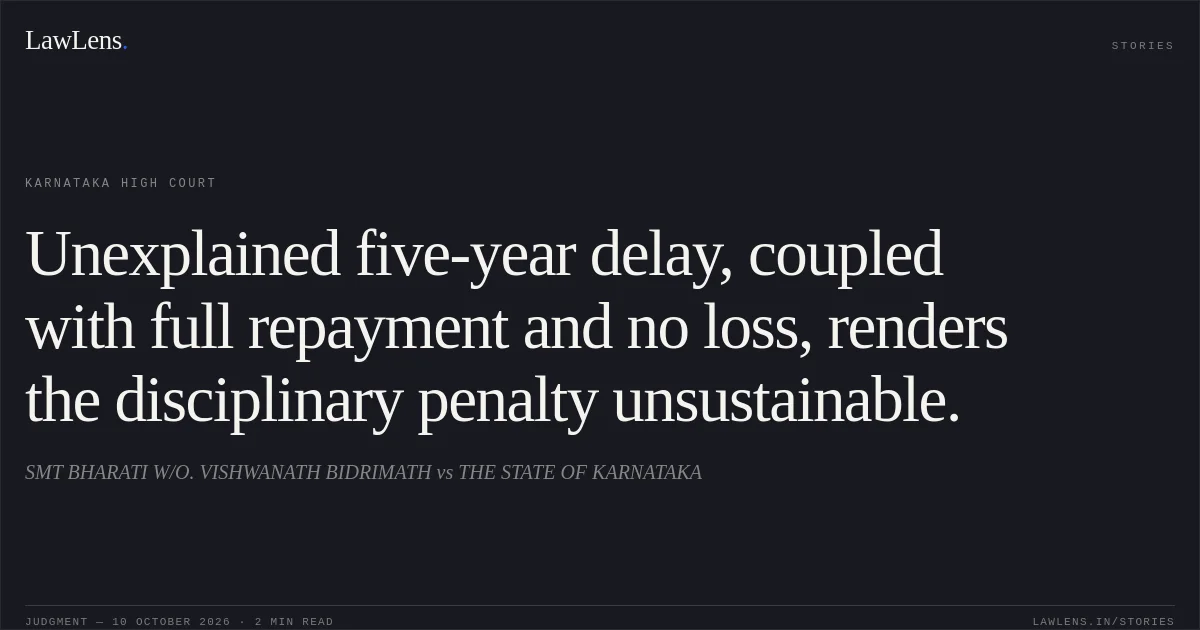
The alleged misconduct was from 2018, but the charge memo was issued only in April 2023, and the department offered no persuasive explanation for the delay.
Source reference: pp. 6–7, 15–16, paras. 7, 10–11The High Court held that the Tribunal had glossed over this issue.
Source reference: pp. 6–7, 15–16, paras. 7, 10–11It also treated the repayment by all 64 beneficiaries, and the resulting absence of any departmental loss, as relevant circumstances that the Tribunal should have considered.
Source reference: pp. 6–7, 15–16, paras. 7, 10–11Applying the delay-prejudice principles in the cited authorities to these facts, the Court concluded that sustaining the penalty was unjustified
Source reference: pp. 6–7, 15–16, paras. 7, 10–11Holding
The Court allowed the writ petition, quashed the Tribunal’s order dated 16 July 2026 and the State’s penalty order dated 2/3 August 2024 insofar as they concerned the petitioner, and held that she was entitled to all consequential benefits flowing from that quashment.
Acts & Sections Cited
2 provisions across 1 statute referred to in this judgment. Linked provisions open on LawLens.
Tamil Nadu State Housing Board Act, 19612
Original Court PDF
SMT BHARATI W/O. VISHWANATH BIDRIMATHvsTHE STATE OF KARNATAKA
Click to open original judgment
Original judgment, available to read, download and summarize on LawLens.in