Facts
The twelve petitioners claimed to have qualified in the physical test for appointment as Home Guards in Darbhanga and to have been included in the merit list.
Source reference: pp. 2–4They alleged that, against 308 notified vacancies—227 rural and 81 urban—only 190 appointments had been made, leaving 118 vacancies unfilled.
Source reference: pp. 2–4They sought appointment or joining orders, relying on earlier decisions of the Patna High Court concerning accommodation of eligible candidates against available vacancies.
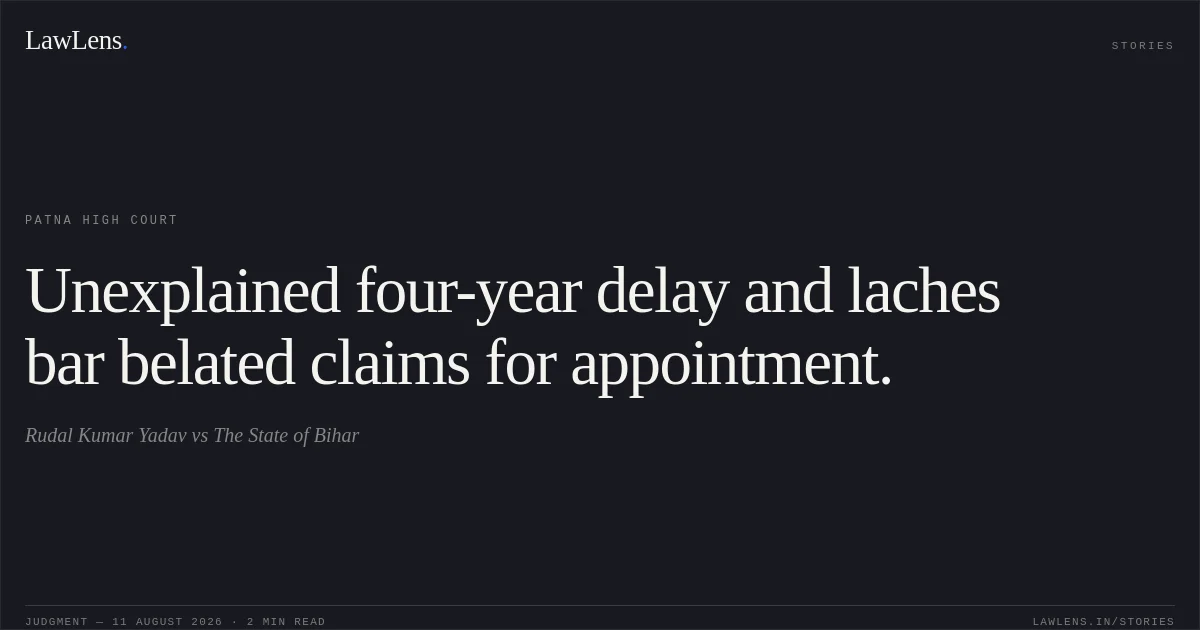
Source reference: pp. 2–4The State opposed the petition on the preliminary ground of delay and laches, contending that the petitioners’ cause of action arose in 2022, whereas the writ petition was filed in 2026, after approximately four years.
Source reference: para. 3Issues
Whether the writ petition was liable to be dismissed on the ground of delay and laches, given that the petitioners approached the Court approximately four years after the alleged cause of action arose?
Source reference: paras. 3–5Whether the petitioners were entitled to directions for appointment against the alleged 118 unfilled Home Guard vacancies in Darbhanga, on the basis of their inclusion in the merit list and the earlier decisions relied upon by them?
Source reference: pp. 2–4; para. 5Law Applied
The Court applied the equitable and discretionary principle that a writ court may refuse relief where a petitioner approaches the Court after an unreasonable and unexplained delay.
Source reference: paras. 3, 5Relying on Chennai Metropolitan Water Supply and Sewerage Board v. T.T. Murali Babu, (2014) 4 SCC 108, the Court held that delay and laches cannot be lightly disregarded, since delay may prejudice third-party rights and undermine finality in public administration.
Source reference: paras. 3, 5The Court also relied on Gyasuddin @ Gyasuddin Khan v. State of Bihar, C.W.J.C. No. 13306 of 2023, which applied the principle that “equity aids the vigilant and not those who slumber on their rights” and dismissed a belated writ petition in the absence of a satisfactory explanation for delay.
Source reference: para. 4Reasoning
The Court treated the petitioners’ claim as arising from the 2022 recruitment process, while the writ petition was instituted only in 2026.
Source reference: paras. 3–5Since the petitioners did not provide any adequate explanation for the approximately four-year delay, the Court applied the settled rule that extraordinary writ jurisdiction should not ordinarily be exercised in favour of an indolent litigant.
Source reference: paras. 3–5In light of the potential effect of delayed litigation on settled appointments and other candidates’ rights, the Court declined to examine the petitioners’ substantive claim regarding the unfilled vacancies, merit list, or applicability of the earlier judgments.
Source reference: para. 5The petition was therefore found devoid of merit on the ground of delay and laches.
Source reference: para. 5Holding
The Patna High Court held that the writ petition was barred by delay and laches because the petitioners approached the Court approximately four years after the alleged cause of action without sufficient explanation.
The Court consequently dismissed the writ petition and granted no direction for appointment, joining, or consideration against the alleged remaining Home Guard vacancies.
Source reference: para. 5Original Court PDF
Rudal Kumar YadavvsThe State of Bihar
Click to open original judgment
Original judgment, available to read, download and summarize on LawLens.in