Facts
The applicant’s Tata Sumo vehicle, bearing registration No. MP-15-A-3806, was seized in connection with Crime No. 317/2007 registered under Sections 34(1) and 34(2) of the Madhya Pradesh Excise Act.
Source reference: para. 2Although the criminal case subsequently resulted in the applicant’s acquittal on 12 January 2017, independent confiscation proceedings culminated in an order dated 4 August 2011 passed by the Collector (Excise), Sagar, confiscating the vehicle.
Source reference: para. 2The applicant filed an appeal against the confiscation order after approximately seven years, accompanied by an application under Section 5 of the Limitation Act.
Source reference: para. 3The Additional Commissioner, Excise, rejected the application for condonation of delay and dismissed the appeal as time-barred on 9 January 2019.
Source reference: para. 3The applicant’s criminal revision was similarly dismissed by the Sixth Additional Sessions Judge, Sagar, on 29 August 2019.
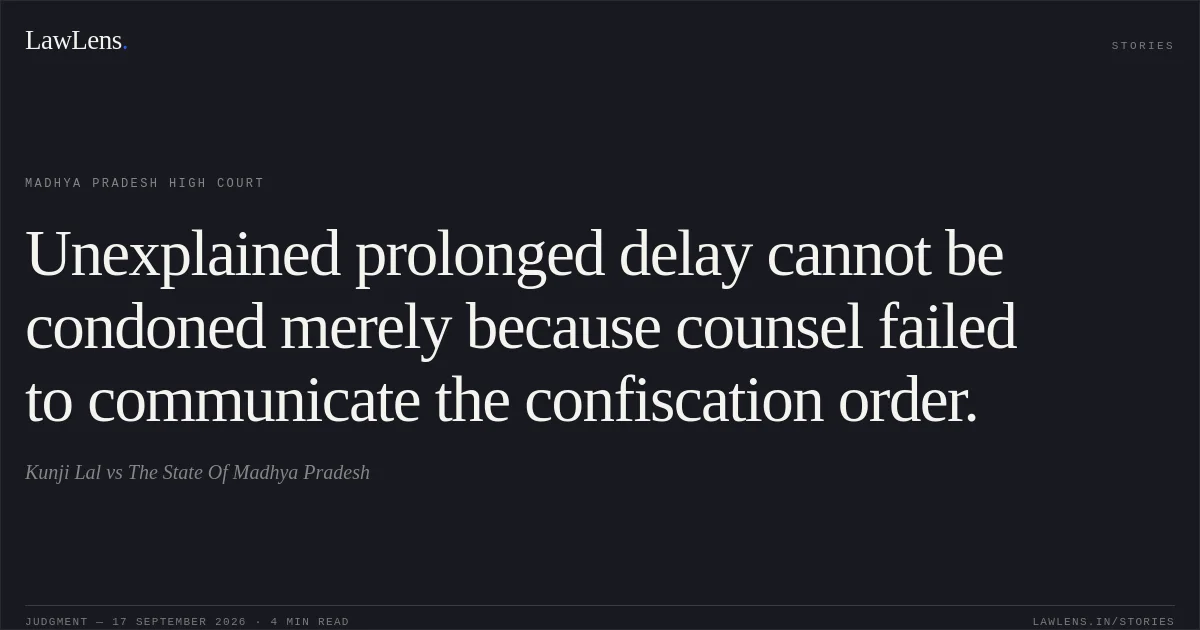
Source reference: para. 5The applicant thereafter invoked the High Court’s inherent jurisdiction under Section 482 Cr.P.C., contending that the delay occurred because his counsel had not informed him of the confiscation order.
Source reference: para. 4The respondents stated that the vehicle had already been auctioned in January 2012 after expiry of the limitation period.
Source reference: para. 5Issues
Whether the applicant had shown sufficient cause under Section 5 of the Limitation Act for condoning the approximately seven-year delay in filing the appeal against the confiscation order dated 4 August 2011?
Source reference: paras. 6–8Whether the High Court should exercise its inherent jurisdiction under Section 482 Cr.P.C. to interfere with the concurrent orders refusing to condone the delay and dismissing the appeal and revision as time-barred?
Source reference: paras. 6, 10–12Whether the applicant’s subsequent acquittal in the criminal case constituted sufficient cause for reopening or challenging the concluded confiscation proceedings after the expiry of limitation?
Source reference: para. 9Law Applied
The Court applied Section 482 of the Code of Criminal Procedure, 1973, which permits the High Court to exercise inherent powers to prevent abuse of process and secure the ends of justice, but does not ordinarily permit substitution of the Court’s discretion in limitation matters absent manifest illegality, perversity, or jurisdictional error.
Source reference: para. 10Section 5 of the Limitation Act requires an applicant to establish “sufficient cause” for the entire period of delay; although the expression may receive a liberal and justice-oriented interpretation, an extraordinary delay cannot be condoned without a satisfactory and supported explanation.
Source reference: paras. 6–8The Court considered Rafiq v. Munshilal, AIR 1981 SC 1400, for the principle that a litigant should not ordinarily suffer for the bona fide lapse of counsel, but held that the principle cannot dispense with the requirement of explaining prolonged inaction.
Source reference: para. 8It further relied on Ramendra Pal Singh v. State of M.P., (2013) 2 MPLJ 226, and State of M.P. v. Uday Singh, (2020) 12 SCC 733, for the proposition that confiscation proceedings under the Excise law are independent of the criminal prosecution and that a subsequent acquittal does not automatically reopen concluded confiscation proceedings.
Source reference: paras. 5, 9Reasoning
The Court held that the applicant had not satisfactorily explained the entire period of approximately seven years between the confiscation order and the filing of the appeal.
Source reference: paras. 6–7The explanation that counsel had failed to communicate the order was the same explanation rejected by both subordinate authorities and was unsupported by any affidavit or convincing material.
Source reference: paras. 6–7Even assuming a bona fide lapse by counsel, the applicant failed to explain why he remained inactive or did not make enquiries concerning the seized vehicle and confiscation proceedings.
Source reference: para. 8Accordingly, Rafiq did not assist him because it could not justify dispensing with the requirement of due diligence in the face of extraordinary delay.
Source reference: para. 8The applicant’s acquittal in the criminal case also did not constitute sufficient cause, since the confiscation proceedings were legally distinct and the vehicle had reportedly been auctioned in January 2012 after expiry of the challenge period.
Source reference: para. 9As the revisional Court had considered the relevant circumstances and its decision disclosed neither perversity nor jurisdictional error, no interference under Section 482 Cr.P.C. was warranted.
Source reference: para. 10Holding
The High Court answered the issues against the applicant.
It held that the applicant failed to establish sufficient cause for condoning the approximately seven-year delay and that his subsequent acquittal did not reopen the independent confiscation proceedings.
Source reference: paras. 11–12Finding no manifest illegality, perversity, or jurisdictional error in the orders below, the Court dismissed the application under Section 482 Cr.P.C. and upheld the order dated 29 August 2019 dismissing the criminal revision as time-barred, as well as the order dated 9 January 2019 dismissing the appeal against confiscation.
Source reference: paras. 11–12The Court clarified that it had not examined the legality of the original confiscation order on merits and that its decision was confined to limitation and refusal to condone delay.
Source reference: para. 12Acts & Sections Cited
2 provisions across 2 statutes referred to in this judgment. Each provision opens on LawLens.
Code of Criminal Procedure, 19731
Limitation Act, 19631
Original Court PDF
Kunji LalvsThe State Of Madhya Pradesh
Click to open original judgment
Original judgment, available to read, download and summarize on LawLens.in