Facts
The Karnataka State Administrative Tribunal set aside the dismissal from service of the delinquent government official (DGO) and directed payment of consequential benefits to his legal representatives, as the DGO had died during the Tribunal proceedings
Source reference: p.3, p.11The Lokayuktha’s review application was dismissed on 21 September 2021; it filed the present writ petition on 29 August 2023, leaving nearly two years unexplained after the review decision
Source reference: p.4The petition challenged the Tribunal’s order dated 5 January 2021
Source reference: p.3Issues
1. Whether the High Court should entertain a writ petition under Articles 226 and 227 where it was filed after a substantial, unexplained delay
Source reference: p.3–52. Whether the delay should weigh against entertaining the petition where the Tribunal’s order granted consequential benefits to the deceased DGO’s legal representatives
Source reference: p.11Law Applied
The High Court’s jurisdiction under Articles 226 and 227 is discretionary, and no fixed statutory limitation period governs a writ petition; however, the petitioner must approach the Court within a reasonable time. Unexplained delay or laches may justify refusing relief, particularly where delay, together with the circumstances of the case, risks prejudice or injustice to the opposing party.
Source reference: p.5–8The Court relied on Mr. Inmoy Maity v. Chhanda Koley, 2024 SCC OnLine SC 551, which reaffirmed that delay may defeat a claim for discretionary writ relief and that memorials or review proceedings do not indefinitely revive a stale cause of action
Source reference: p.5–8It also relied on Karnataka Power Corporation Ltd. v. K. Thangappan, (2006) 4 SCC 322, on the Court’s discretion to refuse relief where negligence or omission to assert a right, considered alongside the lapse of time and other circumstances, makes intervention inequitable
Source reference: p.9–11Reasoning
The Tribunal’s order was made on 5 January 2021, but the writ petition was filed only on 29 August 2023, after a delay of nearly two years and eight months
Source reference: p.3–4Although the Lokayuktha relied on its review application, that application was dismissed on 21 September 2021, and the further delay of nearly two years remained unexplained
Source reference: p.4Applying the principles governing discretionary writ jurisdiction, the Court held that this unexplained delay was unreasonable.
Source reference: no citationIt also considered that the Tribunal had directed consequential benefits to the DGO’s legal representatives and found that entertaining the delayed petition could cause them unnecessary hardship and prejudice
Source reference: p.11Holding
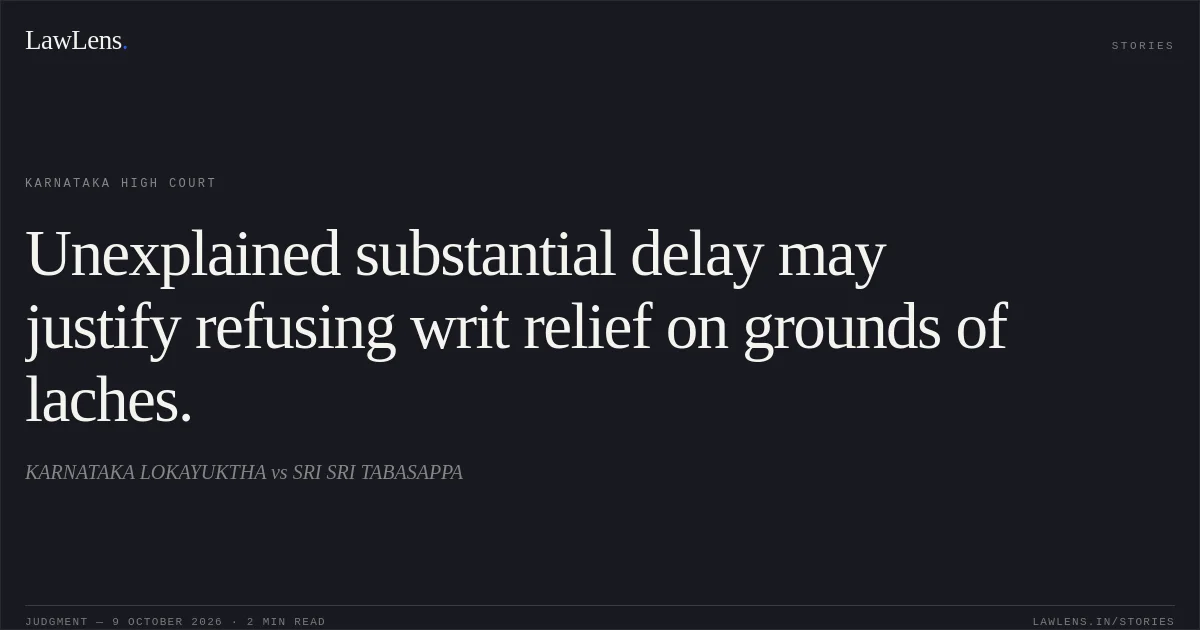
The Court declined to entertain the writ petition on the ground of unexplained delay and laches and dismissed it
It did not determine the merits of the challenge to the Tribunal’s order.
Source reference: no citationOriginal Court PDF
KARNATAKA LOKAYUKTHAvsSRI SRI TABASAPPA
Click to open original judgment
Original judgment, available to read, download and summarize on LawLens.in