Facts
The Appellant advanced a business loan of ₹2,00,000 to Allahuddin under a Loan Agreement dated 7 May 2019. The Respondent executed a Deed of Guarantee and was allegedly liable to repay ₹2,34,000 in 90 daily instalments, with late-payment charges at 36% per annum.
Source reference: p.2–3, paras. 5–6Upon default, the Appellant invoked the arbitration clause and a sole arbitrator, Manohar Lal Saini, Advocate, conducted ex parte proceedings. The arbitrator issued an award dated 12 October 2020 at Alwar, Rajasthan, awarding ₹5,18,600 with interest at 18% per annum from 1 July 2020 until realization.
Source reference: p.3, paras. 7–8The Respondent challenged the award under Section 34 of the Arbitration and Conciliation Act, 1996, contending, inter alia, that the loan agreement was void under the Rajasthan Money-Lenders Act, 1963 and that the arbitrator had been unilaterally appointed. The District Judge allowed the Section 34 petition and set aside the award. The Appellant challenged that decision under Section 37 of the A&C Act.
Source reference: p.3–4, para. 9; p.1, para. 1The High Court noted that the Appellant had been served in the Section 34 proceedings but neither appeared nor filed a reply, and that the arbitrator failed to produce the arbitral record despite repeated directions.
Source reference: p.4, para. 11; p.9, para. 23Issues
1. Whether the Delhi District Court had territorial jurisdiction to entertain the Section 34 petition when the award was signed and made at Alwar, Rajasthan.
Source reference: p.8–10, paras. 20–252. Whether the Section 34 petition was barred by limitation under Section 34(3) of the A&C Act.
Source reference: p.10–11, paras. 26–283. Whether the appointment of the sole arbitrator was invalid because it was made unilaterally by the Appellant, notwithstanding that the arbitrator’s name was allegedly contained in the arbitration agreement.
Source reference: p.11–15, paras. 29–444. Whether the Rajasthan Money-Lenders Act, 1963 applied to the Appellant and rendered the loan transaction unenforceable because of the stipulated rate of interest.
Source reference: p.16–17, paras. 45–495. Whether the District Judge’s order setting aside the award disclosed any jurisdictional error, patent illegality, or perversity warranting interference under Section 37 of the A&C Act.
Source reference: p.7–8, paras. 17–19Law Applied
The Court applied the limited and supervisory scope of appellate jurisdiction under Section 37 of the A&C Act, permitting interference only for jurisdictional error, patent illegality, manifest perversity, or failure to apply the law correctly, relying on McDermott International Inc. v. Burn Standard Co. Ltd., MMTC Ltd. v. Vedanta Ltd., Punjab State Civil Supplies Corporation Ltd. v. Sanman Rice Mills, and UHL Power Company Ltd. v. State of Himachal Pradesh.
Source reference: p.7–8, paras. 17–18Under Section 34(3), limitation begins from receipt of the arbitral award, not merely from the date on which it was made.
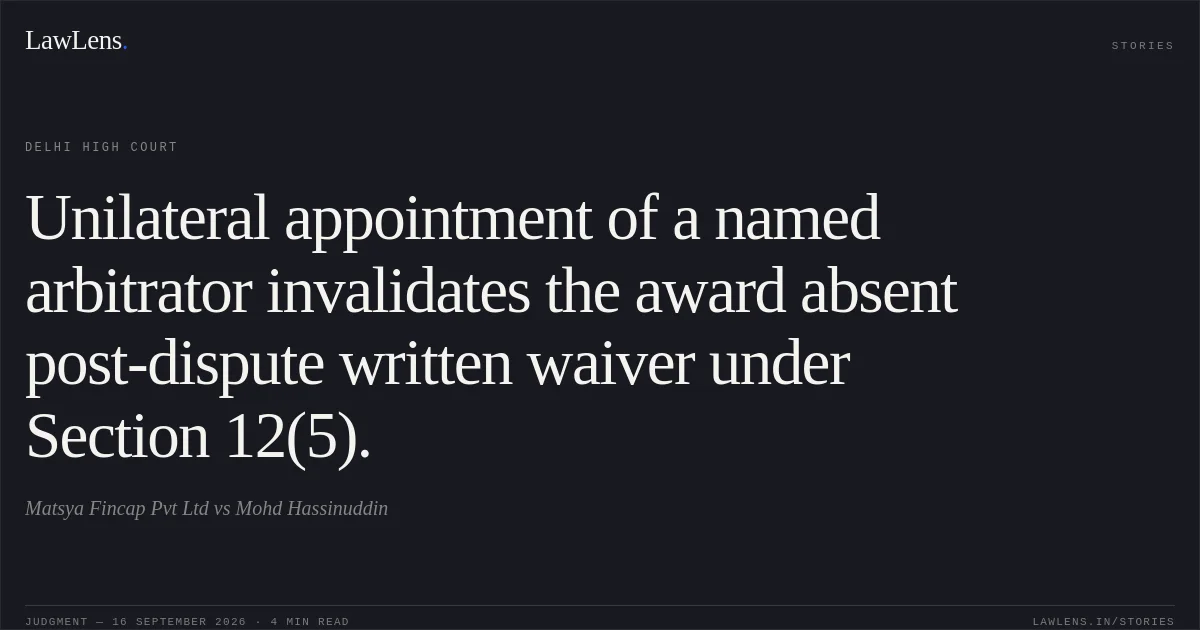
Source reference: p.10, para. 26Section 12(5), read with the Seventh Schedule, renders a person ineligible for appointment where the statutory requirements of independence and impartiality are violated; waiver of Section 12(5) is valid only through an express written agreement made after disputes have arisen.
Source reference: p.13–14, paras. 36–40The Court relied on TRF Ltd. v. Energo Engineering Projects Ltd., Bharat Broadband Network Ltd. v. United Telecoms Ltd., and Bhadra International (India) Pvt. Ltd. v. Airport Authority of India.
Source reference: p.13–14, paras. 36–40A prior designation of an arbitrator is not automatically invalid, but the actual post-dispute constitution of the tribunal must comply with the A&C Act.
Source reference: p.11–13, paras. 30–35The Court also considered the Rajasthan Money-Lenders Act, including the definition of “money-lender” and restrictions on interest, as well as the principle in Nedumpilli Finance Company Ltd. v. State of Kerala concerning the regulatory field governing RBI-regulated NBFCs.
Source reference: p.16, paras. 45–46Reasoning
The Court held that the place where an award is signed does not, by itself, conclusively establish the juridical seat of arbitration; the arbitration agreement and the conduct of proceedings must be examined.
Source reference: p.8–9, paras. 21–25Since the Appellant had not raised or substantiated the territorial-jurisdiction objection before the District Judge, and had itself pursued execution proceedings in Delhi, the objection could not be successfully advanced for the first time in the Section 37 appeal.
Source reference: p.9, paras. 23–25The limitation objection also failed because the Appellant produced no material showing when the Respondent received the signed award, while the Respondent asserted that he learned of it only during execution proceedings.
Source reference: p.10–11, paras. 26–28On the principal issue, the award itself recorded that the Appellant had appointed the arbitrator by a letter dated 18 August 2020 and that the arbitrator had thereafter issued an acceptance letter.
Source reference: p.11–12, paras. 32–34Thus, the appointment was effected by the Appellant alone after the dispute had arisen.
Source reference: p.11–12, paras. 32–34The mere inclusion of the arbitrator’s name in the agreement did not establish bilateral consent to the actual appointment, particularly when the Respondent neither participated in the constitution of the tribunal nor expressly waived Section 12(5) in writing after the dispute arose.
Source reference: p.12–15, paras. 34–44The Court further held that the Appellant’s argument regarding the absence of a specific Seventh Schedule relationship did not answer the broader requirement of an independent and impartial tribunal.
Source reference: p.14, para. 40Although the Court did not independently undertake the entire Money-Lenders Act/NBFC analysis, it held that the invalid constitution of the tribunal independently justified setting aside the award.
Source reference: p.16–18, paras. 47–51Holding
The High Court dismissed the appeal and upheld the District Judge’s order dated 31 August 2024 setting aside the arbitral award.
It held that the Appellant failed to demonstrate any jurisdictional error, patent illegality, or perversity warranting interference under Section 37.
Source reference: p.17–18, paras. 48, 50–53The unilateral constitution of the arbitral tribunal, coupled with the absence of a post-dispute express written waiver under Section 12(5), was independently sufficient to invalidate and sustain the setting aside of the award.
Source reference: p.17–18, paras. 48, 50–53Acts & Sections Cited
9 provisions across 4 statutes referred to in this judgment. Each provision opens on LawLens.
Arbitration and Conciliation Act, 19964
Commercial Courts Act, 20151
RAJASTHAN MONEY-LENDERS ACT, 19632
Indian Contract Act, 18722
Original Court PDF
Matsya Fincap Pvt LtdvsMohd Hassinuddin
Click to open original judgment
Original judgment, available to read, download and summarize on LawLens.in