Facts
The Petitioner (GNCTD/PWD) and the Respondent entered into an agreement in 2015-16 for the construction of additional classrooms in North-West Delhi.
Source reference: para. 3(a)Following disputes regarding payments, escalation, and prolongation costs, the Respondent requested the Petitioner to initiate arbitration.
Source reference: para. 3(d)-(e)Consequently, the Chief Engineer (Projects), PWD, acting under Clause 25 of the General Conditions of Contract (GCC), unilaterally appointed Mr. Shashi Kant as the Sole Arbitrator on January 17, 2023.
Source reference: para. 3(f), 26The Arbitrator rendered the Impugned Award on May 22, 2024, allowing several claims of the Respondent.
Source reference: para. 1-2The Petitioner challenged the award under Section 34 of the Arbitration and Conciliation Act, 1996, solely on the ground that the Arbitrator’s appointment was unilateral and void ab initio.
Source reference: para. 4-6Issues
1. Whether the unilateral appointment of a sole arbitrator by an interested party (the Chief Engineer of the Petitioner Department) renders the resulting arbitral award void and liable to be set aside under Section 34.
Source reference: para. 19, 422. Whether the Respondent’s participation in the arbitral proceedings without objection constitutes an "express agreement in writing" to waive the ineligibility of the arbitrator under the proviso to Section 12(5).
Source reference: para. 13-17, 29Law Applied
The Court applied Section 12(5) of the Arbitration and Conciliation Act, 1996, read with the Seventh Schedule, which mandates that any person whose relationship with the parties falls under the specified categories is ineligible to be an arbitrator.
Source reference: para. 21It relied on the Supreme Court decisions in TRF Ltd. v. Energo Engineering Projects Ltd. and Perkins Eastman Architects DPC v. HSCC (India) Ltd., as reaffirmed in Bhadra International (India) Pvt. Ltd. v. Airports Authority of India [para. 23] and Bharat Broadband Network Ltd. v. United Telecoms Ltd. [para. 33-34], establishing that unilateral appointment mechanisms by interested parties are legally impermissible.
Source reference: para. 23, 33-34The Court applied the principle from Central Organisation for Railway Electrification v. ECI-SPIC-SMO-MCML (JV) (2025), holding that the principle of equal treatment applies to the appointment stage and unilateral clauses in public-private contracts violate Article 14 of the Constitution.
Source reference: para. 41Reasoning
The Court observed that the Arbitrator’s appointment traces its origin entirely to Clause 25(ii) of the GCC, which empowered the Chief Engineer—a representative of an interested party—to appoint a sole arbitrator.
Source reference: para. 24-26The Court rejected the Respondent’s argument that participation without protest constituted a waiver. It reasoned that under the proviso to Section 12(5), waiver can only be effected through an "express agreement in writing" executed after disputes have arisen.
Source reference: para. 32, 36The Court found no such written agreement in the arbitral record.
Source reference: para. 31Following the "heightened and mandatory requirement" set by the Supreme Court, the Court held that "deemed waiver" or "waiver by conduct" (such as filing a statement of claim or attending hearings) is inapplicable to Section 12(5).
Source reference: para. 23, 35Since the appointment was void at the inception, the Arbitrator lacked the jurisdiction to adjudicate the matter.
Source reference: para. 42-43Holding
The Court held that the appointment of the Sole Arbitrator was unilateral and in clear contravention of Section 12(5) of the Act.
Consequently, the Arbitral Tribunal was not validly constituted, rendering the Impugned Award dated May 22, 2024, unsustainable. The Court allowed the petition and set aside the award, clarifying that the parties remain free to pursue legal remedies through a validly constituted tribunal.
Source reference: para. 43, 45, 46-47Acts & Sections Cited
11 provisions across 2 statutes referred to in this judgment. Each provision opens on LawLens.
Arbitration and Conciliation Act, 1996
Indian Contract Act, 18721
Original Court PDF
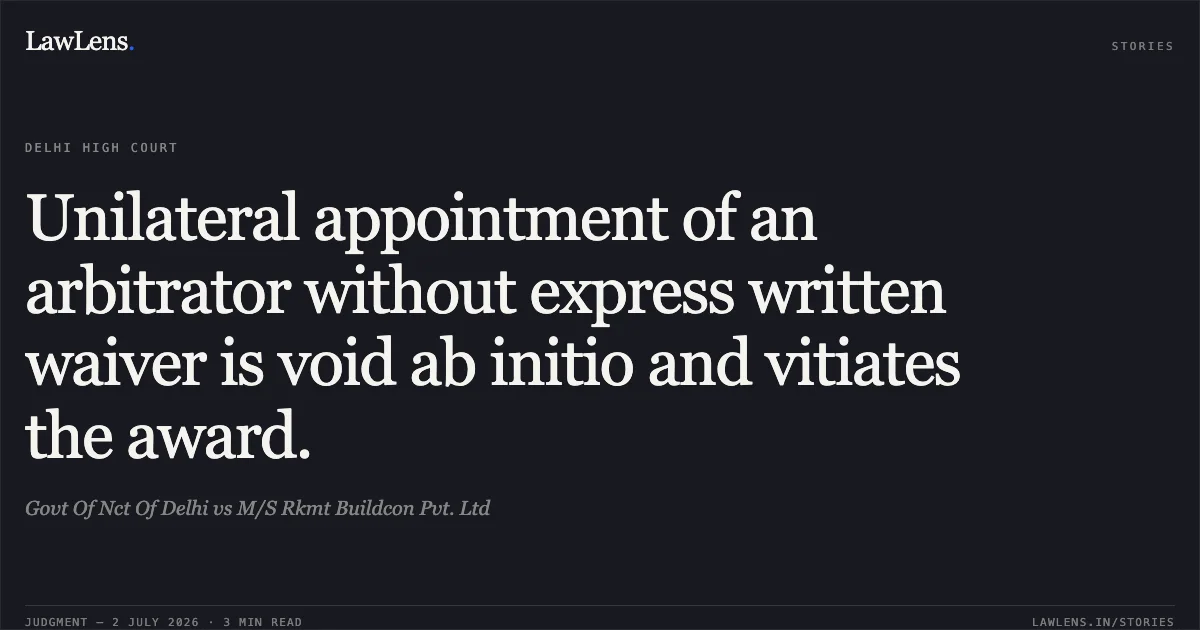
Govt Of Nct Of DelhivsM/S Rkmt Buildcon Pvt. Ltd
Click to open original judgment
Original judgment, available to read, download and summarize on LawLens.in