Facts
The Petitioner, the elected Vice President of Hockey India, filed a writ petition alleging violations of the National Sports Development Code of India, 2011, by the respondents.
Source reference: para. 2On 17.01.2025, the High Court passed an interim order directing the respondents to provide the Petitioner with video conferencing links to enable her participation in all Executive Board meetings.
Source reference: para. 4, 13The Petitioner alleged willful non-compliance as the respondents failed to provide links for meetings held on 04.07.2025 and 27.07.2025.
Source reference: para. 9, 19The respondents contended that the Petitioner’s parent unit (Hockey J&K) had disaffiliated her club and de-recognized her as a representative, purportedly vacating her post under the Hockey India Constitution, which they argued rendered the court's direction inapplicable.
Source reference: para. 10, 21-22Respondent No. 3 filed an affidavit tendering an "unconditional apology" in English, though he later admitted to not understanding the language.
Source reference: para. 8, 46Issues
1. Whether the respondents’ failure to provide meeting links, based on their internal interpretation of the Petitioner’s eligibility, constitutes "civil contempt" under Section 2(b) of the Contempt of Courts Act, 1971.
Source reference: p. 6 / para. 19, 562. Whether a party can unilaterally qualify or limit the implementation of a clear court direction based on subsequent material developments without seeking prior modification from the court.
Source reference: p. 11 / para. 23-253. Whether the apology tendered by Respondent No. 3 satisfies the legal requirements for purging contempt given the procedural infirmities and lack of contrition.
Source reference: p. 18 / para. 48-51Law Applied
The court exercised its inherent powers under Article 215 of the Constitution of India to punish for contempt.
Source reference: para. 1, 52It applied Section 2(b) of the Contempt of Courts Act, 1971, which defines "civil contempt" as the willful disobedience of any court direction or undertaking.
Source reference: para. 56The court relied on Kapildeo Prasad Sah v. State of Bihar, establishing that disobedience must be deliberate or contumacious to attract liability.
Source reference: para. 25, 58Furthermore, per Anil Ratan Sarkar v. Hirak Ghosh, the court held that a party's "own understanding" or "misunderstanding" of a clear and unequivocal order is not a valid defense against contempt.
Source reference: para. 25, 58Procedurally, the court applied Paragraph 14, Chapter 12-B, Volume IV of the Delhi High Court Rules and Orders, which requires an attesting officer to certify that an affidavit was read and explained to a declarant ignorant of the language in which it is written.
Source reference: para. 47Reasoning
The court observed that the order dated 17.01.2025 was "simpliciter" and contained no caveats regarding the Petitioner’s continued recognition by her parent unit.
Source reference: para. 17-18It rejected the respondents' attempt to read external qualifications into the court's mandate, noting that if subsequent developments necessitated a change, the respondents ought to have moved for modification prior to the breach.
Source reference: para. 23, 25The court detected prima facie collusion between Hockey India and Hockey J&K, noting that the meeting agenda discussing the Petitioner’s ouster was drafted before the official communications from the parent unit were ostensibly received.
Source reference: para. 29, 33Regarding the modification applications filed by respondents, the court characterized them as "strategic legal maneuvers" rather than bona fide attempts at compliance, as they were filed months after the contemptuous acts occurred.
Source reference: para. 41-42Finally, the "unconditional apology" was rejected because the affidavit failed to comply with the High Court Rules regarding language interpretation and Respondent No. 3’s demeanor showed a complete lack of genuine remorse.
Source reference: para. 48-50Holding
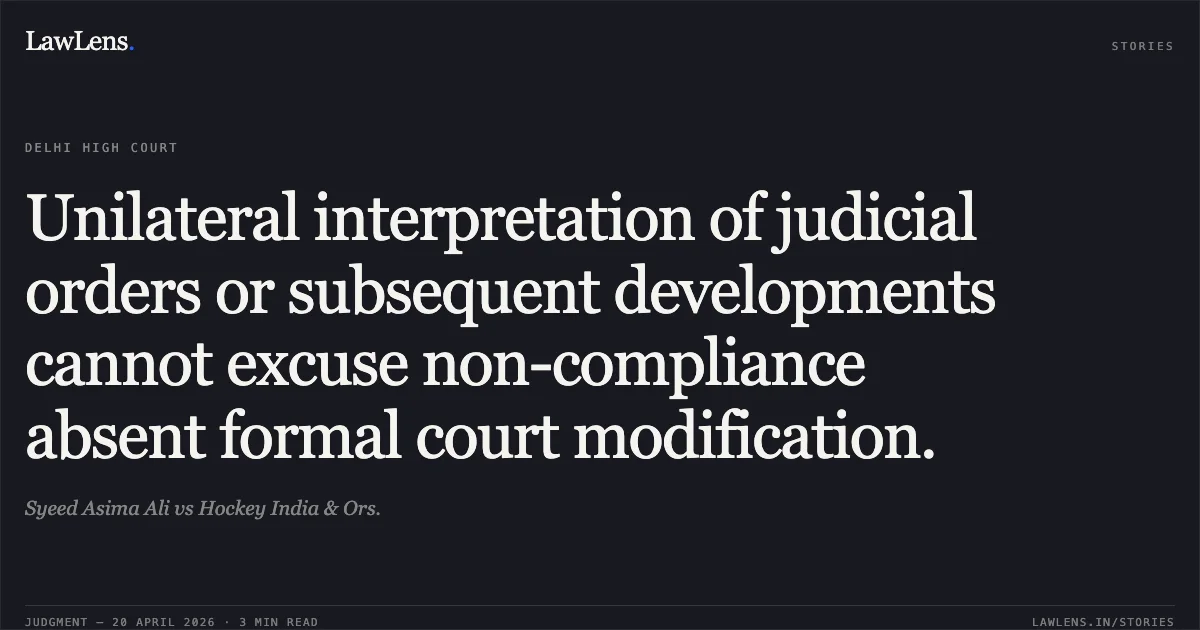
The court held that the respondents, specifically Mr. Bhola Nath Singh (Secretary General, Hockey India), were guilty of willful disobedience and civil contempt of the order dated 17.01.2025.
The court concluded that the non-supply of links was a concerted effort to circumvent judicial directions and that the administrative changes within the federation did not excuse non-compliance.
Source reference: para. 63.3, 63.4The affidavit of apology was discarded as procedurally defective and legally meaningless.
Source reference: para. 51Consequently, the court found the respondents guilty and listed the matter for 04.05.2026 to hear arguments on the question of sentencing.
Source reference: para. 65Acts & Sections Cited
2 provisions across 1 statute referred to in this judgment. Each provision opens on LawLens.
Contempt of Courts Act, 19712
Original Court PDF
Syeed Asima AlivsHockey India & Ors.
Click to open original judgment
Original judgment, available to read, download and summarize on LawLens.in


![Subsequent exoneration does not retrospectively invalidate a finalized promotion select list.. UNNIKRISHNAN M vs M/o Environment And Forests. CAT - ['Ernakulam']. LawLens](/stories/thumbnails/subsequent-exoneration-does-not-retrospectively-invalidate-a-finalized-promotion-select-li-ce80a0e84f2f4887857271e8b4341c42.webp)