Facts
The proceedings involve five connected matters concerning Dayanand Adarsh Vidyalaya, a recognized private school in Tilak Nagar.
Source reference: p. 3-4The school effectively stopped functioning on April 1, 2020, citing financial unviability and falling student enrollment.
Source reference: p. 3-4Petitioners, comprising teaching and non-teaching staff, alleged that while the school ceased operations and locked its premises, it failed to obtain the mandatory prior approval for closure from the Directorate of Education (DoE) under the Delhi School Education Rules.
Source reference: p. 4-6Consequently, the Petitioners sought recovery of unpaid salaries from April 1, 2020, along with arrears arising from the 7th Central Pay Commission (CPC) effective from January 1, 2016.
Source reference: p. 4, 7The school management contended that liability should be limited to the school’s non-existent assets, while the Petitioners sought to fasten liability on the parent bodies, including Arya Samaj (Tilak Nagar) and Delhi Arya Pratinidhi Sabha, alleging they exercised real control over the institution.
Source reference: p. 4-5, 9Issues
1. Whether a recognized school can be treated as "closed" in law merely because the management unilaterally stopped functioning and locked the premises without prior statutory approval
Source reference: p. 5, 112. Whether the Petitioners must be treated as continuing in service after April 1, 2020, thereby entitling them to salaries and service benefits
Source reference: p. 10, 153. Whether liability for salary and retiral dues can be carried beyond the school to the society or parent bodies that managed its affairs
Source reference: p. 5, 10, 15-16Law Applied
The Court primarily applied Sections 3, 4, 8, 10, and 20 of the Delhi School Education Act (DSEA), 1973, which govern the recognition, service conditions, and management of schools.
Source reference: p. 12, 14-15It specifically relied on Rule 46 of the Delhi School Education Rules (DSER), 1973, which mandates "prior approval" from the Director of Education for closing a school.
Source reference: p. 12The Court followed the precedent in Manju Tomar Ors. v. NCT and Ors.
Source reference: p. 13the Supreme Court’s ruling in NDMC Anr. v. Manju Tomar Ors. (2024), which held that a closure de hors Rule 46 is illegal and management cannot utilize such illegality to evade salary obligations
Source reference: p. 13, 18It also referenced Anjna Sharma v. Shishu Bharti Vidyalaya regarding the liability of a running society to absorb or pay staff of a closed branch.
Source reference: p. 14, 18Reasoning
The Court reasoned that legal closure is a statutory process, not a factual "drift" or managerial declaration.
Source reference: p. 11Under Rule 46, the insistence on prior approval is mandatory to protect the interests of students and staff; thus, a physical lock on the gate does not terminate legal obligations.
Source reference: p. 12, 15The Court rejected the school’s reliance on Rule 55 (lapse of recognition), noting that while unlawful cessation may trigger a lapse in recognition, it does not validate an unapproved closure.
Source reference: p. 12Regarding liability, the Court observed that the DSEA does not view the school as an isolated unit but as an enterprise under a managing committee and society.
Source reference: p. 16-17It held that "unlawful closure does not scatter liability into the air" but keeps it anchored to the entity exercising "real and effective control".
Source reference: p. 18-19However, finding the record inconclusive as to whether control rested with the local Arya Samaj or the Delhi Arya Pratinidhi Sabha, the Court determined that this factual nexus required a specific inquiry by the DoE.
Source reference: p. 19-21Holding
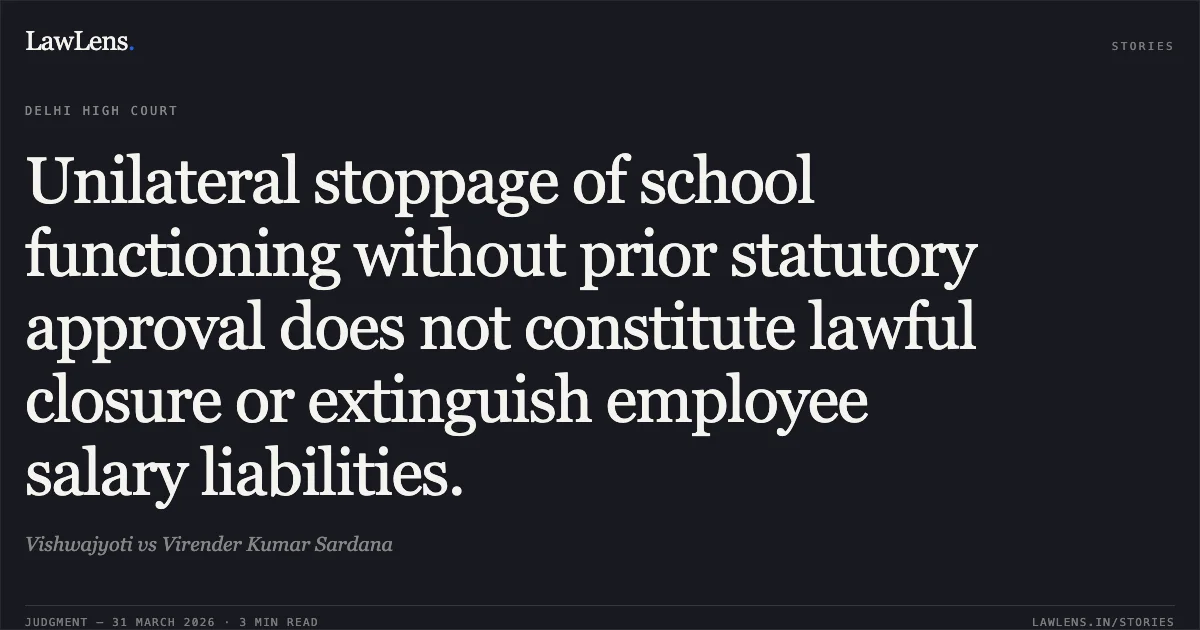
The Court held that Dayanand Adarsh Vidyalaya was not lawfully closed from April 1, 2020, and the unilateral stoppage of work could not defeat the Petitioners' service claims.
The Court ordered that liability rests jointly and severally upon the school and the entity identified by the DoE as being in actual management.
Source reference: p. 22The DoE was directed to: (i) identify the controlling entity within eight weeks
Source reference: p. 21(ii) nominate an officer to compute Petitioner-wise dues including 7th CPC arrears and 6% interest
Source reference: p. 22-23(iii) decide on the school’s closure application within ten weeks, ensuring dues are secured before granting any approval
Source reference: p. 25The contempt petition was disposed of as the claims were integrated into the writ proceedings.
Source reference: p. 21-22Dues must be paid within four weeks of determination, failing which 9% interest will apply.
Source reference: p. 24Acts & Sections Cited
5 provisions across 1 statute referred to in this judgment. Each provision opens on LawLens.
Delhi School Education Act, 19735
Original Court PDF
VishwajyotivsVirender Kumar Sardana
Click to open original judgment
Original judgment, available to read, download and summarize on LawLens.in