Facts
The plaintiff entered into a registered Agreement to Sale (ATS) with Defendant No. 1 (D-1) on 01.10.1985 for a property in Ahmedabad for ₹16,000.
Source reference: para 3.2The plaintiff paid ₹2,000 as earnest money and subsequently paid various sums totaling ₹8,400.
Source reference: para 6.2D-1 failed to execute the sale deed and unilaterally cancelled the ATS via notice on 21.07.1986, claiming time was of the essence.
Source reference: para 3.6The plaintiff filed for specific performance on 02.09.1986.
Source reference: para 6.3During pendency, D-1 violated a court injunction dated 11.11.1987 and sold the property to Defendant No. 2 (D-2) via a registered deed dated 23.12.1993.
Source reference: para 3.4The trial court decreed the suit in favor of the plaintiff, declaring D-2’s deed void.
Source reference: para 1.1Issues
1. Whether the suit for specific performance was maintainable in the absence of a prayer for a declaratory relief that the unilateral termination of the agreement was bad in law.
Source reference: para 7.1(i)2. Whether the plaintiff proved continuous readiness and willingness to perform his part of the contract under Section 16(c) of the Specific Relief Act.
Source reference: para 7.1(ii)3. Whether time was the essence of the contract.
Source reference: para 7.1(iii)4. Whether Defendant No. 2 qualified as a bona fide purchaser for value without notice.
Source reference: para 7.1(iv)Law Applied
The Court applied the principles of Section 16(c) of the Specific Relief Act, 1963, requiring the plaintiff to prove continuous readiness and willingness from the date of contract to the decree.
Source reference: para 7.14Regarding termination, it relied on K.S. Manjunath v. Moorasavirappa [2025 SCC OnLine SC 2378], which establishes that if a contract is not "determinable" by nature and lacks a termination clause, a suit for specific performance is maintainable without seeking a declaration against a unilateral repudiatory breach.
Source reference: para 7.12On the "time is essence" doctrine, it applied the Constitution Bench ruling in Chand Rani v. Kamal Rani [(1993) 1 SCC 519], holding that in immovable property sales, there is a presumption against time being of the essence unless expressly and unequivocally stated.
Source reference: para 7.23The Court applied Section 19(b) of the Specific Relief Act and Section 52 of the Transfer of Property Act regarding the doctrine of lis pendens and the duties of a bona fide purchaser.
Source reference: paras 7.25-7.26Reasoning
The Court observed that the ATS contained no clause permitting D-1 to unilaterally terminate the contract or forfeit earnest money; thus, D-1’s notice was a repudiatory breach, making a separate declaratory prayer unnecessary.
Source reference: para 7.7, 7.12It rejected the "time as essence" argument, noting that Clause 6’s six-month limit lacked penal consequences or an "inflexible" intent, especially since Clause 7 required D-1 to obtain government permissions.
Source reference: para 7.22The Court found the plaintiff was ready and willing, proven by the payment of ₹6,000 (evidenced by D-1’s own handwriting in a diary at Exh. 108) even though not required by the ATS until the final deed.
Source reference: para 7.20Regarding D-2, the Court held he was not a bona fide purchaser because the sale occurred in violation of an injunction.
Source reference: para 7.2D-2 failed to exercise due diligence—such as publishing a public notice or obtaining a title clearance certificate—rendering him bound by the doctrine of lis pendens.
Source reference: para 7.28, 7.29Holding
the suit was maintainable without a declaratory relief against termination as the contract was non-determinable.
time was not the essence of the contract; the plaintiff successfully proved continuous readiness and willingness; and D-2 was not a bona fide purchaser and the sale deed in his favor was illegal and void.
Source reference: para 7.24, 7.21, 1.1, 7.29The High Court dismissed both appeals and confirmed the trial court's decree for specific performance. D-1 was ordered to execute the sale deed and D-2 was directed to handover vacant possession.
Source reference: para 8, 1.1Acts & Sections Cited
6 provisions across 5 statutes referred to in this judgment. Each provision opens on LawLens.
Code of Civil Procedure, 19082
Indian Contract Act, 18721
Limitation Act, 19631
General Clauses Act, 18971
Bharatiya Nyaya Sanhita, 20231
Original Court PDF
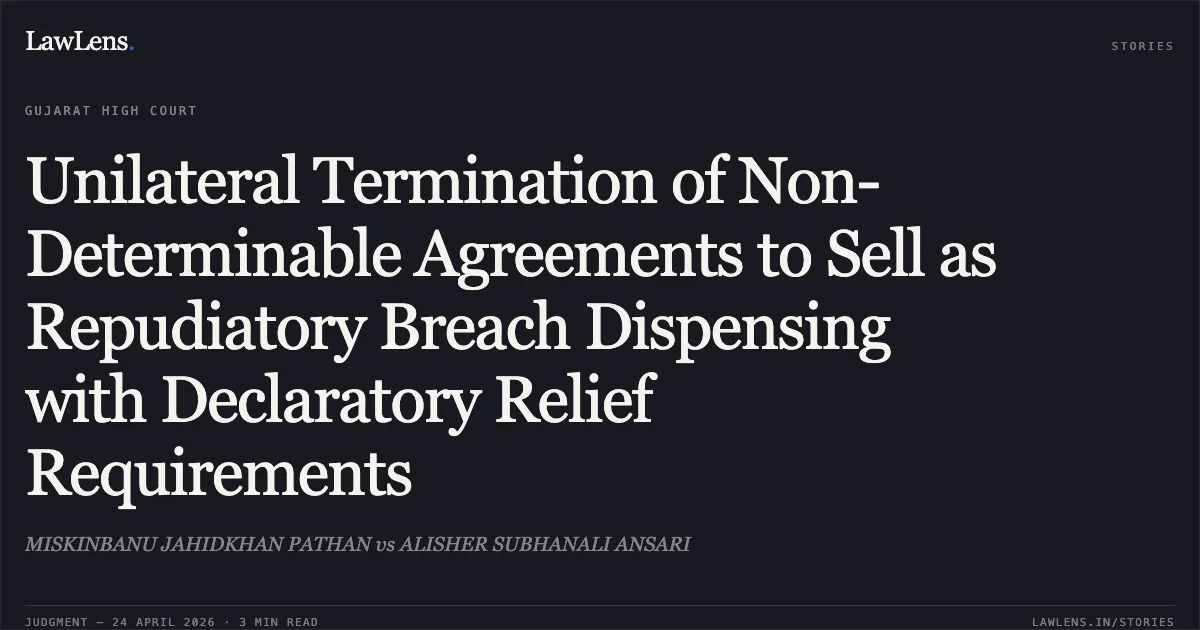
MISKINBANU JAHIDKHAN PATHANvsALISHER SUBHANALI ANSARI
Click to open original judgment
Original judgment, available to read, download and summarize on LawLens.in