Facts
Respondent No. 2 filed a complaint under Section 138 of the Negotiable Instruments Act, 1881 (“N.I. Act”) concerning cheque No. 380118 dated 20.03.2020 for ₹4,00,000, which was dishonoured with the remarks “KYC awaited and funds insufficient.” Despite service of the statutory notice dated 20.04.2020, payment was not made, resulting in the complaint
Source reference: p.2The Judicial Magistrate First Class, Jalandhar, convicted petitioner No. 2 under Section 138 of the N.I. Act by judgment dated 30.10.2025 and sentenced him to one year’s rigorous imprisonment, besides compensation of ₹4,00,000 with 9% annual interest
Source reference: p.2During the pendency of the petitioners’ criminal appeal, they applied for compounding under Section 147 of the N.I. Act, offering to pay the cheque amount along with 7.5% costs in terms of Sanjabij Tari v. Kishore S. Borcar
Source reference: pp.2–3Respondent No. 2 expressly refused to compound, citing the petitioners’ alleged delaying tactics, harassment, and failure to honour earlier settlement arrangements
Source reference: p.4The appellate Court dismissed the compounding application on 16.05.2026, holding that consent of the complainant was essential
Source reference: p.5The petitioners challenged that order under Section 528 of the Bharatiya Nagarik Suraksha Sanhita, 2023
Source reference: p.1Issues
1. Whether an offence under Section 138 of the N.I. Act can be compounded at the unilateral request of the accused, in the absence of the complainant’s consent, merely because the accused is willing to pay the cheque amount and prescribed costs?
Source reference: p.5; para. 102. Whether the guidelines in paragraph 38(c) of Sanjabij Tari v. Kishore S. Borcar confer an absolute right upon the accused to obtain compounding upon payment of the cheque amount and 7.5% costs?
Source reference: pp.7–8; paras. 12–133. Whether the High Court could exercise its inherent jurisdiction under Section 528 of the BNSS to override the complainant’s refusal and direct compounding?
Source reference: p.6; para. 11Law Applied
Section 147 of the N.I. Act permits compounding of offences under the Act, but compounding remains fundamentally consensual and cannot ordinarily be imposed without the complainant’s consent.
Source reference: p.6Relying on A.S. Pharma Pvt. Ltd. v. Nayati Medical Pvt. Ltd., 2024 SCC OnLine SC 2539, and JIK Industries Ltd. v. Amarlal V. Jumani, (2012) 3 SCC 255, the Court held that the complainant’s consent is a sine qua non for compounding and that willingness to pay, even with additional compensation, cannot substitute such consent
Source reference: p.6K.M. Ibrahim v. K.P. Mohammed, (2010) 1 SCC 798, and the decisions of the High Court in M/s Nidhi Knitwears (P) Ltd. v. Honey Hosiery Mills, 2022 (3) RCR (Criminal) 304, and Surinder Kumar Bindal v. Satinder Nath Radhey Shyam and Sons reaffirm the same principle
Source reference: p.6Paragraph 38(c) of Sanjabij Tari v. Kishore S. Borcar, 2025 INSC 1158, prescribes 7.5% costs where payment is made before the Sessions Court or High Court in appeal or revision, but paragraph 39 merely permits the Court to “suggest” compounding and does not authorise compulsion of an unwilling complainant
Source reference: pp.7–8Section 528 of the BNSS, corresponding to Section 482 of the Cr.P.C., cannot be used to override an express statutory requirement or to equate quashing with compounding
Source reference: p.6; para. 11Reasoning
The Court held that respondent No. 2’s refusal to compound was clear and unequivocal
Source reference: p.8; para. 13Although the petitioners offered the full cheque amount together with 7.5% costs, that offer could facilitate a consensual settlement but could not create a unilateral right to compounding.
Source reference: pp.7–8; para. 12The costs framework in Sanjabij Tari regulates the financial consequences of compounding at different procedural stages; it does not dispense with the complainant’s consent
Source reference: pp.7–8; para. 12Since compounding is based on mutual agreement, the appellate Court correctly declined to compel respondent No. 2 to settle.
Source reference: pp.7–8; paras. 12–13The inherent jurisdiction under Section 528 of the BNSS could not be invoked to bypass the consent requirement under Section 147 of the N.I. Act, particularly because quashing and compounding operate in distinct legal fields
Source reference: p.6; paras. 11–13Holding
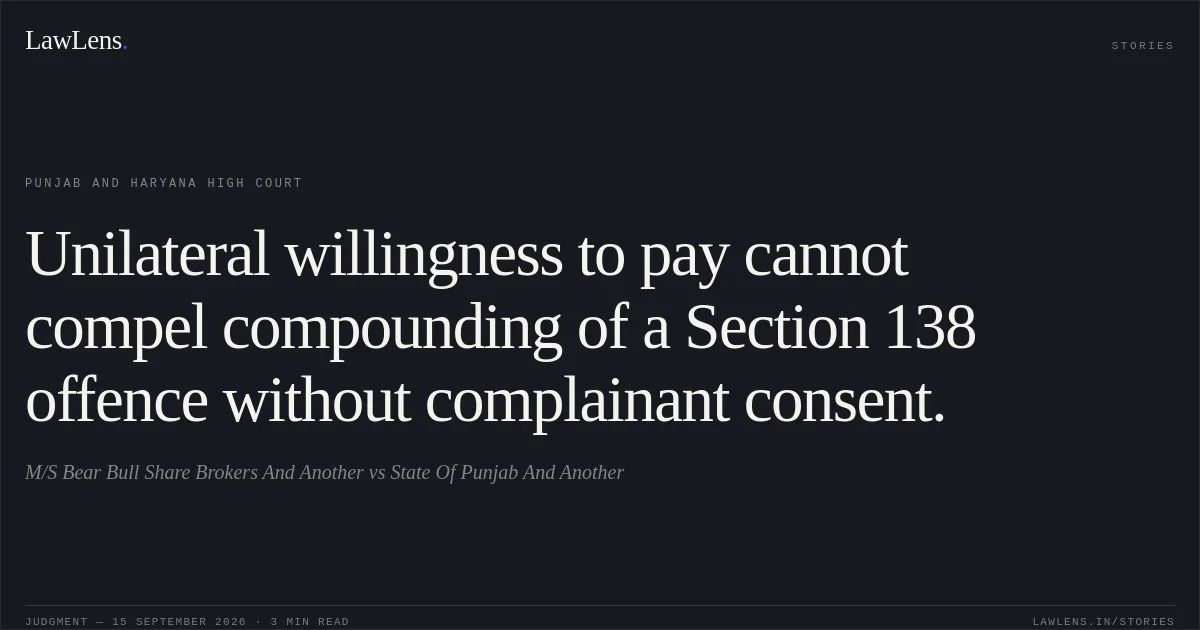
The High Court held that an offence under Section 138 of the N.I. Act cannot be compounded solely at the accused’s instance when the complainant expressly refuses consent, notwithstanding the accused’s willingness to pay the cheque amount and 7.5% costs.
Finding no illegality, infirmity, or perversity in the appellate Court’s order dated 16.05.2026, the Court dismissed the petition
Source reference: p.9; para. 14It clarified that the dismissal would not prejudice the petitioners’ rights in the pending statutory appeal, which was to be decided independently on its merits and in accordance with law.
Source reference: p.9; para. 15Acts & Sections Cited
4 provisions across 3 statutes referred to in this judgment. Each provision opens on LawLens.
Bharatiya Nagarik Suraksha Sanhita, 20231
Negotiable Instruments Act, 18812
Code of Criminal Procedure, 19731
Original Court PDF
M/S Bear Bull Share Brokers And AnothervsState Of Punjab And Another
Click to open original judgment
Original judgment, available to read, download and summarize on LawLens.in


![Subsequent exoneration does not retrospectively invalidate a finalized promotion select list.. UNNIKRISHNAN M vs M/o Environment And Forests. CAT - ['Ernakulam']. LawLens](/stories/thumbnails/subsequent-exoneration-does-not-retrospectively-invalidate-a-finalized-promotion-select-li-ce80a0e84f2f4887857271e8b4341c42.webp)