Facts
The parties married on 23 October 2005 and had two children.
Source reference: para. 4–13The wife sought divorce under Section 13(1)(i-a) of the Hindu Marriage Act, 1955, alleging physical and mental cruelty.
Source reference: para. 4–13The husband denied cruelty and alleged that the wife had an illicit relationship with his paternal uncle’s son, Ramkumar.
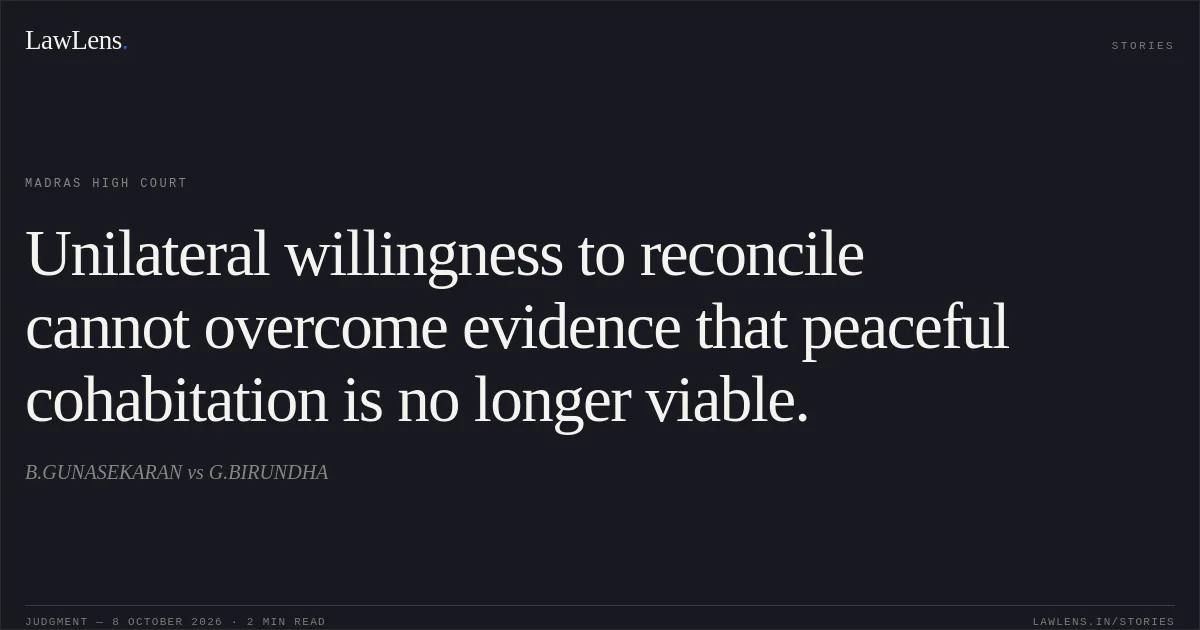
Source reference: para. 4–13While the wife’s petition was pending, the husband sought restitution of conjugal rights under Section 9, asserting that he was willing to resume married life. The Family Court allowed the wife’s divorce petition and dismissed the husband’s restitution petition; he appealed both orders under Section 19 of the Family Courts Act, 1984.
Source reference: para. 4–13, 22–23Issues
1. Whether the Family Court was justified in granting the wife a divorce under Section 13(1)(i-a) of the Hindu Marriage Act
Source reference: para. 27(i)2. Whether the Family Court was justified in dismissing the husband’s petition for restitution of conjugal rights under Section 9 of the Hindu Marriage Act
Source reference: para. 27(ii)3. Whether the Family Court’s common order warranted appellate interference
Source reference: para. 27(iii)Law Applied
Section 13(1)(i-a) of the Hindu Marriage Act permits divorce on the ground of cruelty, and Section 9 provides for restitution of conjugal rights where a spouse has withdrawn from the other’s society without reasonable excuse.
Source reference: no citationUnder Section 19 of the Family Courts Act, the High Court hears appeals from Family Court judgments and orders.
Source reference: no citationThe Court relied on Amutha v. A.R. Subramanian, 2024 SCC OnLine SC 3822, for the relevance of prolonged separation and inability to reconcile when assessing whether a marriage can be revived.
Source reference: para. 34It also relied on Chetan Dass v. Kamla Devi, (2001) 4 SCC 250, which describes marriage as requiring mutual trust, respect, affection, and reasonable adjustment, while cautioning that irretrievable breakdown is not a standalone, automatic ground for divorce.
Source reference: para. 36–38Reasoning
The Court upheld the Family Court’s assessment of the evidence as a whole, including the parties’ serious allegations, the police complaints, and the wife’s evidence concerning her departure from the matrimonial home with Ramkumar.
Source reference: para. 29–31It considered that the husband’s stated willingness to take the wife back did not, by itself, establish a realistic prospect of restoring a peaceful relationship given the apparent erosion of mutual trust.
Source reference: para. 32–41The children’s welfare did not require the parties to remain in a marriage the Court found unworkable; the father’s parental responsibilities would continue notwithstanding the divorce.
Source reference: para. 42–52The Court found no perversity, material illegality, or substantial error warranting appellate interference.
Source reference: para. 54–57Holding
The Court held that the Family Court was justified in granting the wife a decree of divorce and dismissing the husband’s petition for restitution of conjugal rights.
Both appeals were dismissed, the common order and decree dated 1 July 2022 were confirmed, no costs were awarded, and the connected miscellaneous petition was closed.
Source reference: para. 59Acts & Sections Cited
3 provisions across 2 statutes referred to in this judgment. Each provision opens on LawLens.
Family Courts Act, 19841
Hindu Marriage Act, 19552
Original Court PDF
B.GUNASEKARANvsG.BIRUNDHA
Click to open original judgment
Original judgment, available to read, download and summarize on LawLens.in