Facts
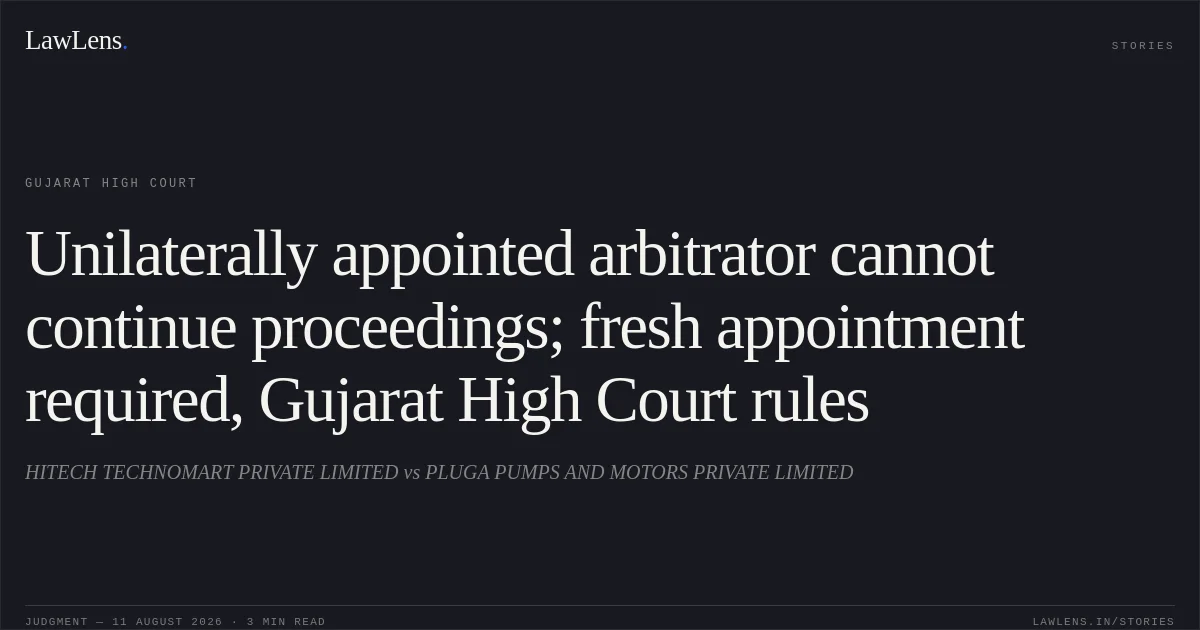
Pluga Pumps and Motors Private Limited issued an arbitration notice and, on the same date—1 May 2019—unilaterally appointed a sole arbitrator through its Managing Director. Hitech Technomart Private Limited challenged the appointment, contending that it had neither consented to the appointment nor received a valid notice under Section 21 of the Arbitration and Conciliation Act, 1996 (“the Act”).
Source reference: para. 2; p. 2Hitech filed an application under Section 14(1)(a) read with Section 29A(4) seeking termination of the arbitrator’s mandate, while Pluga filed an application under Sections 29A(5) and 151 CPC seeking a six-month extension of the arbitrator’s mandate from 25 August 2022.
Source reference: para. 2; p. 2By a common order dated 4 December 2023, the Commercial Court held that the arbitrator was ineligible under Section 12(5) because he had been appointed unilaterally by Pluga’s Managing Director, but nevertheless permitted the arbitration to continue from the stage already reached and extended the mandate.
Source reference: paras. 3–7; pp. 2–4Hitech challenged that order under Article 227 of the Constitution.
Source reference: para. 1; p. 1Issues
Whether the mandate of the sole arbitrator was liable to be terminated under Section 14(1)(a) of the Act because his unilateral appointment rendered him de jure ineligible to act as arbitrator.
Source reference: paras. 6–7; pp. 3–4Whether, after terminating the mandate of an arbitrator found ineligible from inception, the Commercial Court could extend the arbitral mandate under Section 29A(5) and permit continuation of the proceedings on the basis of the evidence and material already on record.
Source reference: paras. 8–9; pp. 4–7Whether a substitute arbitrator could be appointed under Sections 15(2) or 29A(6) in the circumstances of the case.
Source reference: paras. 10–14; pp. 8–10Law Applied
The Court applied Section 12(5) of the Arbitration and Conciliation Act, 1996, under which a person falling within the statutory ineligibility provisions cannot act as arbitrator unless the parties expressly waive the disqualification by a written agreement after the dispute has arisen.
Source reference: paras. 4–5; pp. 3–4Section 14(1)(a) mandates termination of an arbitrator’s mandate where the arbitrator becomes de jure or de facto unable to perform his functions; Section 14(2) permits the Court to decide a controversy concerning such termination.
Source reference: p. 5Section 15(2) provides for appointment of a substitute arbitrator according to the rules applicable to the appointment of the arbitrator being replaced.
Source reference: p. 6; para. 10Section 29A(4) concerns termination of the arbitrator’s mandate upon expiry of the prescribed period, subject to judicial extension, while Section 29A(5) permits extension only for sufficient cause and on appropriate terms; Section 29A(6) permits substitution while extending the period under Section 29A(4), with continuation of proceedings from the stage already reached.
Source reference: pp. 6–7; para. 9The Court held that Sections 29A(5) and 29A(6) cannot be used to extend or continue proceedings before an arbitrator whose appointment was invalid and who was de jure ineligible from the outset.
Source reference: paras. 11–15; pp. 9–11Reasoning
The Court upheld the Commercial Court’s finding that the arbitrator was ineligible under Section 12(5), since he had been appointed unilaterally by Pluga’s Managing Director and without Hitech’s consent or concurrence.
Source reference: paras. 4, 7, 11; pp. 3–4, 8–9Because the defect affected the appointment at its inception, the arbitrator was de jure unable to perform his functions and his mandate was correctly terminated under Section 14(1)(a).
Source reference: paras. 10–12; pp. 8–9The Court held that the Commercial Court erred by separately considering the application for extension under Section 29A(5) after deciding to terminate the mandate. Section 29A addresses expiry of the permissible period for making an award and cannot validate or extend the mandate of an arbitrator whose appointment itself was legally void or impermissible.
Source reference: paras. 8–9, 13–15; pp. 4–7, 10–11Similarly, Section 15(2) could not justify substitution because the “rules applicable” to the original appointment could not be invoked to perpetuate an appointment made unilaterally and contrary to the Act.
Source reference: paras. 10–12; pp. 8–9Continuation of the proceedings from the stage already reached was therefore impermissible.
Source reference: paras. 16–17; pp. 11–12Holding
The Gujarat High Court partly allowed the petition under Article 227. It affirmed the termination of the sole arbitrator’s mandate under Section 14(1)(a) of the Act on the ground that the unilateral appointment rendered him ineligible under Section 12(5).
It set aside the Commercial Court’s order to the extent that it extended the arbitrator’s mandate under Section 29A(5), permitted continuation of the proceedings from the existing stage, and granted liberty for substitution within that proceeding.
Source reference: para. 18; p. 12The parties were, however, granted liberty to invoke the Act for appointment of a fresh arbitrator strictly in accordance with law; the High Court clarified that its observations would not govern any such fresh appointment proceeding.
Source reference: para. 19; p. 12Acts & Sections Cited
7 provisions across 2 statutes referred to in this judgment. Each provision opens on LawLens.
Arbitration and Conciliation Act, 19966
Code of Civil Procedure, 19081
Original Court PDF
HITECH TECHNOMART PRIVATE LIMITEDvsPLUGA PUMPS AND MOTORS PRIVATE LIMITED
Click to open original judgment
Original judgment, available to read, download and summarize on LawLens.in