Facts
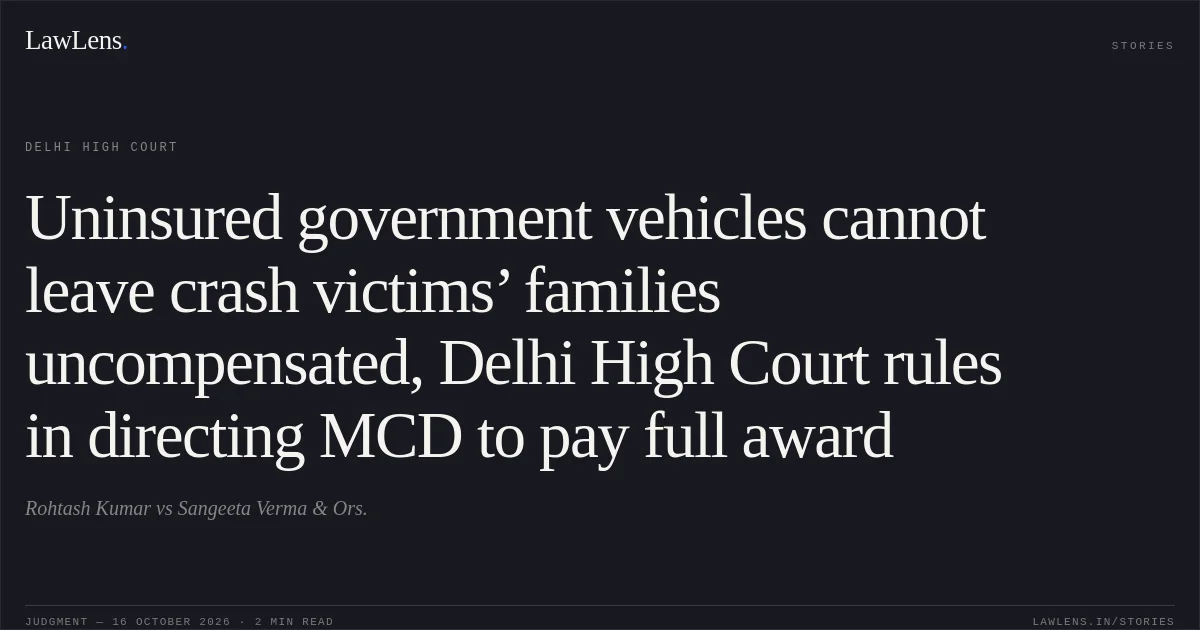
Sujeet Kumar, aged 26, died after his motorcycle was struck from behind by an MCD truck driven by appellant Rohtash Kumar.
Source reference: pp. 1–2, paras. 1–3The MACT found the driver negligent and awarded compensation of ₹22,05,000 with 9% annual interest, holding the driver and MCD jointly and severally liable.
Source reference: pp. 1–2, paras. 1–3The driver appealed against personal liability, arguing that the MCD, as vehicle owner and his employer, should satisfy the entire award.
Source reference: pp. 2, 23–24, paras. 4–9, 25–26The truck was uninsured, and the MCD acknowledged that it was being used for official purposes.
Source reference: pp. 2, 23–24, paras. 4–9, 25–26Issues
1. Whether the MCD, as owner of the offending vehicle, was vicariously liable to satisfy the compensation award where its employee drove the vehicle in the course of employment.
Source reference: pp. 22–24, paras. 21–242. Whether the driver could remain personally liable for the award merely because the MCD vehicle was uninsured.
Source reference: pp. 23–27, paras. 23, 27–32Law Applied
Under Sections 146(1) and 146(3)(b) of the Motor Vehicles Act, 1988, compulsory third-party insurance may be exempted for vehicles owned by a local authority, subject to the statutory framework for a fund to meet liabilities; the exemption does not extinguish the authority’s liability to third parties.
Source reference: pp. 3–5, 24–26, paras. 6–8, 27–29Under the principles of vicarious liability, an employer is liable for an employee’s tort committed in the course of employment. State of Maharashtra v. Kanchanmala Vijaysing Shirke, (1995) 5 SCC 659, supports liability where the employee’s negligent act is connected with authorised work; State of Rajasthan v. Vidhyawati, 1962 SCC OnLine SC 144, rejects governmental immunity for such torts.
Source reference: pp. 11–16, paras. 14–17Rules 148 and 151–158 of the Central Motor Vehicles Rules, 1989 provide for vehicle records and a fund mechanism for meeting liabilities of relevant authorities.
Source reference: p. 25, para. 28Reasoning
The Court found negligence undisputed and accepted that the driver was an MCD employee operating the truck in the course of his employment; the MCD’s evidence also acknowledged the vehicle’s official use and uninsured status.
Source reference: pp. 22–24, paras. 22–26Applying vicarious-liability principles, the Court held that the MCD’s responsibility as owner and employer was established. The statutory exemption from insurance did not allow the MCD to avoid satisfying the award, and any failure to establish or maintain the contemplated fund could not defeat the claimants’ rights.
Source reference: pp. 24–27, paras. 27–33The MCD’s proposal that the driver bear 50% of the compensation was therefore rejected.
Source reference: p. 26, para. 32Holding
The appeal was allowed. The Court directed the MCD to pay the full compensation award, with accrued interest, within four weeks; any balance remaining after amounts already paid was also to be paid within that period.
Execution proceedings against the driver were to be set aside, without prejudice to the MCD’s right to take action against him under applicable service and conduct rules.
Source reference: p. 27, para. 38Acts & Sections Cited
3 provisions across 1 statute referred to in this judgment. Each provision opens on LawLens.
Motor Vehicles Act, 19883
Original Court PDF
Rohtash KumarvsSangeeta Verma & Ors.
Click to open original judgment
Original judgment, available to read, download and summarize on LawLens.in