Facts
The petitioner, appointed as Lecturer on 30 April 1984, challenged Memo No. C/299/Estab/2025 dated 1 March 2025, by which respondent no. 5, Shri Bhim Singh, was treated as Professor-in-Charge of Ishwar Dayal Bhagwat Prasad Singh College, despite allegedly being junior to the petitioner, who claimed to have obtained a Ph.D. in 1991.
Source reference: paras. 2; p. 2The University constituted a three-member committee through Letter No. C/1191/Estab/2025 dated 2 August 2025. The committee concluded that the petitioner was senior to respondent no. 5 both in terms of date of appointment and acquisition of the Ph.D., and found the petitioner’s claim of seniority supported by the records.
Source reference: para. 4; pp. 2–3Despite the committee’s report and repeated communications from the Registrar directing consideration and implementation of the report, no effective action was taken by the College authorities.
Source reference: para. 5; pp. 3–4The petitioner subsequently sought amendment of the writ petition to seek implementation of the committee’s decision and dissolution of the governing body under Section 28 of Statute 32.
Source reference: para. 6; p. 4The University objected to the maintainability of the writ petition on the ground that a statutory appellate remedy was available and stated that a related matter concerning removal from the post of Principal was pending before the State Appellate Authority in Appeal No. 11 of 2025.
Source reference: para. 7; p. 4Issues
Whether the writ petition should be entertained despite the availability of a statutory remedy before the Appellate Authority?
Source reference: paras. 7, 10; pp. 4–5Whether the University should be directed to act upon the three-member committee’s finding that the petitioner was senior to respondent no. 5 for determining the Professor-in-Charge of the College?
Source reference: paras. 4–6, 10; pp. 2–5Whether the petitioner was entitled, at this stage, to a direction for dissolution of the governing body under Section 28 of Statute 32?
Source reference: paras. 6, 9; pp. 4–5Law Applied
The Court applied the principle that the existence of an alternative statutory remedy ordinarily weighs against the exercise of writ jurisdiction, while recognising that the High Court may nevertheless issue appropriate directions where the circumstances justify intervention.
Source reference: paras. 7, 10; pp. 4–5It also considered the seniority principle relied upon by the petitioner, namely that a teacher who acquired a Ph.D. earlier would rank senior in law, as stated by the Division Bench in LPA No. 774 of 2024.
Source reference: para. 3; p. 2The Court further relied upon the University’s own three-member committee report, which found the petitioner senior on the basis of both appointment date and Ph.D. qualification.
Source reference: para. 4; pp. 2–3Section 28 of Statute 32 was invoked by the petitioner as the basis for seeking dissolution of the governing body, although the Court did not grant that relief at this stage.
Source reference: para. 6; p. 4Reasoning
Although the Court acknowledged that the petitioner had an alternative statutory remedy, it considered the University’s subsequent conduct significant.
Source reference: para. 10; p. 5The University itself had constituted a committee to examine the dispute, and that committee had found, on the basis of the records, that the petitioner was senior to respondent no. 5.
Source reference: para. 10; p. 5The University thereafter repeatedly addressed communications to the College seeking implementation of the committee’s findings, but the dispute remained unresolved.
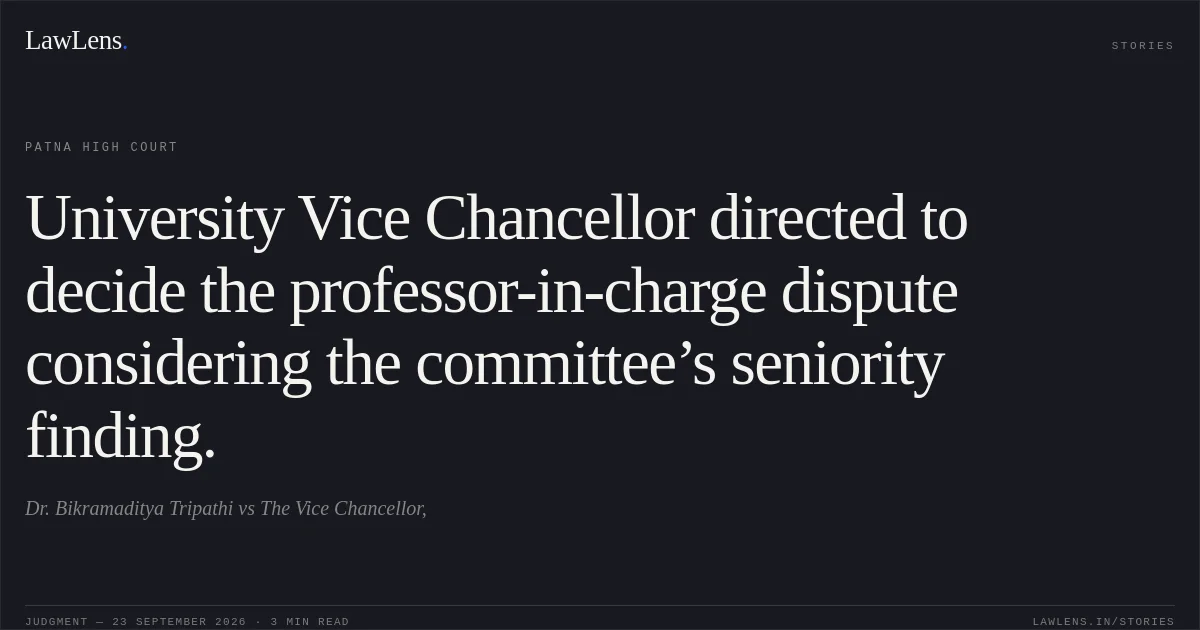
Source reference: paras. 4–5, 10; pp. 2–5In these circumstances, rather than deciding the petitioner’s entitlement to appointment directly or granting the prayer for dissolution of the governing body, the Court directed the Vice Chancellor to take an appropriate decision in light of the committee report and bring the dispute to an end.
Source reference: para. 10; p. 5The Court therefore adopted a limited supervisory approach while leaving the final administrative decision to the University.
Source reference: para. 10; p. 5Holding
The writ petition was disposed of with a direction to the Vice Chancellor of Veer Kunwar Singh University to take appropriate action and decide the dispute in light of the three-member committee’s report within six weeks from receipt or production of a copy of the order.
The Court did not itself appoint the petitioner as Professor-in-Charge and did not grant the requested dissolution of the governing body.
Source reference: para. 11; p. 6The petition was accordingly disposed of without further relief.
Source reference: para. 11; p. 6Acts & Sections Cited
1 provisions across 1 statute referred to in this judgment. Linked provisions open on LawLens.
Statute 32 (alias, unresolved)1
Original Court PDF
Dr. Bikramaditya TripathivsThe Vice Chancellor,
Click to open original judgment
Original judgment, available to read, download and summarize on LawLens.in