Facts
The parties married on 12 April 2015. The husband sought divorce under Section 13 of the Hindu Marriage Act, 1955, alleging cruelty and desertion; the wife denied the allegations and asserted that she had been subjected to cruelty by the husband and his family
Source reference: para. 3–9The husband pleaded that the wife left the matrimonial home on 10 October 2015. His petition was filed on 6 July 2017, and the Family Court granted a divorce decree on 27 October 2022
Source reference: para. 6, 11, 18The wife appealed, challenging the Family Court’s appreciation of the evidence
Source reference: para. 11–12Issues
Whether the husband established desertion for the statutory period of at least two years immediately preceding presentation of the divorce petition
Source reference: para. 17–19Whether the wife’s conduct, considered on the evidence, amounted to cruelty warranting divorce under Section 13(1)(ia) of the Hindu Marriage Act, 1955
Source reference: para. 19–20, 27–31Law Applied
Section 13(1)(ib) of the Hindu Marriage Act, 1955 requires desertion to have continued for at least two years immediately before the divorce petition is presented
Source reference: para. 15–18Under Section 13(1)(ia), cruelty may be a ground for divorce; its assessment depends on the nature and effect of the conduct, the surrounding circumstances, and the cumulative course of conduct, rather than a fixed or exhaustive definition
Source reference: para. 15–16, 28–29The Court relied on Ravi Kumar v. Julmidevi, (2010) 4 SCC 476, and its reference to Shobha Rani v. Madhukar Reddi, (1988) 1 SCC 105, for these principles
Source reference: para. 28–29Reasoning
The Court held that the pleaded separation began on 10 October 2015, less than two years before the petition was filed on 6 July 2017; the statutory requirement for divorce on desertion was therefore not met
Source reference: para. 17–19On cruelty, it relied on admissions in the wife’s cross-examination and her mother’s evidence concerning the wife’s departure, removal of her belongings, the community meeting intended to bring her back, and the husband’s alleged visits and contributions to treatment and delivery expenses
Source reference: para. 21–26Considering those circumstances cumulatively, the Court found that the wife had left voluntarily and remained unwilling to resume cohabitation despite social intervention, and treated that conduct as mental cruelty
Source reference: para. 25–30Holding
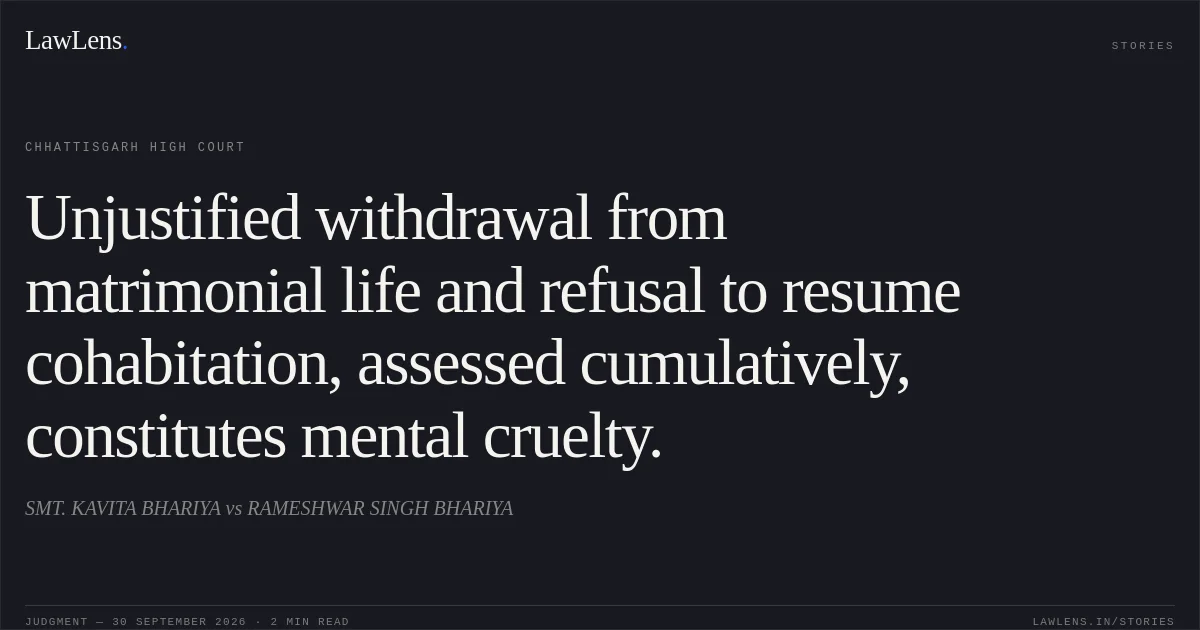
The Court concluded that the desertion ground was unavailable because the two-year statutory period had not elapsed when the petition was filed, but upheld the divorce decree on the ground of cruelty
It dismissed the wife’s appeal and directed that a decree be drawn accordingly
Source reference: para. 32–33Acts & Sections Cited
2 provisions across 2 statutes referred to in this judgment. Each provision opens on LawLens.
Family Courts Act, 19841
Hindu Marriage Act, 19551
Original Court PDF
SMT. KAVITA BHARIYAvsRAMESHWAR SINGH BHARIYA
Click to open original judgment
Original judgment, available to read, download and summarize on LawLens.in