Facts
A reference was made by the Superintendent of Police (Border), Kamrup (M), against Jiarul Sheikh before Foreigners Tribunal No. 4, Kamrup (M), in F.T. Case No. 1078/2017.
Source reference: para. 2The petitioner filed a written statement, adduced evidence as DW1, examined his father as DW2, and relied on voter lists, khatians and his EPIC to establish Indian citizenship and linkage with his predecessors who allegedly resided in India before 25 March 1971.
Source reference: pp. 3–5; paras. 2–5By order dated 30 April 2019, the Tribunal held that the petitioner had failed to discharge the burden under Section 9 of the Foreigners Act, 1946 and declared him a foreigner entering India after 25 March 1971.
Source reference: p. 3; para. 2(iii)The petitioner challenged that opinion under Article 226 of the Constitution.
Source reference: p. 3; para. 1Issues
Whether the petitioner discharged the burden under Section 9 of the Foreigners Act, 1946 to establish that he was not a foreigner and was an Indian citizen?
Source reference: pp. 9–13; paras. 15, 19–25Whether the materials relied upon—particularly the voter lists, khatians and oral evidence—established a credible genealogical link between the petitioner and his projected ancestors residing in India before 25 March 1971?
Source reference: pp. 12–13; paras. 21–25Whether the Tribunal’s opinion disclosed any jurisdictional error, procedural illegality or error apparent on the face of the record warranting interference under Article 226 in certiorari jurisdiction?
Source reference: pp. 10–12; paras. 17–18Law Applied
Section 9 of the Foreigners Act, 1946 places the burden on the person concerned to prove that he is not a foreigner, notwithstanding the Indian Evidence Act.
Source reference: p. 9; para. 15Relying on Sarbananda Sonowal v. Union of India, (2005) 5 SCC 665, the Court held that the proceedee must ordinarily disclose and establish facts such as date and place of birth, parentage, and the parents’ place of birth and citizenship.
Source reference: pp. 6–7; para. 8Fateh Mohd. v. Delhi Administration, AIR 1963 SC 1035, following Ghaus Mohammad v. Union of India, AIR 1961 SC 1526, reaffirmed that the burden under Section 9 rests upon the person claiming not to be a foreigner.
Source reference: pp. 9–10; para. 16Under the certiorari jurisdiction described in Central Council for Research in Ayurvedic Sciences v. Bikartan Das, the High Court does not reappreciate or reweigh evidence as an appellate court and interferes only for jurisdictional error, patent illegality or an error apparent on the face of the record.
Source reference: pp. 10–12; paras. 17–18The Court also relied on Aziz Miah v. Union of India, holding that mere inclusion of a person’s name in a voter list, without proof of the claimed relationship, does not establish citizenship.
Source reference: pp. 12–13; para. 22Reasoning
The Court found the petitioner’s written statement materially vague because it did not adequately disclose his date of birth, place of birth, or the relevant details concerning his parents and ancestors.
Source reference: p. 12; paras. 19–20The voter lists of 1966 and 1970 only showed the presence of the projected grandparents and did not establish the petitioner’s genealogical link to them.
Source reference: pp. 12–13; para. 21The voter list of 1989, which allegedly contained the names of the petitioner’s parents, was separated from the earlier lists by an unexplained gap of nearly two decades and did not prove the relationship between the projected father and grandfather.
Source reference: pp. 12–13; para. 21The later voter lists of 2005 and 2010, even though containing the petitioner’s name with his projected father, could not independently establish citizenship.
Source reference: no citationThe Court also noted that several voter-list documents annexed to the writ petition were uncertified photocopies and could not be relied upon in certiorari proceedings.
Source reference: p. 13; para. 23The petitioner’s admissions in cross-examination, including that the exhibits had not been proved by their issuing authorities, further weakened his case.
Source reference: p. 14; para. 24In the absence of a reliable link document and in view of the deficient pleadings and evidentiary gaps, the Tribunal’s conclusion was supported by the record and disclosed no error warranting judicial review.
Source reference: pp. 10–14; paras. 17, 24–26Holding
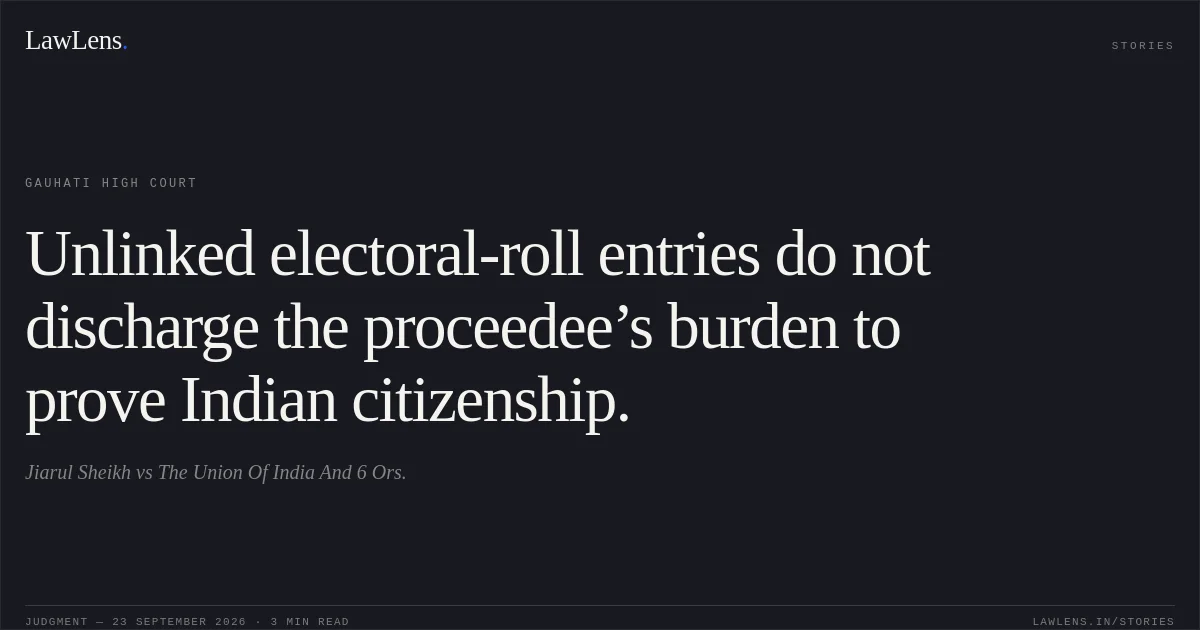
The Gauhati High Court held that the petitioner failed to discharge the burden under Section 9 of the Foreigners Act, 1946 and failed to establish a credible link with ancestors residing in India before 25 March 1971.
The Tribunal’s opinion dated 30 April 2019 declaring him a foreigner was therefore not liable to interference under Article 226.
Source reference: p. 14; para. 26The writ petition was dismissed, the interim order was vacated, consequential action was directed to proceed in accordance with law, and the Tribunal’s records were ordered to be returned.
Source reference: p. 14; paras. 27–28Acts & Sections Cited
5 provisions across 3 statutes referred to in this judgment. Linked provisions open on LawLens.
Foreigners Act, 19463
Foreigners (Tribunals) Order, 19641
Citizenship Act, 19551
Original Court PDF
Jiarul SheikhvsThe Union Of India And 6 Ors.
Click to open original judgment
Original judgment, available to read, download and summarize on LawLens.in