Facts
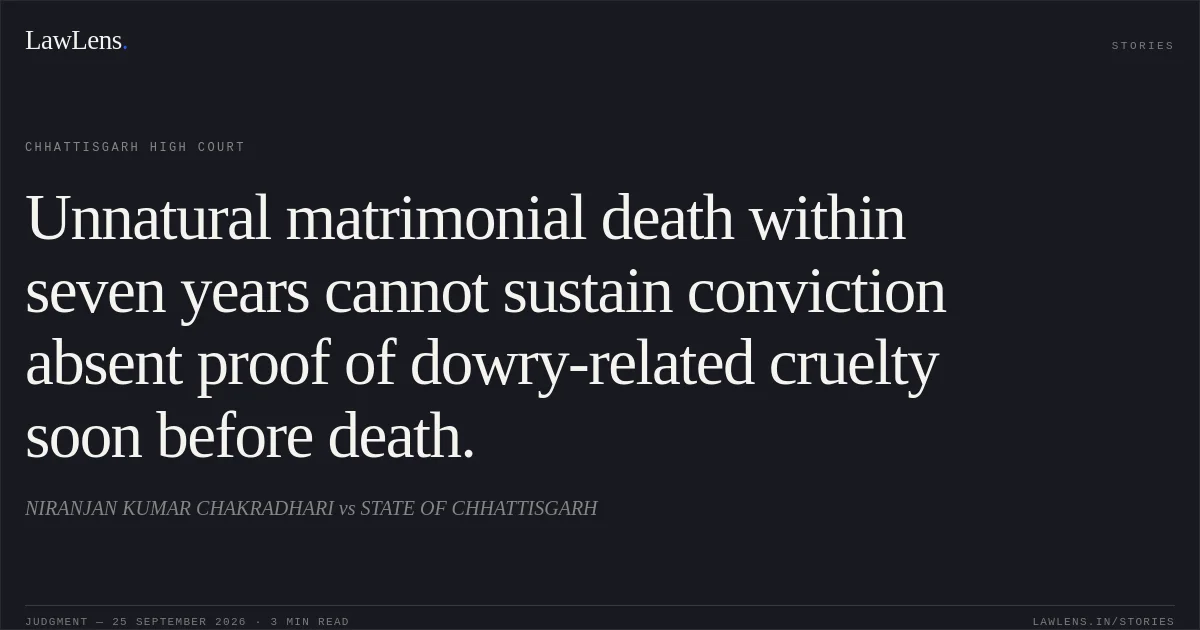
Khushbu, aged approximately 20 years, married the appellant on 21 June 2022. She died on 23 April 2023, within seven years of marriage, after consuming a poisonous substance at her matrimonial home.
Source reference: paras. 2–3; p. 2–3The prosecution alleged that the appellant subjected her to physical and mental cruelty because the household articles and cash given at marriage were allegedly of inferior quality and demanded their replacement.
Source reference: paras. 2–3; p. 2–3The post-mortem examination disclosed no external or internal injuries, while the viscera examination detected aluminium phosphide.
Source reference: para. 11; p. 6The Trial Court convicted the appellant under Sections 304-B and 498-A of the IPC and Section 4 of the Dowry Prohibition Act, sentencing him to concurrent terms of seven years, three years, and two years’ rigorous imprisonment respectively.
Source reference: para. 1; p. 1Issues
Whether the prosecution proved that Khushbu’s death constituted a dowry death under Section 304-B IPC, including that she was subjected to cruelty or harassment for, or in connection with, a dowry demand soon before her death?
Source reference: paras. 15–18, 23; pp. 7–13Whether the prosecution established the ingredients of cruelty under Section 498-A IPC and the offence of demanding dowry under Section 4 of the Dowry Prohibition Act?
Source reference: para. 20; p. 9–10Whether the statutory presumption under Section 113-B of the Indian Evidence Act could be invoked against the appellant?
Source reference: paras. 16–18, 21–23; pp. 7–13Law Applied
Section 304-B IPC requires proof that a woman died otherwise than under normal circumstances within seven years of marriage and that, soon before her death, she was subjected by her husband or his relative to cruelty or harassment for, or in connection with, a demand for dowry.
Source reference: para. 15; p. 7Section 113-B of the Indian Evidence Act permits the presumption of dowry death only after the prosecution establishes the foundational fact of such cruelty or harassment in reasonable proximity to the death.
Source reference: paras. 16–18; pp. 7–9Section 498-A IPC covers wilful conduct likely to drive a woman to suicide or cause grave injury, as well as harassment connected with an unlawful demand for property or valuable security.
Source reference: para. 20; p. 9Section 4 of the Dowry Prohibition Act penalises a direct or indirect demand for dowry, which is defined under Section 2 of that Act.
Source reference: paras. 17, 20; pp. 7, 9–10Relying principally on K. Prema S. Rao v. Yadla Srinivasa Rao, (2003) 1 SCC 217, Charan Singh v. State of Uttarakhand, (2024) 13 SCC 649, and Chabi Karmakar v. State of West Bengal, (2025) 1 SCC 398, the Court held that mere unnatural death within seven years of marriage is insufficient; the prosecution must prove, by cogent and credible evidence, dowry-related cruelty or harassment soon before death before the presumption can arise.
Source reference: paras. 19, 21–22, 34; pp. 8–13, 17Reasoning
The Court accepted that Khushbu died unnaturally by consuming poison within seven years of marriage, satisfying only the foundational circumstances of Section 304-B IPC.
Source reference: paras. 9–13; pp. 5–7However, the prosecution failed to prove the essential element of dowry-related cruelty soon before death.
Source reference: no citationAlthough the parents and relatives alleged that the appellant objected to the quality of the marriage articles, the father admitted that the articles were voluntary customary gifts and that the appellant had never demanded dowry or asked him to replace them; the mother made similar admissions.
Source reference: paras. 24–27; pp. 13–15Allegations regarding physical injuries were inconsistent with the post-mortem report, and the inquest statements did not contain the later allegations of dowry demand and physical torture, indicating material improvements.
Source reference: paras. 25, 29; pp. 14–16No neighbour or independent witness supported the alleged cruelty, while defence witnesses described the matrimonial relationship as cordial.
Source reference: para. 30; pp. 16–17The Court also noted that the deceased had recently suffered the deaths of close family members and that the possibility of suicide arising from grief could not be excluded.
Source reference: paras. 31, 35; pp. 17–19Since the foundational fact of dowry-related cruelty was not proved, the presumption under Section 113-B was unavailable; consequently, the charges under Sections 304-B and 498-A IPC and Section 4 of the Dowry Prohibition Act were not established beyond reasonable doubt.
Source reference: paras. 33, 36–37; pp. 17–19Holding
The appeal was allowed.
The conviction and sentences imposed by the Trial Court were set aside, and the appellant was acquitted of offences under Sections 304-B and 498-A IPC and Section 4 of the Dowry Prohibition Act.
Source reference: paras. 37–39; pp. 19–20As the appellant was in custody, the Court directed that he be released forthwith if not required in any other case, upon furnishing a personal bond of ₹15,000 in accordance with Section 481 of the Bharatiya Nagarik Suraksha Sanhita, 2023.
Source reference: para. 40; p. 20Any deposited fine was directed to be refunded in accordance with law.
Source reference: para. 40; p. 20Acts & Sections Cited
5 provisions across 3 statutes referred to in this judgment. Each provision opens on LawLens.
Code of Criminal Procedure, 19732
Bharatiya Nagarik Suraksha Sanhita, 20231
Original Court PDF
NIRANJAN KUMAR CHAKRADHARIvsSTATE OF CHHATTISGARH
Click to open original judgment
Original judgment, available to read, download and summarize on LawLens.in