Facts
Sukhbir Singh, aged approximately 35–36 years, was allegedly employed as a driver by respondent No. 4, Ashok Sikka, earning Rs. 6,000 per month along with Rs. 50 per day as diet money. On 30 May 2012, he travelled to Badrinath as the driver of a Mahindra Xylo bearing Engine No. B4L32642, along with respondent No. 4’s relatives. He stayed at Jai Kandi in Sajwan Hotel and was found dead the following morning. A DDR recorded that he might have fallen from the hotel roof. His dependants filed a claim under the Employees’ Compensation Act, 1923.
Source reference: para. 2The Commissioner under the Employees’ Compensation Act, Rohtak, held that an employer–employee relationship existed between Sukhbir Singh and respondent No. 4, and that the deceased sustained fatal injuries during the course of employment. The deceased’s age was assessed at 36 years and his monthly wages at Rs. 7,500. The insurer was directed to pay Rs. 10,53,757, including compensation, interest of Rs. 3,13,857, funeral expenses and expenses of Rs. 5,000 each, with further interest at 12% per annum in case of non-payment within 60 days.
Source reference: paras. 1, 4The insurance company appealed, disputing the employer–employee relationship, contending that the death resulted from a fall at the hotel rather than the use of the insured vehicle, and alleging that the vehicle was being used for hire and reward in breach of the insurance policy.
Source reference: para. 3Issues
Whether the employer–employee relationship between the deceased and respondent No. 4 was proved despite the absence of direct evidence.
Source reference: paras. 5, 8Whether the vehicle was being used for hire and reward in violation of the insurance policy, thereby relieving the insurer of its liability to indemnify the owner.
Source reference: paras. 5, 7Whether the Commissioner’s finding that the deceased died due to an accident arising during the course of employment warranted interference in appeal.
Source reference: paras. 4, 9Law Applied
The Court applied the provisions and principles of the Employees’ Compensation Act, 1923, under which compensation is payable where an employee suffers fatal injury by an accident arising out of and in the course of employment.
Source reference: paras. 6–8The insurer’s liability depends upon the policy terms and proof of a breach by the insured. The Court also applied the evidentiary principle that a document or police record cannot be relied upon substantively against a party on disputed facts where its maker has not been examined and the opposing party has thereby been denied an opportunity of cross-examination.
Source reference: paras. 6–8Reasoning
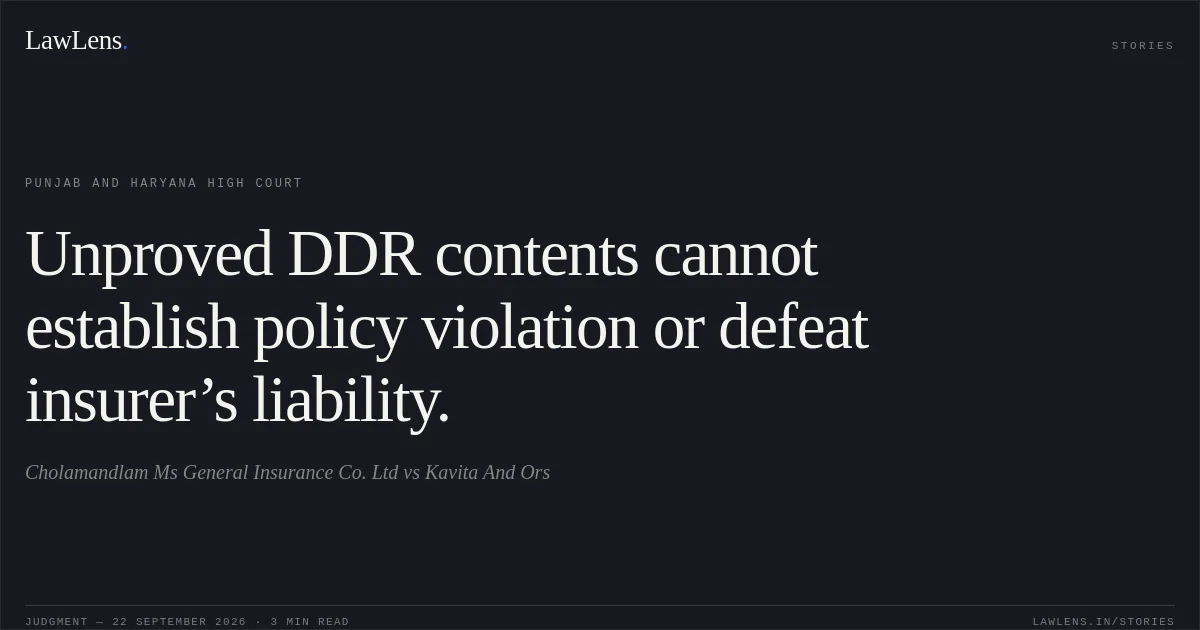
The Court rejected the insurer’s reliance on DDR Ex. P-1 to establish that the vehicle was being used for hire. Although the DDR mentioned such use, the Sub-Inspector who recorded it was not examined, and no statement from any alleged passenger who had hired the vehicle was produced. Consequently, the claimants had no opportunity to cross-examine or rebut that assertion, and the alleged policy violation remained unproved.
Source reference: para. 7The Court further noted that it was undisputed that the deceased had travelled to Badrinath as the vehicle’s driver and was staying at the hotel in that capacity. The insurer had also not put any specific case denying the employer–employee relationship to the claimant during cross-examination. These circumstances supported the Commissioner’s findings regarding employment and the connection of the death with the deceased’s employment. The Commissioner’s factual findings were therefore neither illegal nor perverse.
Source reference: paras. 8, 9Holding
The High Court held that the employer–employee relationship was sufficiently established and that the insurer failed to prove the alleged use of the vehicle for hire and reward or any consequent breach of the insurance policy. No substantial question of law arose for consideration.
The appeal was dismissed, and the Commissioner’s award was affirmed. Pending applications, if any, were also disposed of. The Court further directed that a copy of the order be furnished to the District Legal Services Authority and served upon the claimants.
Source reference: paras. 9–11Original Court PDF
Cholamandlam Ms General Insurance Co. LtdvsKavita And Ors
Click to open original judgment
Original judgment, available to read, download and summarize on LawLens.in