Facts
On 14 January 1997, the informant, Sandeep Kumar, was allegedly filling earth in a lane when co-accused Arjun Singh and Rameshwar Singh caught hold of him and the appellant, Uday Singh, allegedly fired at him with a pistol, causing an injury to his right elbow.
Source reference: no citationA case was registered under Sections 307/34 of the Indian Penal Code and Section 27 of the Arms Act. During the proceedings, the two co-accused died, and the trial continued against the appellant alone.
Source reference: para. 3The prosecution examined eight witnesses, including the injured informant, his family members, the Investigating Officer and a witness concerning his treatment. However, the doctor who examined the informant was not examined.
Source reference: para. 4The Fast Track Court convicted the appellant under Sections 307 and 34 IPC and Section 27 of the Arms Act and sentenced him to seven years’ rigorous imprisonment under Section 307 IPC and three years’ rigorous imprisonment under Section 27 of the Arms Act, with concurrent sentences.
Source reference: para. 2The appellant challenged the conviction on the grounds of unreliable and interested testimony, discrepancies in the prosecution evidence, non-examination of the doctor, and non-recovery of the alleged firearm.
Source reference: paras. 7–8Issues
Whether the prosecution proved beyond reasonable doubt that the appellant fired at the informant with the intention or knowledge necessary to constitute an offence under Section 307 IPC read with Section 34 IPC.
Source reference: paras. 9–14Whether the prosecution established the appellant’s use of a firearm so as to sustain his conviction under Section 27 of the Arms Act.
Source reference: paras. 11–14Whether the ocular testimony of the informant and related witnesses could sustain the conviction in the absence of the examining doctor and recovery of the alleged firearm.
Source reference: paras. 9–13Law Applied
The Court applied Section 307 IPC, which requires proof of an act done with the requisite intention or knowledge to constitute an attempt to murder, read with Section 34 IPC concerning common intention.
Source reference: para. 2It also applied Section 27 of the Arms Act, requiring proof of the prohibited use of a firearm by the accused.
Source reference: paras. 2, 13The Court reiterated that the prosecution bears the burden of proving guilt beyond reasonable doubt and that suspicion, however strong, cannot substitute proof.
Source reference: para. 14Testimony of related or interested witnesses is legally admissible and may support a conviction where it is wholly reliable; however, where such evidence requires material corroboration, deficiencies in the corroborative evidence must be considered.
Source reference: para. 12Medical evidence is particularly material in a firearm-assault case for establishing the nature, location and severity of the injury, although the absence of medical evidence must be assessed with the entire record.
Source reference: paras. 9–10Reasoning
The Court held that the prosecution case substantially rested on the oral testimony of the informant and his related witnesses.
Source reference: paras. 9, 11Although the informant had received treatment, the doctor who examined the alleged injury was not produced, and the witness who testified regarding treatment could not substitute for the examining doctor’s evidence or establish the medical nature and firearm connection of the injury.
Source reference: paras. 9–10, 13The alleged firearm was also not recovered from the appellant, depriving the prosecution of independent corroboration.
Source reference: para. 11The Court further considered the admitted land dispute between the parties, the close relationship of the witnesses with the informant, discrepancies in the ocular evidence, and the fact that the case against the appellant had to stand independently after the death of the co-accused.
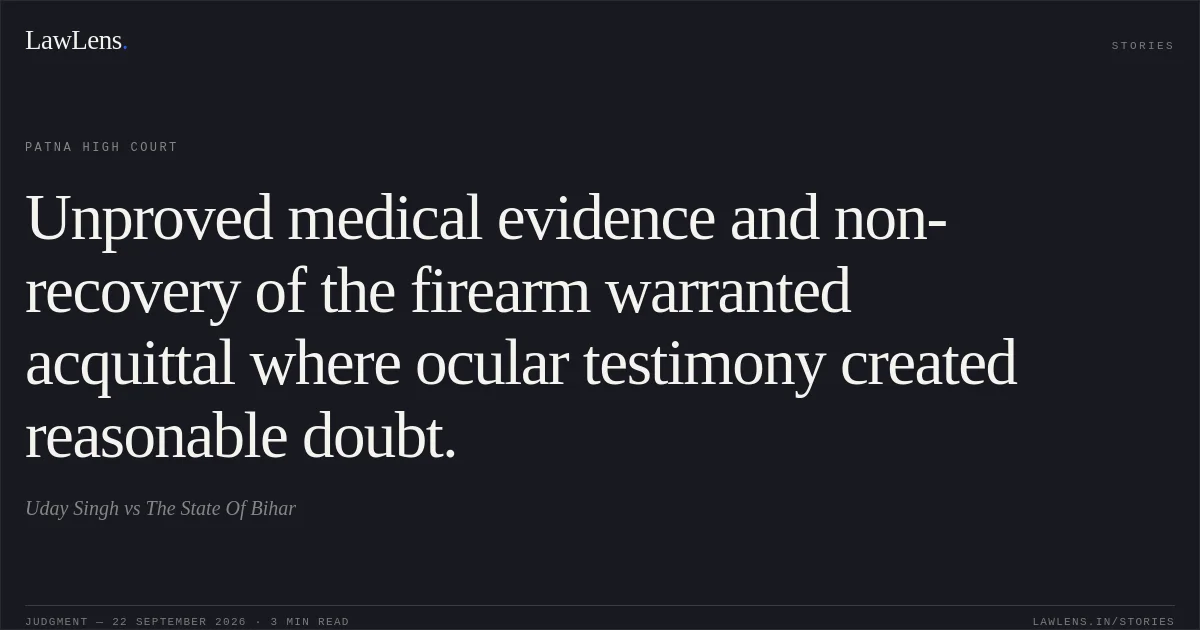
Source reference: paras. 10–14Taken cumulatively, these deficiencies created a reasonable doubt as to whether the appellant had fired the shot with the intention or knowledge required under Section 307 IPC and whether he had used a firearm within the meaning of Section 27 of the Arms Act.
Source reference: paras. 13–14Holding
The Court answered the issues in favour of the appellant and held that the prosecution failed to prove the charges under Sections 307/34 IPC and Section 27 of the Arms Act beyond reasonable doubt.
The judgment of conviction and order of sentence dated 13 February 2018 were set aside; the appellant was acquitted and discharged from the liabilities of his bail bond.
Source reference: paras. 16–17The appeal was accordingly allowed, and any pending interlocutory applications were disposed of.
Source reference: paras. 18–19Acts & Sections Cited
3 provisions across 2 statutes referred to in this judgment. Each provision opens on LawLens.
Indian Penal Code, 18602
Arms Act, 19591
Original Court PDF
Uday SinghvsThe State Of Bihar
Click to open original judgment
Original judgment, available to read, download and summarize on LawLens.in