Facts
The complainant alleged that four persons entered her farmhouse at night, where the appellant threatened and assaulted her, causing injuries, and took her mangalsutra and dorle.
Source reference: para. 2–6Her husband and daughter were also assaulted or restrained.
Source reference: para. 2–6The appellant and one other accused were arrested; the Trial Court convicted the appellant under Section 394 of the Indian Penal Code, 1860 (IPC), and the Bombay High Court affirmed that conviction.
Source reference: para. 2–6The appellant challenged his conviction before the Supreme Court, disputing identification and the proof of robbery.
Source reference: para. 2–6Issues
1. Whether the appellant’s identity as an assailant was proved despite the nighttime occurrence, the assailants’ covered faces, and the absence of a Test Identification Parade.
Source reference: para. 6–72. Whether the evidence proved robbery, an essential element of the appellant’s conviction under Section 394 IPC.
Source reference: para. 9–103. Whether the proved assault and resulting injury supported conviction for a lesser offence, and what sentence was appropriate.
Source reference: para. 10–14Law Applied
Section 394 IPC applies where an offender, while committing or attempting robbery, voluntarily causes hurt; robbery is therefore an essential element of that offence.
Source reference: para. 9Section 222 of the Code of Criminal Procedure, 1973 (CrPC), corresponding to Section 245 of the Bharatiya Nagarik Suraksha Sanhita, 2023, permits conviction for a minor offence where the proved facts establish its elements, even if that offence was not separately charged. The Court relied on Rafiq Ahmed @ Rafi v. State of U.P., which describes this as the principle of cognate offences.
Source reference: para. 10Under Section 320 IPC, fracture or dislocation of a tooth constitutes grievous hurt; such hurt may support conviction under Section 325 IPC.
Source reference: para. 12In sentencing, Mathai v. State of Kerala recognises that, on the particular facts of a case, the substantive sentence may be limited to the period already undergone.
Source reference: para. 13Reasoning
The Court upheld the identification evidence because the complainant promptly named the appellant in the FIR, consistently identified him, and had a close opportunity to observe him during an incident lasting about an hour in a lit porch; her husband and daughter also identified him. The absence of a Test Identification Parade was not fatal in those circumstances.
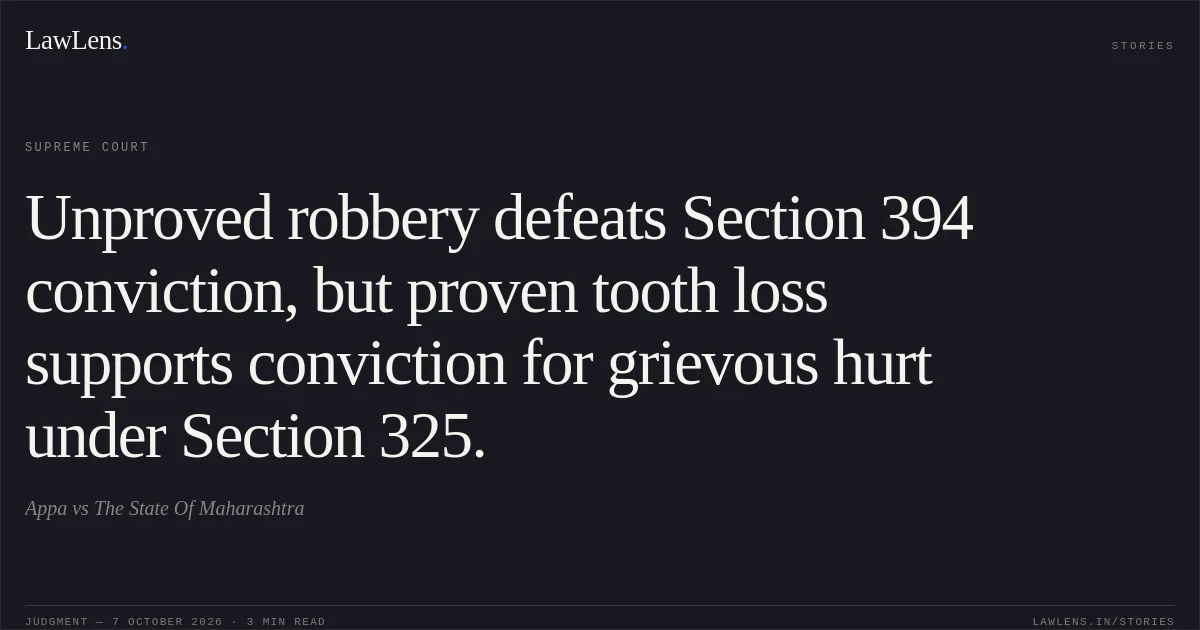
Source reference: para. 7However, the alleged jewellery was not recovered, and the scattered beads and rope found at the scene were not connected by evidence to the complainant’s jewellery. The essential robbery element of Section 394 was therefore not proved.
Source reference: para. 9The Court also declined to convict under Section 326 IPC based on the knife injury, given the absence of a recovered or linked weapon and the relatively shallow wound.
Source reference: para. 11It found, however, that the appellant’s blow caused the complainant’s upper incisor to fall out, an injury established by testimony and medical evidence and amounting to grievous hurt under Section 320 IPC; conviction under Section 325 IPC was therefore appropriate.
Source reference: para. 12Given the appellant’s age, time already served, and the circumstances of the case, the Court reduced the substantive sentence to the period already undergone.
Source reference: para. 13–14Holding
The Supreme Court partly allowed the appeal, set aside the conviction under Section 394 IPC, and convicted the appellant under Section 325 IPC.
It reduced the substantive sentence to the period already undergone, maintained the fine of ₹1,000, and directed that the appellant be released forthwith unless required in custody in another case.
Source reference: para. 15Acts & Sections Cited
8 provisions across 3 statutes referred to in this judgment. Each provision opens on LawLens.
Indian Penal Code, 18606
Code of Criminal Procedure, 19731
Bharatiya Nagarik Suraksha Sanhita, 20231
Original Court PDF
AppavsThe State Of Maharashtra
Click to open original judgment
Original judgment, available to read, download and summarize on LawLens.in