Facts
The petitioners sought a succession certificate under Section 372 of the Indian Succession Act, 1925, for the service and terminal benefits of R. Sundar Singh, who died intestate in 2017.
Source reference: para. 1–2The first petitioner claimed to be his wife and the second petitioner his son. The respondents disputed those claims and asserted that Jayanthi was the deceased’s wife and respondents 2 and 3 were his children.
Source reference: para. 1–2Jayanthi died during the proceedings; her children continued to contest the petition.
Source reference: para. 1–2The Court considered the petition on its own evidentiary record, noting that the respondents’ alleged deed of severance and service records had not been marked as exhibits.
Source reference: para. 11–19The first petitioner relied on a receipt, photograph, birth certificate and other documents; the respondents called one witness but marked no exhibits.
Source reference: para. 17–19Issues
Whether the petitioners had shown, at least prima facie, the best title to the deceased’s estate required for a succession certificate under Section 373(3) of the Indian Succession Act, 1925.
Source reference: para. 20Whether the summary proceedings could determine the disputed validity of the alleged marriage, the second petitioner’s parentage and the rival claimants’ succession status.
Source reference: para. 21, 26, 28Law Applied
Under Sections 372 and 373(3) of the Indian Succession Act, 1925, a succession certificate may be sought by petition, and where the parties’ rights involve questions of law or fact too intricate for summary determination, the Court may nevertheless grant the certificate to the applicant who appears to have prima facie the best title.
Source reference: para. 24, 26, 28Section 387 provides that a decision in succession-certificate proceedings does not bar a subsequent suit to try the same questions.
Source reference: para. 24, 26, 28The Court also considered the statutory frameworks governing the asserted forms of marriage: the Hindu Marriage Act, 1955 applies to marriages between Hindus; the Indian Christian Marriage Act, 1872 governs marriages in Christian form where at least one party is Christian and its requirements are met; and no marriage under the Special Marriage Act, 1954 was pleaded.
Source reference: para. 24, 26, 28Reasoning
The Court found that the first petitioner had not produced reliable prima facie evidence of a legally recognised marriage: the receipt relied on as proof of marriage registration was, on its face and by her admission, a chit-fund fee receipt, and no alleged celebrant or witness was called.
Source reference: para. 22–24Her account described a Christian-form ceremony, although she was Muslim and the deceased Hindu, without establishing compliance with a legally applicable marriage regime.
Source reference: para. 22–24The second petitioner’s birth certificate and Aadhaar card named his father as “Baskar,” while the deceased’s estate was that of R. Sundar Singh; apart from the first petitioner’s uncorroborated testimony, the Court found no satisfactory independent evidence linking the deceased to the second petitioner.
Source reference: para. 25Given these deficiencies and the serious disputes over marital status and parentage, the petitioners had not shown the prima facie best title required for relief in a summary proceeding.
Source reference: para. 26Holding
The Court held that the petitioners had not established a prima facie title sufficient to obtain a succession certificate
It dismissed O.P. No. 588 of 2018 without costs.
Source reference: para. 27–29It made no final determination on either asserted marriage, the second petitioner’s status or the parties’ ultimate succession rights; those matters were left open for adjudication by a competent civil court, consistently with Section 387.
Source reference: para. 27–29Acts & Sections Cited
3 provisions across 1 statute referred to in this judgment. Each provision opens on LawLens.
Indian Succession Act, 19253
Original Court PDF
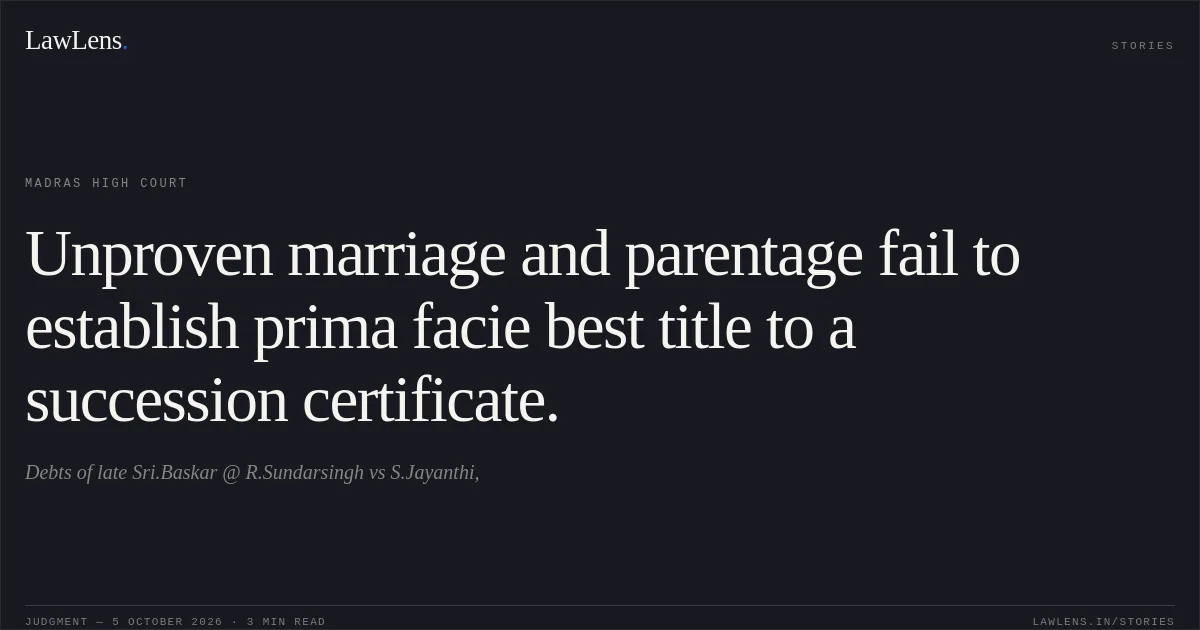
Debts of late Sri.Baskar @ R.SundarsinghvsS.Jayanthi,
Click to open original judgment
Original judgment, available to read, download and summarize on LawLens.in