Facts
The parties married on 15 May 2003 and have three children.
Source reference: paras. 3–5The wife alleged that the husband abused and assaulted her, pressured her to obtain money from her parental family, and left the matrimonial home in October 2015.
Source reference: paras. 3–5She claimed that he had deserted her for about nine years and had not supported or enquired about her and the children.
Source reference: paras. 3–5The husband appeared in the Family Court but did not file a written statement and was proceeded ex parte; the wife’s testimony was the only oral evidence before that court.
Source reference: paras. 6, 13The Family Court dismissed her divorce petition.
Source reference: paras. 1, 7–9, 13On appeal under Section 19(1) of the Family Courts Act, 1984, the High Court considered the wife’s unchallenged testimony and the documents, including her Aadhaar card and a maintenance order.
Source reference: paras. 1, 7–9, 13Issues
1. Whether the Family Court was justified in rejecting the wife’s divorce petition on the grounds of cruelty and desertion
Source reference: para. 10(i)2. Whether the wife was entitled to a decree of divorce
Source reference: para. 10(ii)Law Applied
The appeal was brought under Section 19(1) of the Family Courts Act, 1984.
Source reference: para. 1The judgment does not identify a specific statutory provision governing the substantive grounds for divorce or cite any precedent.
Source reference: no citationIt applies the grounds of cruelty and desertion, assessing the evidence as a whole.
Source reference: no citationThe court treated material, unchallenged testimony as significant where the opposing spouse had an opportunity to contest it but neither effectively challenged it nor adduced evidence; it also considered whether the alleged conduct caused mental agony and distress.
Source reference: paras. 15–20Reasoning
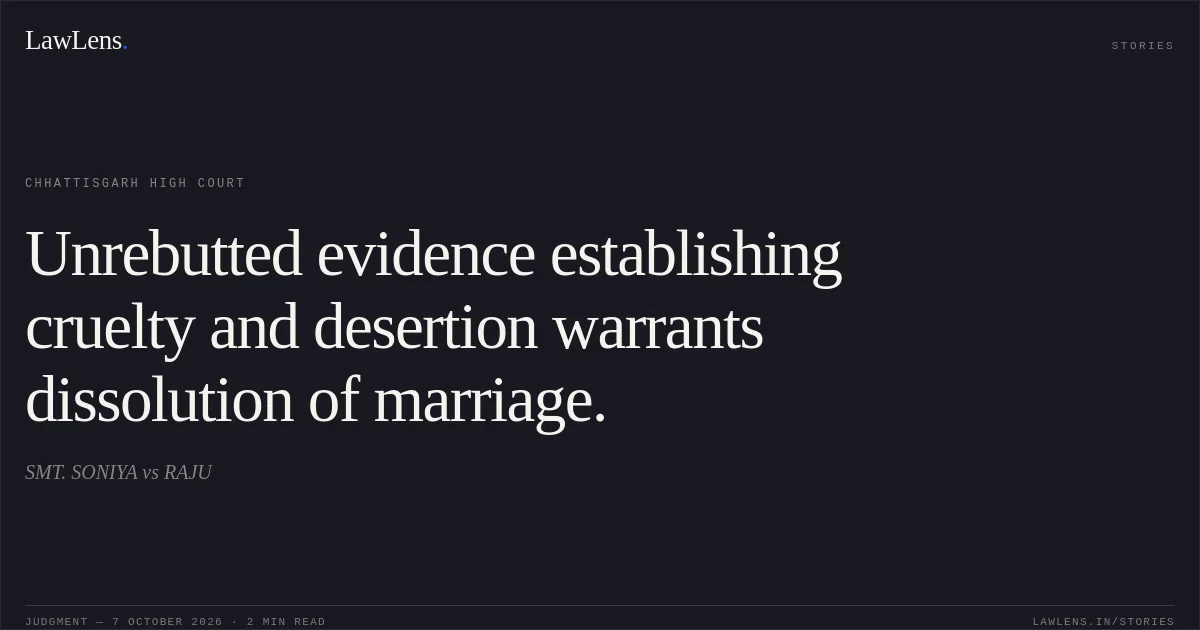
The wife’s testimony that the husband had left her for about nine years and had not enquired about her well-being was uncontroverted, and the husband had not filed a written statement or led evidence.
Source reference: para. 16Her account of assaults, quarrels, pressure to obtain money, and the husband’s departure was supported in part by documents that also remained unchallenged.
Source reference: paras. 17–18The High Court held that the Family Court erred by discounting this evidence because the wife had not convened a social meeting to resolve the dispute.
Source reference: para. 19It found that the husband’s alleged conduct, together with his prolonged failure to fulfil responsibilities towards the wife and children, amounted to cruelty; the prolonged separation and absence of any steps to resume the relationship supported the finding of desertion.
Source reference: paras. 20–22Holding
The High Court allowed the appeal, set aside the Family Court’s judgment and decree, and held that the wife was entitled to a decree of divorce.
The operative paragraph states that the marriage solemnized on 15 May 2023 was dissolved, although the judgment elsewhere records the marriage date as 15 May 2003; this appears to be a clerical inconsistency in the decree.
Source reference: paras. 3, 25Acts & Sections Cited
1 provisions across 1 statute referred to in this judgment. Each provision opens on LawLens.
Family Courts Act, 19841
Original Court PDF
SMT. SONIYAvsRAJU
Click to open original judgment
Original judgment, available to read, download and summarize on LawLens.in