01Facts
The plaintiff, Smt. Athijamma, sued the defendant-appellant, Ramachandra, for vacant possession of the suit building, arrears of rent of Rs.16,500, and mesne profits (O.S. No. 320/2001).
¶ 2 (Trial Court) · ¶ 1 (HC)She claimed the suit property was granted to her husband, G. Ismail, by the Land Tribunal, that Ismail died on 26.02.1995, and that the defendant was a monthly tenant who had paid rent until 1998 and then defaulted.
¶ 2 (Trial Court) · ¶ 1 (HC)The defendant denied any tenancy.
¶ 3 (Trial Court)The defendant pleaded an irrevocable General Power of Attorney (Ex. D-7) dated 16.02.1990, under which Ismail allegedly delivered possession for 30 years, or until repayment of Rs.30,000 with 16% interest, and a supporting agreement dated 17.02.1990 (Ex. D-8) executed by the plaintiff and her children.
¶ 3 (Trial Court)The defendant also claimed Rs.35,000 for renovation.
¶ 3 (Trial Court) · ¶ 37 (Trial Court)The Land Tribunal's Assistant Commissioner had earlier rejected the defendant's occupancy claim (Ex. P-4).
¶ 22 (Trial Court)The Trial Court found the tenancy established, held Ex. D-7 and D-8 invalid and fabricated, and decreed possession and arrears of Rs.16,500.
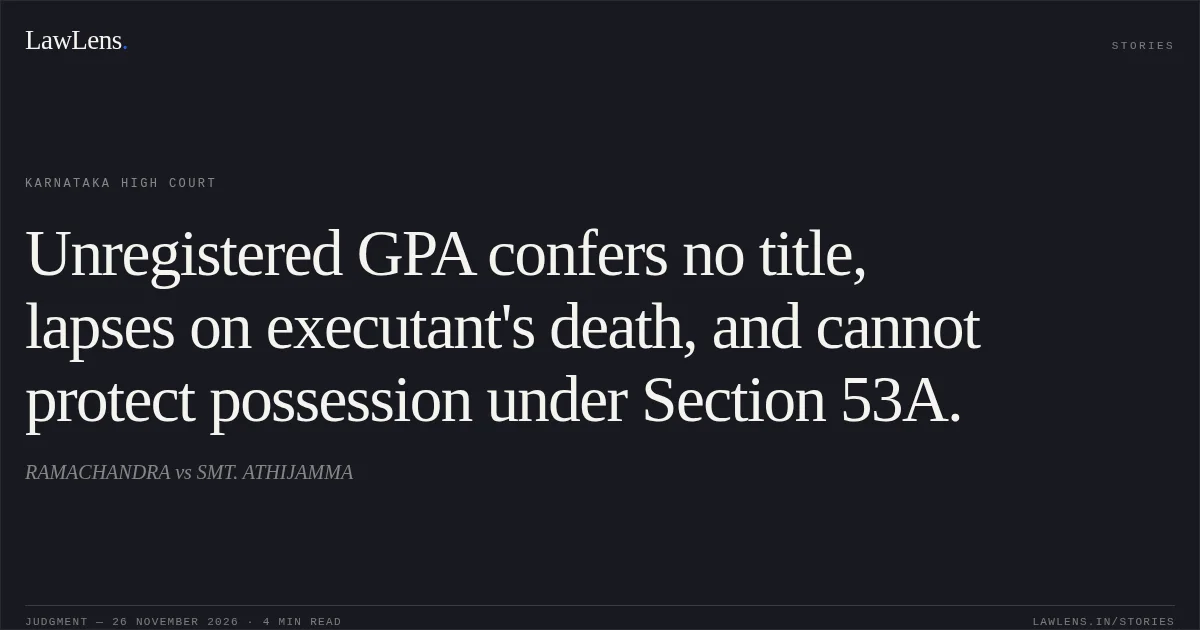
¶ 29–37 (Trial Court) · ¶ 38 (Trial Court)On appeal (R.A. No. 74/2009), the First Appellate Court (Prl. Senior Civil Judge, Belthangady; judgment 08.12.2017) held Ex. D-7 unregistered and incapable of conveying any interest, and held that s.53A of the Transfer of Property Act did not apply.
¶ 16–20 (FAC)The First Appellate Court set aside the arrears decree for want of evidence of the agreed rent, but confirmed the order for possession.
¶ 22 (FAC)The defendant then filed this second appeal under s.100 CPC.
¶ 1 (HC)02Issues
i.1. Whether the defendant established a tenancy or any right to possession under the GPA (Ex. D-7) and agreement (Ex. D-8) so as to resist recovery of possession.
¶ 4, Issues 1–4 (Trial Court) · ¶ 13, Points 1–2 (FAC)ii.2. Whether the defendant's possession is protected under s.53A of the Transfer of Property Act.
¶ 13, Point 1 (FAC) · ¶ 19–20 (FAC)iii.3. Whether the plaintiff is entitled to arrears of rent of Rs.16,500.
¶ 36 (Trial Court) · ¶ 20 (FAC)iv.4. Whether the concurrent findings of the Courts below disclose any substantial question of law warranting interference under s.100 CPC.
¶ 7–8 (HC)03Law Applied
Section 100 CPC: a second appeal lies only on a substantial question of law, and concurrent findings of fact are not disturbed absent perversity or illegality.
¶ 8 (HC)Section 17 of the Registration Act requires compulsory registration of an instrument that acknowledges receipt of consideration for the creation of any right, title or interest in immovable property; the First Appellate Court held that unregistered Ex. D-7 therefore conveyed no title or interest.
¶ 17 (FAC)Following Suraj Lamp & Industries Pvt. Ltd. v. State of Haryana, (2012) 1 SCC 656, a GPA, agreement to sell, or will transaction does not convey title or create an interest in immovable property and is recognised only to the limited extent of s.53A TPA; a GPA is revocable except where coupled with interest, and the donee acts fiduciarily.
¶ 18 (FAC) · ¶ 7 (HC)Section 53A TPA requires a written contract for transfer for consideration, part performance, and the transferee's possession with readiness on the transferor's part.
¶ 19 (FAC)The Trial Court relied on the principle that the GPA lapsed on the executant's death, though no statutory provision was cited.
¶ 25 (Trial Court)A co-owner or wife of the deceased owner may maintain a suit for possession without impleading all co-heirs.
¶ 21 (FAC) · ¶ 37 (Trial Court)Provisions in the judgment · 2 · Linked ones open on LawLens
Code of Civil Procedure, 1908 Section 100
Registration Act, 1908 Section 17
04Reasoning
The Trial Court rejected the defence because Ex. D-7 recorded no consideration receipt, its terms were internally inconsistent (possession was given but the principal could reclaim it on repayment), and the GPA was not disclosed in the Land Tribunal proceedings.
¶ 24, 29, 30 (Trial Court)The Trial Court noted that Ex. D-8 treated the plaintiff as an LR of a living person and was suspicious.
¶ 27, 31 (Trial Court)The First Appellate Court added that Ex. D-7, being unregistered and reciting receipt of Rs.30,000 with a right to repayment and interest, resembled a mortgage, which itself requires registration.
¶ 17 (FAC)Applying Suraj Lamp, the First Appellate Court held the parties' evident intention was a sale, which cannot be effected by an unregistered GPA, so s.53A could not be invoked.
¶ 19–20 (FAC)Possession therefore followed the plaintiff's title as Ismail's widow.
¶ 32 (Trial Court) · ¶ 20 (FAC)On arrears, the First Appellate Court found no evidence of the agreed rent or the amount due, and set aside that decree.
¶ 20 (FAC)The High Court held that the findings of both Courts on the GPA and tenancy were neither perverse nor illegal, and so raised no substantial question of law.
¶ 7 (HC)The High Court did not separately address the arrears finding, which the plaintiff did not challenge in the second appeal.
¶ 8 (HC)05Holding
No substantial question of law arises. Both Courts correctly held that the defendant could not claim tenancy or protection under s.53A on the basis of Ex. D-7, and that the plaintiff is entitled to possession.
¶ 7–8 (HC)The second appeal is dismissed at the admission stage.
¶ 8 (HC)The First Appellate Court's decree stands: the defendant must hand over vacant possession, and the Rs.16,500 arrears decree remains set aside.
¶ 20 (FAC) · ¶ 22 (FAC)Original Court PDF
RAMACHANDRAvsSMT. ATHIJAMMA
Click to open original judgment
Original judgment, available to read, download and summarize on LawLens.in