Facts
The respondents (plaintiffs in O.S. No. 140/2011) claimed title as legal heirs of Bommaya Gounder, whose father Pandara Gounder allegedly acquired the land in 1912 and 1925.
Source reference: p. 5-6The appellants (defendants in O.S. No. 140/2011 and plaintiffs in O.S. No. 31/2012) claimed title via three registered sale deeds from 1982-1983 based on an unregistered partition deed dated 05.10.1982.
Source reference: p. 7, 23While the Trial Court dismissed both suits, the First Appellate Court reversed the dismissal of O.S. No. 140/2011, granting a declaration of title for a restricted area (4.74 acres), and affirmed the dismissal of the appellants' suit for bare injunction (O.S. No. 31/2012).
Source reference: p. 13-14Issues
1. Whether the respondents' suit was barred by limitation under Article 58 of the Limitation Act given the knowledge of fixed survey stones in 2006?
Source reference: p. 4, para. 3(i); p. 232. Whether P. Bommaya Gounder and the respondents’ predecessor are the same person, particularly regarding the validity of the genealogy rejected by the Tahsildar?
Source reference: p. 4, para. 3(ii); p. 113. Whether the suit for bare injunction (O.S. No. 31/2012) was maintainable without seeking a declaration of title when a cloud on title existed?
Source reference: p. 17; p. 284. Whether the First Appellate Court could "mould the relief" by granting a declaratory right for a lesser extent than originally prayed for?
Source reference: p. 15, 25Law Applied
Section 34 of the Specific Relief Act, 1963, which bars a mere declaration where the plaintiff is able to seek further relief but omits to do so.
Source reference: p. 20, 29Principles from Anathula Sudhakar v. P. Buchi Reddy, establishing that a suit for bare injunction is not maintainable when there is a serious cloud on the title.
Source reference: p. 20, 29Section 17 of the Registration Act, 1908, and Section 35 of the Indian Stamp Act, 1899, holding that unregistered and unstamped partition deeds are inadmissible to prove title.
Source reference: p. 29-30Article 58 of the Limitation Act, 1963, where the three-year period for declaration runs from the date the right to sue "first accrues," interpreted here as the date of actual knowledge of the adverse documents.
Source reference: p. 24The court can grant a "lesser relief" than prayed for, as supported by Kesavalu Naidu v. Doraiswami Naidu.
Source reference: p. 31Reasoning
The Court found that the respondents proved their lineage through a legal heir certificate (Ex.A9) and established a chain of title back to 1919-1925 via patta and adangal records (Ex.A1-A6).
Source reference: p. 27The appellants' title was deemed defective because their 1982-1983 sale deeds relied on an unregistered 1982 partition deed (Ex.A16) that failed to trace any relationship to the original owner, Pandara Gounder.
Source reference: p. 23, 30Regarding limitation, the Court upheld the First Appellate Court’s finding that the cause of action accrued in 2010 upon the discovery of the sale deeds through an Encumbrance Certificate, not in 2006 when survey stones were fixed, as the lands were barren.
Source reference: p. 24The Court rejected the appellants' suit for bare injunction, noting they suppressed the existence of the title dispute (O.S. 140/2011), thereby failing the Anathula Sudhakar test.
Source reference: p. 28-29The "moulding of relief" was held proper as the respondents filed a memo voluntarily restricting their claim to the area occupied by the appellants.
Source reference: p. 25-26Holding
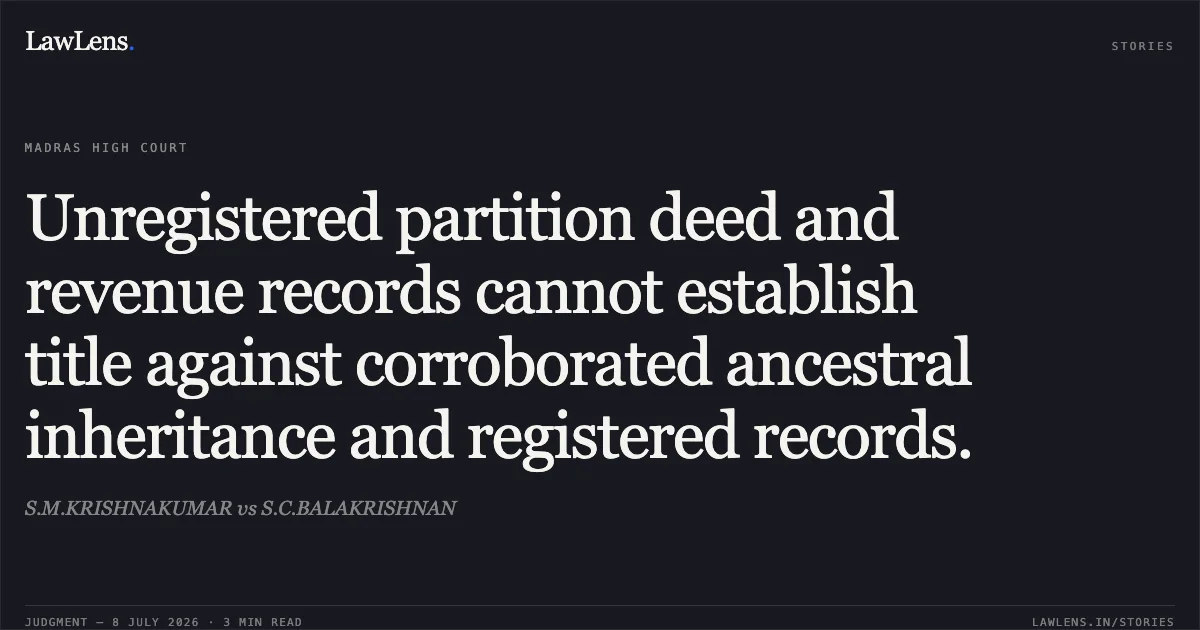
The respondents' suit was within the limitation period as it was filed within three years of gaining knowledge of the adverse sale deeds.
The appellants' suit for bare injunction was not maintainable without a prayer for declaration given the clear cloud on title.
Source reference: p. 29The court is duty-bound to grant a lesser relief (title over 4.74 acres) when the larger relief is not made out but the entitlement to the smaller portion is proved.
Source reference: p. 31-32The High Court dismissed both Second Appeals and confirmed the First Appellate Court’s judgment, answering all substantial questions of law against the appellants.
Source reference: p. 32Acts & Sections Cited
5 provisions across 5 statutes referred to in this judgment. Each provision opens on LawLens.
Code of Civil Procedure, 19081
Specific Relief Act, 19631
Limitation Act, 19631
Registration Act, 19081
Indian Stamp Act, 18991
Original Court PDF
S.M.KRISHNAKUMARvsS.C.BALAKRISHNAN
Click to open original judgment
Original judgment, available to read, download and summarize on LawLens.in


![Authorities must decide pensionary and retiral-benefit claims through a reasoned order within eight weeks.. Habibullah khan vs HOME DEPARTMENT. CAT - ['Srinagar']. LawLens](/stories/thumbnails/authorities-must-decide-pensionary-and-retiral-benefit-claims-through-a-reasoned-order-wit-d0cbe8a8119c48fbabe7df9f2d353488.webp)