Facts
The suit properties formed part of land originally assigned by the Government to Kulandaipaiyan under a conditional D-Card patta dated 15 February 1958.
Source reference: p. 4After his wife predeceased him and he died issueless on 4 September 1999, the plaintiff alleged that defendants 1–3, being Kulandaipaiyan’s legal heirs, became owners of the property.
Source reference: p. 11The plaintiff, who was the first defendant’s son, claimed that defendants 1–3 conveyed 0.76 acres to him for ₹25,000 under an unregistered sale deed dated 22 August 2000, delivered possession, and handed over the title documents.
Source reference: p. 5; para. 14The plaintiff alternatively claimed that, having remained in exclusive and uninterrupted possession since 22 August 2000 and having paid kist, he had perfected title by adverse possession.
Source reference: p. 5In 2017, defendants 1–3 allegedly asserted title and executed subsequent sale deeds in favour of defendants 12 and 13.
Source reference: pp. 5–8The plaintiff therefore sought declaration of title, permanent injunction against defendants 1–13, and an injunction restraining the Sub-Registrar from registering documents relating to the property.
Source reference: p. 3The Principal District Court, Krishnagiri, dismissed the suit in O.S. No. 3 of 2018 on 10 August 2022, holding that the plaintiff had taken inconsistent pleas and had failed to prove adverse possession beyond producing a kist receipt.
Source reference: p. 9; para. 7The plaintiff preferred the present appeal under Section 96 read with Order XLI Rule 1 CPC.
Source reference: p. 3Issues
Whether the plaintiff was entitled to a declaration of title and permanent injunction in respect of the suit property?
Source reference: p. 11; para. 12(I)Whether the plaintiff had perfected title to the suit property by adverse possession?
Source reference: p. 11; para. 12(II)Law Applied
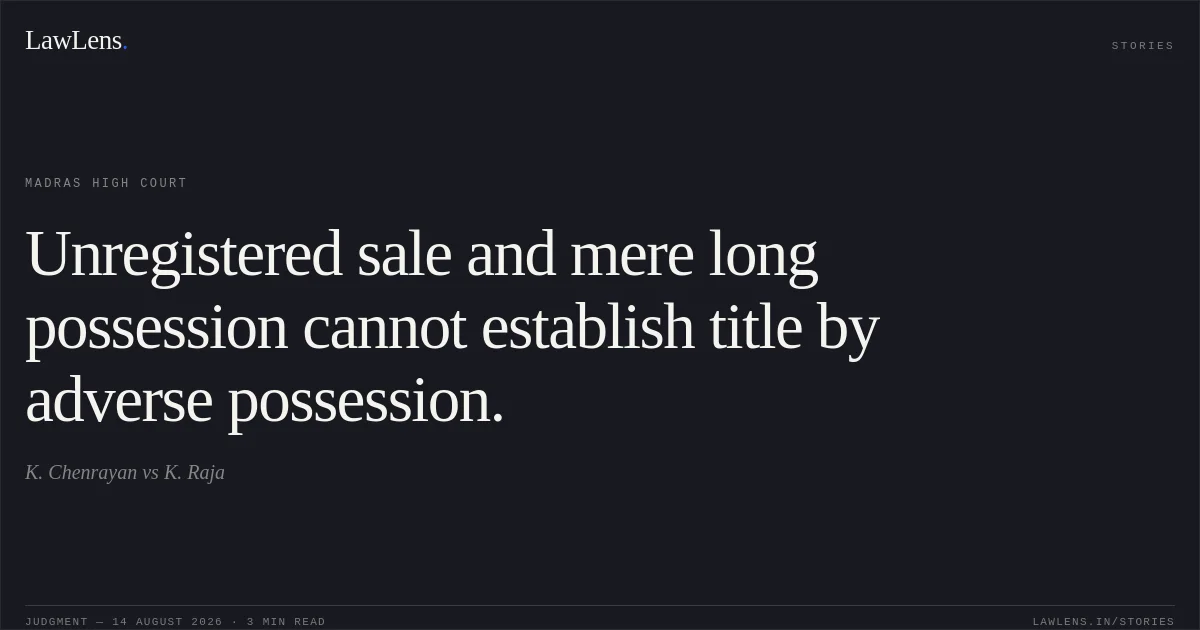
The Court applied the principles governing adverse possession, namely that possession must be actual, exclusive, open, continuous, peaceful, hostile to the true owner, and accompanied by clear animus possidendi.
Source reference: pp. 14–15; para. 19Relying on Karnataka Board of Wakf v. Government of India, (2004) 10 SCC 779, the Court held that a claimant must establish when possession commenced, its nature, the true owner’s knowledge of the adverse claim, its duration, and that it remained open and undisturbed.
Source reference: pp. 14–15; para. 19The Court also relied on Smt. Mamutha Bai v. G. Ramakrishnan, 2024 (3) CTC 622, which states that long possession, permissive possession, mutation of revenue records, and payment of kist alone do not establish adverse possession; specific pleadings and substantive evidence of hostile possession are required.
Source reference: p. 15; para. 20The Court further applied the principle that a party cannot simultaneously assert title under a sale transaction and claim title by adverse possession on an inconsistent basis.
Source reference: pp. 12–13; paras. 15–16Reasoning
The plaintiff relied on Ex. A1, the unregistered sale deed dated 22 August 2000, as the source of his claim and possession, while also asserting that his possession had become adverse to defendants 1–3 from the same date.
Source reference: pp. 12–13; paras. 15–16The Court treated these pleas as inconsistent because possession under an asserted sale transaction was not, without more, hostile possession denying the vendors’ title.
Source reference: pp. 12–13; paras. 15–16The plaintiff’s own evidence showed that his adverse-possession claim was based on Ex. A1 rather than on an independently established hostile assertion of ownership.
Source reference: p. 13; para. 16The only significant document relied upon to prove possession was Ex. A6, a kist receipt dated 18 January 2002.
Source reference: p. 15; para. 20The Court held that payment of kist, custody of original title documents, mutation or revenue entries, and long possession are insufficient unless the claimant proves that denial of the true owner’s title was clearly brought to the owner’s knowledge.
Source reference: pp. 15–16; paras. 20–21Conversely, defendants 1–3 produced documents indicating their joint possession and enjoyment of the property, and they subsequently executed registered sale deeds in favour of defendants 12 and 13.
Source reference: pp. 13–14; para. 17The plaintiff therefore failed to establish the necessary continuity, exclusivity, publicity, and hostile intention required for adverse possession.
Source reference: pp. 15–16; paras. 20–21Holding
The Court answered both issues against the plaintiff.
It held that the plaintiff failed to prove either title under the unregistered sale deed or title by adverse possession, and consequently was not entitled to declaration or permanent injunction.
Source reference: p. 16; para. 22The appeal was dismissed, the judgment and decree dated 10 August 2022 in O.S. No. 3 of 2018 were confirmed, and no costs were awarded.
Source reference: p. 16; para. 23The connected miscellaneous petitions were closed.
Source reference: p. 16; para. 23Acts & Sections Cited
1 provisions across 1 statute referred to in this judgment. Each provision opens on LawLens.
Code of Civil Procedure, 19081
Original Court PDF
K. ChenrayanvsK. Raja
Click to open original judgment
Original judgment, available to read, download and summarize on LawLens.in