Facts
The petitioner, while serving as Sub-Divisional Police Officer (SDPO) in Katihar, was issued a memo of charge on 31.07.2019 alleging poor performance and inefficiency
Source reference: para. 3The petitioner retired on 31.12.2019, yet the State continued departmental proceedings under Rule 43(b) of the Bihar Pension Rules.
Source reference: para. 4The Inquiry Officer found the charges of "unsatisfactory work" only partially proved
Source reference: para. 4Consequently, the State Government issued the impugned order dated 05.07.2024, imposing a permanent 10% deduction from the petitioner's pension
Source reference: para. 4The petitioner challenged this as being contrary to the statutory requirements of "grave misconduct" or "pecuniary loss"
Source reference: para. 5Issues
1. Whether the allegations of "poor performance" or "inefficiency" satisfy the legal threshold of "grave misconduct" required to invoke Rule 43(b) of the Bihar Pension Rules
Source reference: para. 5, 112. Whether the State can withhold pension under Rule 43(b) in the absence of a finding of pecuniary loss caused to the Government
Source reference: para. 5, 18Law Applied
Rule 43(b) of the Bihar Pension Rules, 1950, which mandates that pension can only be withheld if the pensioner is found guilty of "grave misconduct" or has caused "pecuniary loss to Government by misconduct or negligence"
Source reference: para. 12Union of India v. J. Ahmed (1979), which established that lack of efficiency or failure to attain the highest standards of performance does not ipso facto constitute "misconduct"
Source reference: para. 17Ganesh Prasad Yadav v. State of Bihar (2021) and State of Bihar v. Arun Kumar Dubey (2023), which affirm that unless the consequences of negligence are irreparable or result in heavy damage, simple negligence or error of judgment cannot be categorized as grave misconduct for pensionary deductions
Source reference: para. 14, 16Reasoning
The Court examined the inquiry report and the impugned order, noting that the State’s primary grievance was the petitioner's alleged inefficiency and the pace of case disposal
Source reference: para. 3, 4"misconduct" implies a wrongful intention or a forbidden act, whereas the present charges pertained merely to unsatisfactory work or negligence in performance
Source reference: para. 14, 15Applying the J. Ahmed precedent, the Court found that since there was no evidence of "grave misconduct"—meaning acts arising from ill-motive or causing atrocious consequences—the statutory hurdle of Rule 43(b) was not crossed
Source reference: para. 17, 18the Court observed that the State failed to demonstrate any pecuniary loss caused to the treasury, which is a prerequisite for recovery under the said Rules
Source reference: para. 18the imposition of a penalty for mere "inefficiency" was held to be a misapplication of the law.
Source reference: no citationHolding
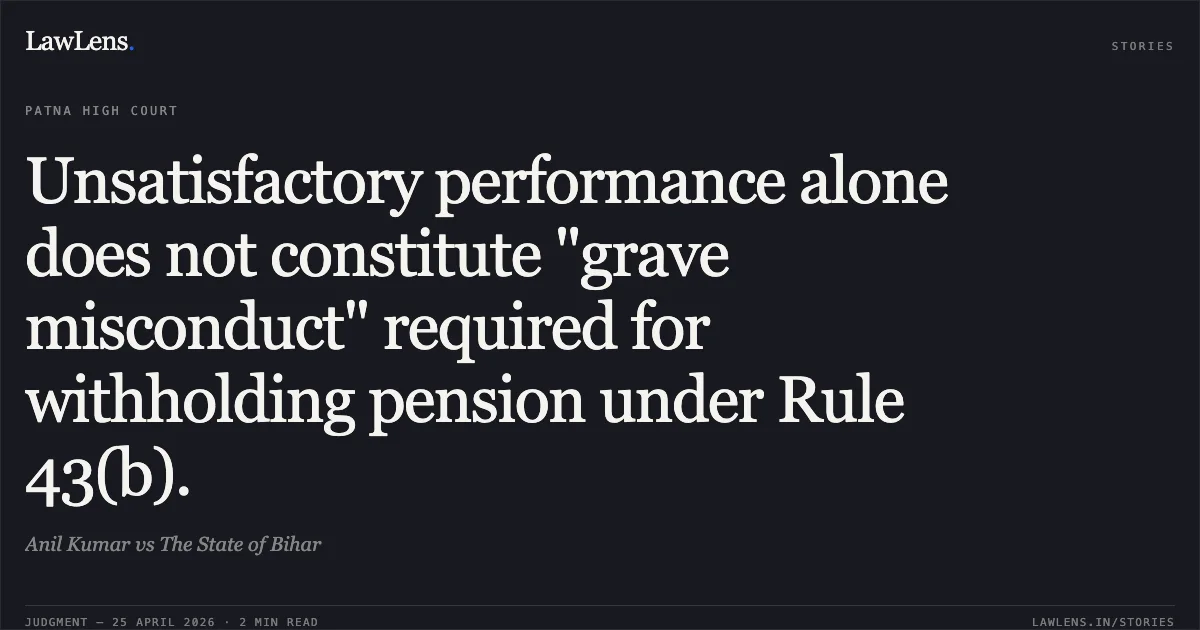
The Court answered both issues in the negative, holding that "poor performance" does not equate to "grave misconduct" under Rule 43(b)
The Court quashed the impugned order (Memo No. 7406 dated 05.07.2024) and declared the 10% pension deduction unsustainable and arbitrary
Source reference: para. 19, 20The Respondent authorities were directed to release the withheld amount of pension to the petitioner within three months of the order
Source reference: para. 20Acts & Sections Cited
2 provisions across 1 statute referred to in this judgment. Linked provisions open on LawLens.
Bihar Pension Rules, 19502
Original Court PDF
Anil KumarvsThe State of Bihar
Click to open original judgment
Original judgment, available to read, download and summarize on LawLens.in


![Subsequent exoneration does not retrospectively invalidate a finalized promotion select list.. UNNIKRISHNAN M vs M/o Environment And Forests. CAT - ['Ernakulam']. LawLens](/stories/thumbnails/subsequent-exoneration-does-not-retrospectively-invalidate-a-finalized-promotion-select-li-ce80a0e84f2f4887857271e8b4341c42.webp)