Facts
The Appellant, a Japanese multinational automobile manufacturer, adopted the mark ‘ALPHARD’ in 1986 and launched a luxury multi-purpose vehicle (MUV) under the mark globally in 2002
Source reference: p. 2, 4While not formally launched in India, the vehicles were available via direct imports by private parties as early as 2008
Source reference: p. 5, 39The Respondent No. 1 secured registrations for 'ALPHARD' in India in 2015 on a "proposed to be used" basis for Classes 9, 12, and 27
Source reference: p. 3, 5The Appellant filed rectification petitions under Section 57 of the Trade Marks Act, 1999, which were dismissed by a Single Judge on the grounds that the Appellant failed to establish sufficient territorial reputation in India prior to the Respondent’s adoption
Source reference: p. 6The Appellant challenged this dismissal in the present Letters Patent Appeal (LPA).
Source reference: no citationIssues
1. Whether the Appellant’s mark ‘ALPHARD’ had acquired a trans-border reputation and goodwill in India prior to the Respondent’s registration in 2015
Source reference: p. 37 / para. 612. Whether the Respondent’s adoption of an identical mark for identical/cognate goods was bona fide or constitutes misappropriation under Section 11 of the Act
Source reference: p. 45 / para. 843. Whether the impugned mark is liable to be removed from the Register under Section 57 for "wrongly remaining" due to relative grounds of refusal
Source reference: p. 27 / para. 5.4Law Applied
The Court primarily applied Section 57 of the Trade Marks Act, 1999, regarding the power to rectify the register if a mark “wrongly remains”
Source reference: p. 26Section 11, which defines relative grounds for refusal, specifically Section 11(6)-(10) regarding factors for determining a “well-known” trade mark
Source reference: p. 31Territoriality Principle as established in Toyota Jidosha Kabushiki Kaisha v. Prius Auto Industries Ltd. (2018), which requires proof of spill-over reputation in India
Source reference: p. 42Definition of "Use" under Section 2(2)(c)(ii) as enlightened in Trustees of Princeton University v. Vagdevi Educational Society, holding that "use" includes any public statement associating the mark with the goods, not just physical sales by the proprietor
Source reference: p. 47-48Reasoning
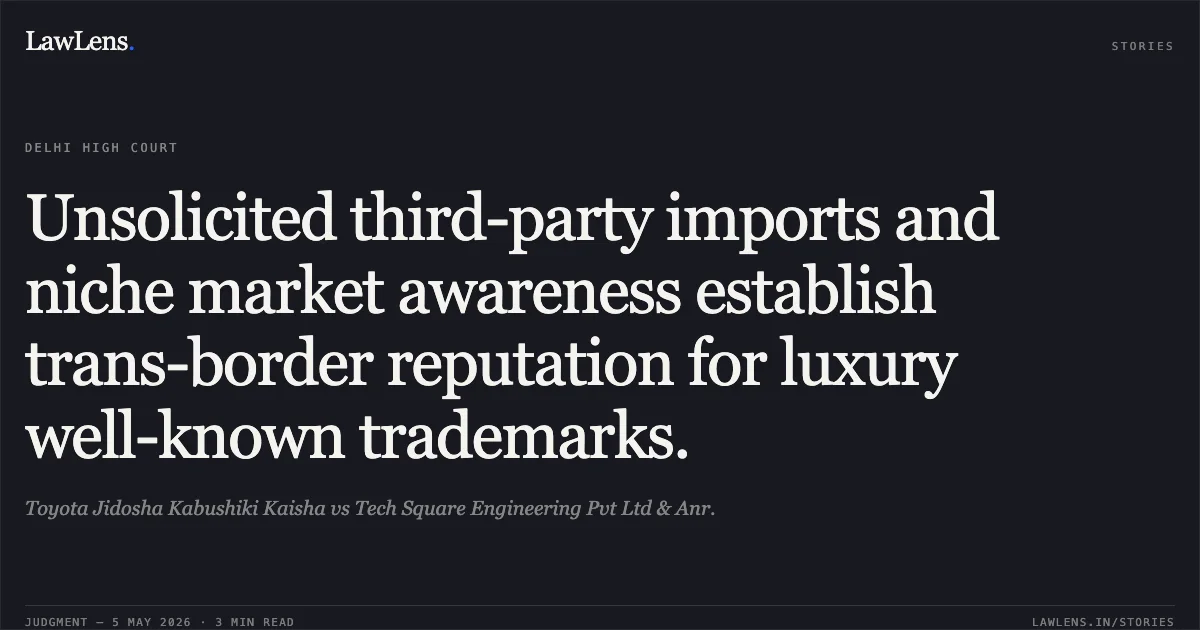
The Court found that the Single Judge erred by requiring "mass-market penetration" to prove reputation. It held that for niche luxury goods, voluntary third-party imports (such as those by high-profile individuals like Gautam Adani) and media coverage in automotive blogs (Team BHP, etc.) constitute "compelling proof" of goodwill within the relevant consumer segment
Source reference: p. 40-41, 44Distinguishing the Prius case, the Court noted that the Appellant provided substantial evidence of Indian awareness and imports dating back to 2008—well before the Respondent's 2015 application
Source reference: p. 43The Court further analyzed the Respondent’s conduct, noting that adopting an identical mark in the same industry is rarely fortuitous; the Respondent’s inconsistent claims of "coining" the mark versus it being a "stellar name" undermined their bona fides
Source reference: p. 45Additionally, the Respondent failed to prove "use" because their invoices were issued by a third party ("Tekstar Global") without proving a legal nexus or "sister concern" status
Source reference: p. 46Holding
The Court allowed the appeal and set aside the Single Judge's judgment. It held that the Appellant’s mark ‘ALPHARD’ was a "well-known" trade mark in India at the time of the Respondent’s application
Consequently, the Respondent’s registrations (Nos. 3093216, 3093218, 3093219) were declared invalid under Section 11 and ordered to be removed from the Register under Section 57. The Registrar of Trade Marks was directed to rectify the Register immediately
Source reference: p. 50 / para. 102, 104Acts & Sections Cited
8 provisions across 1 statute referred to in this judgment. Each provision opens on LawLens.
Trade Marks Act, 19998
Original Court PDF
Toyota Jidosha Kabushiki KaishavsTech Square Engineering Pvt Ltd & Anr.
Click to open original judgment
Original judgment, available to read, download and summarize on LawLens.in