Facts
The petitioner filed O.S. No. 387 of 2022 seeking declaratory and injunctive relief concerning a compound wall and construction on the suit property.
Source reference: para. 2–5The Trial Court rejected his application for temporary injunction under Order XXXIX Rules 1 and 2 CPC.
Source reference: para. 2–5He appealed under Order XLIII Rule 1 read with Section 104 CPC, but filed the appeal 244 days out of time and sought condonation under Section 5 of the Limitation Act.
Source reference: para. 6–12He attributed the delay to ill health and loss of contact with his counsel; the respondent disputed the claim and noted the absence of supporting medical documents.
Source reference: para. 6–12The Appellate Court dismissed the condonation application and consequently the appeal. The petitioner then sought relief under Article 227 of the Constitution.
Source reference: para. 7–8Issues
Whether the petitioner established sufficient cause under Section 5 of the Limitation Act to condone the 244-day delay in filing the miscellaneous appeal.
Source reference: para. 10–14Whether the Appellate Court’s refusal to condone the delay disclosed grounds for interference under Article 227 of the Constitution.
Source reference: para. 13–16Law Applied
Section 5 of the Limitation Act permits condonation of delay where sufficient cause is shown.
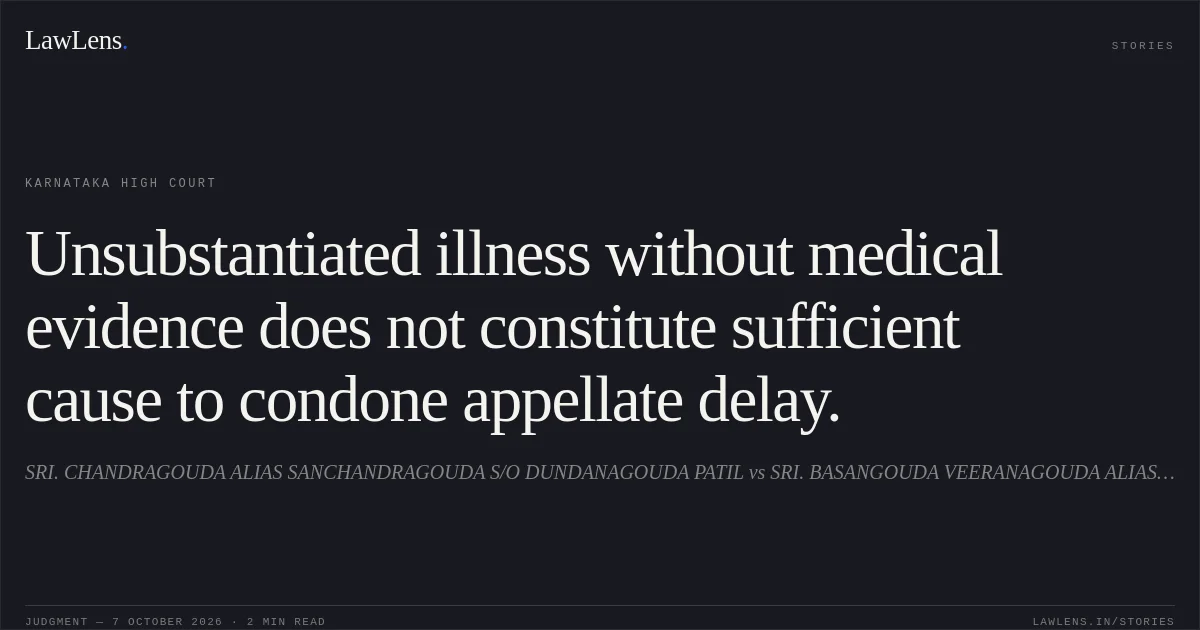
Source reference: no citationIn this case, the Court treated an unsupported assertion of illness as insufficient where the petitioner produced no medical document for the relevant period or details of the illness and treatment.
Source reference: para. 14–15The Court considered its supervisory jurisdiction under Article 227 and found no error warranting interference with the impugned order.
Source reference: para. 15–17The judgment cites no precedent.
Source reference: no citationReasoning
The petitioner relied on his age and alleged ill health, asserting that he had lost contact with his counsel and could not give instructions to file the appeal.
Source reference: para. 11–14The Court found that he had produced no medical evidence for the relevant period, 14 October 2022 to 15 June 2023, and had not adequately explained the nature or duration of his treatment.
Source reference: para. 11–14It therefore held that the illness claim was a bald statement and that the Appellate Court was justified in finding no sufficient cause to condone the delay.
Source reference: para. 15–16In the absence of error in that decision, supervisory interference was unwarranted.
Source reference: para. 15–16Holding
The Court answered the question of interference in the negative and dismissed the writ petition.
The Appellate Court’s dismissal of the Section 5 application, and consequently the miscellaneous appeal, remained undisturbed; pending interlocutory applications were also dismissed.
Source reference: para. 17–18Acts & Sections Cited
2 provisions across 2 statutes referred to in this judgment. Each provision opens on LawLens.
Limitation Act, 19631
Code of Civil Procedure, 19081
Original Court PDF
SRI. CHANDRAGOUDA ALIAS SANCHANDRAGOUDA S/O DUNDANAGOUDA PATILvsSRI. BASANGOUDA VEERANAGOUDA ALIAS IRANAGOUDA PATIL
Click to open original judgment
Original judgment, available to read, download and summarize on LawLens.in