Facts
The appellant was prosecuted for allegedly taking the victim, stated by the prosecution to be approximately 14 years old, from her village on two occasions in July 2019 and sexually assaulting her while keeping her at his house and later in a rented room.
Source reference: paras. 4–5The victim’s mother lodged the report on 22.12.2019, leading to registration of offences under Sections 363, 366 and 376 of the IPC and Sections 5 and 6 of the POCSO Act.
Source reference: paras. 4–5The prosecution relied, inter alia, on the victim’s testimony, her Section 164 Cr.P.C. statement, medical reports, the school Admission and Withdrawal Register, and her Class VIII mark-sheet recording her date of birth as 16.07.2005.
Source reference: paras. 7–8, 21, 31The trial Court convicted the appellant under Sections 363 and 366 IPC and Section 6 of the POCSO Act, sentencing him to concurrent terms of two years, five years and twenty years’ rigorous imprisonment respectively.
Source reference: para. 3The appellant challenged the conviction, principally contending that the prosecution had failed to prove the victim’s minority and that her testimony was not reliable or corroborated by medical or forensic evidence.
Source reference: paras. 14–16Issues
Whether the prosecution proved beyond reasonable doubt that the victim was below 18 years of age on the date of the alleged incident, so as to attract the POCSO Act?
Source reference: paras. 20–25, 30–33Whether the evidence established the offences of kidnapping, abduction and sexual assault against the appellant beyond reasonable doubt?
Source reference: paras. 34–49Law Applied
The Court considered the offences under Sections 363 and 366 IPC and Section 6 of the POCSO Act, along with the appellate jurisdiction under Section 374(2) Cr.P.C.
Source reference: no citationAn entry in a public or official register may be admissible under Section 35 of the Indian Evidence Act, but its probative value depends upon proof of the source and basis of the entry.
Source reference: paras. 26–27Relying on Ravinder Singh Gorkhi v. State of U.P., Birad Mal Singhvi v. Anand Purohit, and Alamelu v. State, the Court held that a school record cannot conclusively establish age where the person who supplied the date of birth or made the entry is not examined and the foundational material is not proved.
Source reference: paras. 26–27The Court also relied on Rishipal Singh Solanki v. State of Uttar Pradesh and P. Yuvaprakash v. State, which recognise the evidentiary hierarchy for age determination and require reliance on credible school, matriculation or birth records before resorting to medical assessment.
Source reference: paras. 28–29Conviction for sexual assault may rest solely on the victim’s testimony if it is wholly reliable and inspires confidence; however, corroboration becomes material where the testimony suffers from material infirmities, omissions or improbabilities.
Source reference: paras. 43–44The prosecution must prove guilt beyond reasonable doubt, and reasonable doubt must enure to the accused’s benefit.
Source reference: para. 49Reasoning
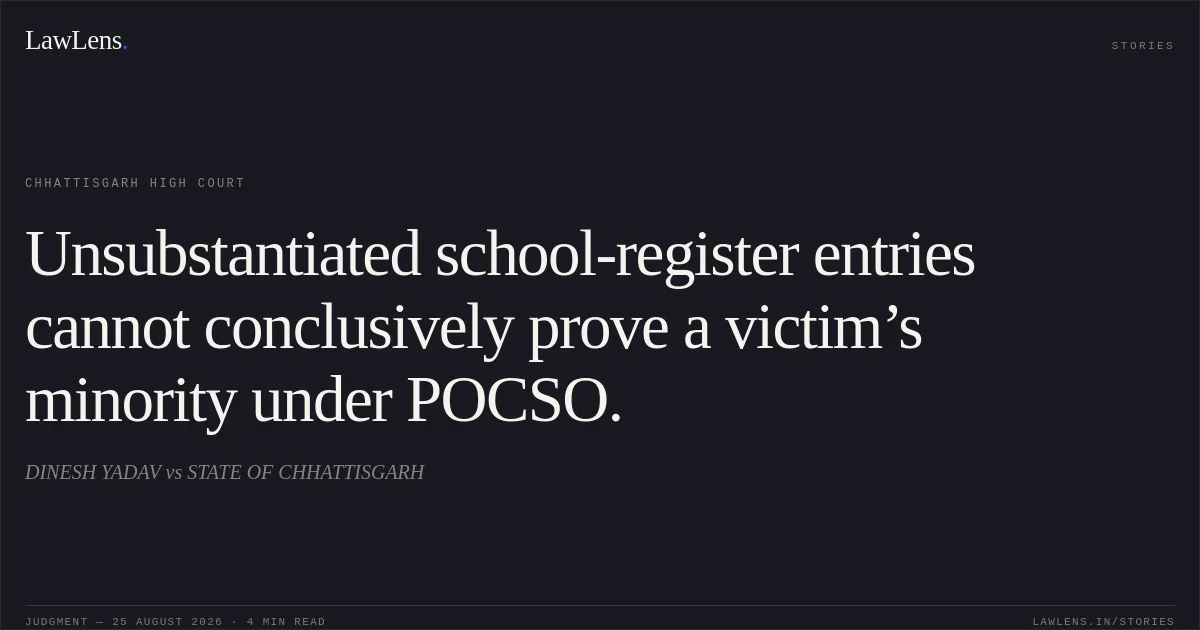
The Court found that the prosecution failed to establish the victim’s age beyond reasonable doubt.
Source reference: paras. 22–25, 30–33Although the victim’s school register and mark-sheet recorded her date of birth as 16.07.2005, the Assistant Teacher who testified about the register admitted that he had neither made the entry nor knew the document or source on which it was based.
Source reference: paras. 22–25The parents also lacked personal knowledge of her exact date of birth, and no birth certificate, contemporaneous public record or medical age-determination evidence was produced.
Source reference: paras. 22–25, 30–33The Court therefore held that the school documents, by themselves, could not conclusively prove minority.
Source reference: paras. 30–33The victim’s testimony regarding forcible intercourse was also found insufficiently reliable: she travelled with the appellant without raising an alarm, encountered several persons on the way, remained with him for a considerable period, and did not disclose the alleged assault despite opportunities to do so.
Source reference: paras. 35–36, 45The medical examination disclosed an old torn hymen and previous sexual intercourse, but no external or internal injuries or physical signs of forcible intercourse; the FSL report detected no semen stains or spermatozoa.
Source reference: paras. 38–42, 46–47While these circumstances were not treated as independently conclusive, the Court held that, cumulatively with the omissions, inconsistencies and conduct attributed to the victim, they created a reasonable doubt that her testimony was sufficiently reliable to sustain the conviction.
Source reference: paras. 45–49Holding
The Court answered both issues in favour of the appellant.
It held that the prosecution had not proved that the victim was below 18 years of age and had also failed to establish the charged offences beyond reasonable doubt.
Source reference: paras. 33, 48–49The appeal was allowed, the judgment of conviction and order of sentence dated 10.02.2022 were set aside, and the appellant was acquitted of all charges.
Source reference: para. 50As he was reportedly in custody, the Court directed that he be released forthwith unless required in another case.
Source reference: para. 50He was further directed to furnish a bond of Rs. 25,000 with one surety for six months under Section 437-A Cr.P.C., corresponding to Section 481 of the BNSS, 2023.
Source reference: para. 51Acts & Sections Cited
12 provisions across 5 statutes referred to in this judgment. Each provision opens on LawLens.
Code of Criminal Procedure, 19734
Indian Penal Code, 18603
Juvenile Justice (Care and Protection of Children) Act, 2015.2
Bharatiya Nagarik Suraksha Sanhita, 20231
Original Court PDF
DINESH YADAVvsSTATE OF CHHATTISGARH
Click to open original judgment
Original judgment, available to read, download and summarize on LawLens.in
![Courts will not interfere with transfers absent mala fides or violation of statutory rules.. M Ramya vs EMPLOYEES STATE INSURANCE CORPORATION (ESIC). CAT - ['Chennai']. LawLens](/stories/thumbnails/courts-will-not-interfere-with-transfers-absent-mala-fides-or-violation-of-statutory-rules-a6845e9ca6f548fca284c51c8351957f.webp)
![Courts cannot direct one-time recruitment age relaxation absent authority in the governing rules or advertisement.. UT OF PUDUCHERRY vs M ANDAL. CAT - ['Chennai']. LawLens](/stories/thumbnails/courts-cannot-direct-one-time-recruitment-age-relaxation-absent-authority-in-the-governing-895d78fde47143e2a8ed0207c4b6a44f.webp)
![A review cannot correct an allegedly erroneous decision absent an error apparent on the record.. Ajit Kumar Jha vs RAILWAY BOARD. CAT - ['Delhi']. LawLens](/stories/thumbnails/a-review-cannot-correct-an-allegedly-erroneous-decision-absent-an-error-apparent-on-the-re-8ac952fd4eba470c92f7da20af72a220.webp)