Facts
The Petitioner, an Associate Professor and Senate member, applied for the post of Registrar at Savitribai Phule Pune University (Respondent No. 2) following an advertisement dated February 1, 2024
Source reference: paras. 3(a)-(b)Although the Petitioner was found eligible and interviewed on July 11, 2024, Respondent No. 6 was eventually appointed to the post on March 23, 2026
Source reference: para. 3(b)The Petitioner challenged this appointment on the grounds that Respondent No. 6 was facing disciplinary proceedings involving allegations by women teachers and had allegedly suppressed these facts
Source reference: paras. 3(c)-4Furthermore, the Petitioner argued that the previous employer had revoked the "No Objection Certificate" (NOC) for Respondent No. 6, rendering him ineligible
Source reference: para. 3(c)Issues
1. Whether an unsuccessful candidate has the locus standi to challenge the appointment of a selected candidate without seeking a Writ of Quo Warranto or demonstrating a personal right to the post
Source reference: paras. 5-62. Whether the mere pendency of disciplinary proceedings or the revocation of an NOC by a previous employer automatically disqualifies a candidate from a public appointment under the Maharashtra Public Universities Act, 2016
Source reference: paras. 10-11Law Applied
The court primarily applied the principle that inclusion in a select list does not confer an indefeasible right to appointment, as established in Shankarsan Dash v. Union of India
Source reference: para. 6It relied on R.K. Jain v. Union of India regarding the non-justiciability of comparative merit in judicial review
Source reference: para. 7The court further applied the doctrine from Dr. Duryodhan Sahu v. Jitendra Kumar Mishra, which bars Public Interest Litigations (PIL) in service matters
Source reference: para. 8Regarding the Writ of Quo Warranto, the court followed University of Mysore v. C.D. Govinda Rao and B. Srinivasa Reddy v. Karnataka Urban Water Supply..., holding that such a writ only lies if there is a clear violation of statutory legal authority or qualification
Source reference: para. 9Finally, it distinguished Union of India v. K.V. Jankiraman, noting that while a charge-sheet initiates proceedings, it does not constitute a finding of guilt or an automatic statutory bar to appointment
Source reference: paras. 10-11Reasoning
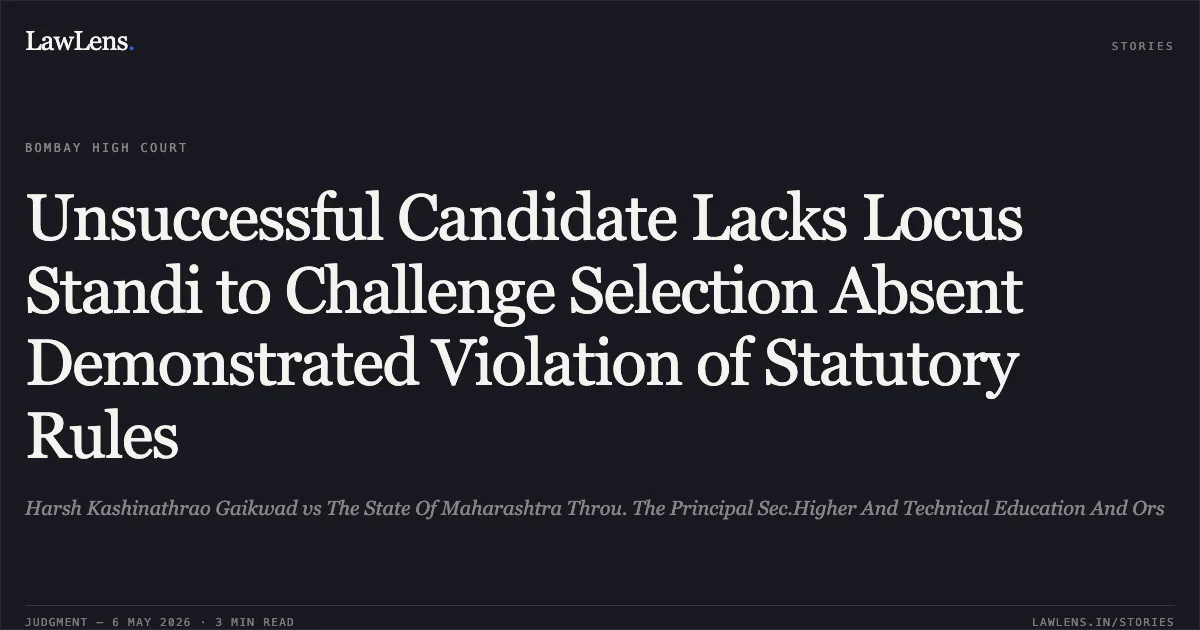
The Court reasoned that the Petitioner lacked locus standi because he failed to demonstrate a violation of statutory rules or a personal legal right to be appointed; he was merely an eligible candidate who was not selected
Source reference: para. 6The Court emphasized that it cannot sit as an appellate body over the selection committee's assessment of merit
Source reference: para. 7On the merits of the disqualification claim, the Court found that the Petitioner could not point to any specific provision in the Maharashtra Public Universities Act, 2016, that disqualifies a candidate solely due to pending disciplinary proceedings by a former employer
Source reference: para. 11The Court held that the truth of the allegations against Respondent No. 6 was a matter for the disciplinary authority and the University to resolve, not a ground for a collateral challenge by a disappointed competitor
Source reference: paras. 10, 15The prayer for the Court to appoint a "suitable candidate" was deemed inherently vague and outside the scope of Article 226
Source reference: para. 13Holding
The Court answered both issues in the negative. It held that the Petition was not maintainable as the Petitioner lacked locus standi and the challenge did not meet the requirements for a Writ of Quo Warranto
The Court concluded that administrative delay and pending inquiries do not automatically invalidate an appointment in the absence of a statutory prohibition. The Writ Petition was dismissed, the rule was discharged, and no costs were awarded
Source reference: paras. 14, 17-19Acts & Sections Cited
1 provisions across 1 statute referred to in this judgment. Each provision opens on LawLens.
Maharashtra Public Universities Act, 20161
Original Court PDF
Harsh Kashinathrao GaikwadvsThe State Of Maharashtra Throu. The Principal Sec.Higher And Technical Education And Ors
Click to open original judgment
Original judgment, available to read, download and summarize on LawLens.in