Facts
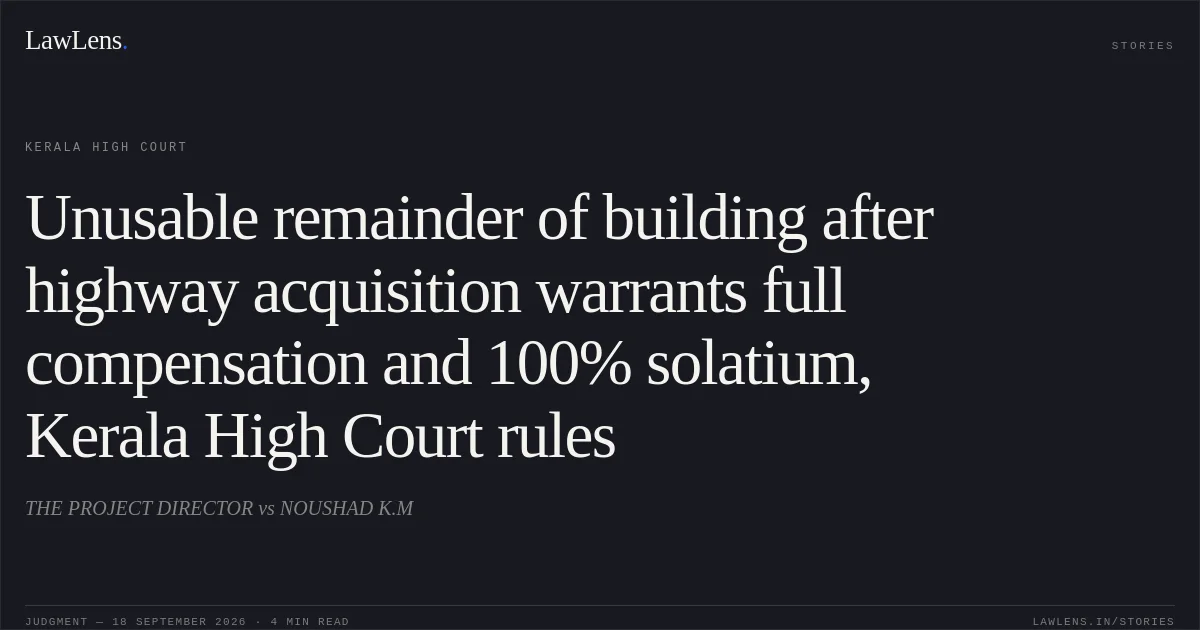
The appeals arose from acquisition of land and structures for widening National Highway 66 in Kasaragod under the National Highways Act, 1956.
Source reference: pp.7–10, paras.1–2The landowners challenged the compensation awarded by the Special Deputy Collector/Competent Authority for Land Acquisition under Section 3G(5) of the National Highways Act.
Source reference: pp.7–10, paras.1–2The Arbitrator and District Collector found, on the basis of PWD inspection reports, that acquisition of a portion of the buildings had destroyed access, rendered the remaining structures unstable and unusable, and substantially impaired their utility.
Source reference: pp.7–10, paras.1–2Compensation for the entire affected building was accordingly directed to be determined and paid.
Source reference: pp.7–10, paras.1–2NHAI challenged the awards under Section 34 of the Arbitration and Conciliation Act, 1996, contending that the portions of the buildings which had not been physically acquired could not attract compensation or solatium, and that such loss could, at most, be treated as damage.
Source reference: pp.10–12, paras.3–4, 7–8The District Court dismissed the challenges and upheld compensation, including 100% solatium under Section 30 of the Right to Fair Compensation and Transparency in Land Acquisition, Rehabilitation and Resettlement Act, 2013 (“2013 Act”).
Source reference: pp.12–14, paras.5–6NHAI preferred the present appeals under Section 37 of the Arbitration and Conciliation Act, 1996.
Source reference: no citationIssues
Whether a portion of a building or structure which is not physically acquired, but is rendered unsafe, unusable or without effective access because of the acquisition, can be treated as part of the compensable property for determining compensation?
Source reference: pp.17–19, para.11Whether compensation payable for such affected or remaining structure attracts solatium under Section 30 of the 2013 Act?
Source reference: pp.12–14, paras.5–6; pp.17–23, paras.11–14Whether the High Court, in an appeal under Section 37 of the Arbitration and Conciliation Act, 1996, could interfere with the Arbitrator’s and District Court’s concurrent findings based on expert PWD reports?
Source reference: pp.24–30, paras.15–22Law Applied
The Court applied Section 3G(5) of the National Highways Act, 1956, concerning determination of compensation by arbitration; Sections 26–30 of the 2013 Act, under which compensation includes the market value of land, the value of assets attached to the land, damages caused by the acquisition’s injurious effect on other property or land, and 100% solatium on the compensation amount; and Section 3(p) of the 2013 Act, which defines “land” broadly to include things attached to the earth or permanently fastened to anything attached to the earth.
Source reference: pp.17–19, para.11Relying on R.B. Dealers Pvt. Ltd. v. Metro Railway, Kolkata, 2019 (20) SCC 658, the Court held that solatium is calculated on the compensation determined under Sections 26–29, including the value of assets attached to the land, but excluding the additional 12% amount payable under Section 30(3).
Source reference: pp.19–22, para.11The Court further applied the restricted scope of review under Sections 34 and 37 of the Arbitration and Conciliation Act, 1996: an award based on a possible, reasonable and evidence-supported view cannot be substituted merely because another view is possible.
Source reference: pp.24–30, paras.15–22The Court relied, inter alia, on MMTC Ltd. v. Vedanta Ltd., (2019) 4 SCC 163, UHL Power Co. Ltd. v. State of H.P., (2022) 4 SCC 116, Somdatt Builders–NCC–NEC (JV) v. NHAI, 2025 SCC OnLine SC 170, and C & C Constructions Ltd. v. IRCON International Ltd., (2025) 4 SCC 234.
Source reference: pp.24–30, paras.15–22Reasoning
The Court held that the statutory scheme does not confine compensation to the physically severed portion of a structure.
Source reference: pp.17–19, para.11Section 27 requires determination of compensation for all assets attached to the land, while Section 28 expressly covers damage caused by the acquisition’s injurious effect on the owner’s other property or land.
Source reference: pp.17–19, para.11The PWD reports and joint inspection materials established that acquisition would demolish the existing accesses, break the building’s connection with the National Highway, and render the remaining structure unstable, unsafe and unusable.
Source reference: pp.7–10, paras.1–2; pp.28–29, paras.20–21Consequently, the remaining structure fell within the compensable consequences of the acquisition, notwithstanding that it had not been physically acquired.
Source reference: pp.17–19, para.11Once the value of the affected structure was included in the compensation determination under Sections 27–29 of the 2013 Act, 100% solatium under Section 30 was payable on that compensation amount.
Source reference: pp.17–23, paras.11–12The Court distinguished Asiamma v. Chief Engineer (LA), observing that it did not decide the specific question of solatium for a structure rendered completely unusable by partial acquisition.
Source reference: p.23, para.13It found that the Arbitrator’s conclusions were based on expert reports and evidentiary material, had been affirmed by the District Court, and were neither perverse, arbitrary nor unsupported by evidence.
Source reference: pp.24–30, paras.15–22The limited jurisdiction under Section 37 therefore did not permit reappreciation or substitution of those findings.
Source reference: pp.24–30, paras.15–22Holding
The Court answered the issues in favour of the landowners.
A structure or portion of a building not physically acquired may nevertheless be included in the compensation assessment where the acquisition renders it unsafe, unusable or substantially deprived of access and utility.
Source reference: pp.17–23, paras.11–14Compensation for that affected structure is also eligible for 100% solatium under Section 30 of the 2013 Act.
Source reference: pp.17–23, paras.11–14Finding no perversity, arbitrariness, violation of natural justice or other ground warranting interference under Sections 34 or 37 of the Arbitration and Conciliation Act, the Court dismissed Arbitration Appeal Nos. 3, 4 and 6 of 2026 and upheld the awards and District Court orders, without costs.
Source reference: pp.28–30, paras.20–23Acts & Sections Cited
9 provisions across 2 statutes referred to in this judgment. Each provision opens on LawLens.
Arbitration and Conciliation Act, 19962
Right to Fair Compensation and Transparency in Land Acquisition, Rehabilitation and Resettlement Act, 20137
Original Court PDF
THE PROJECT DIRECTORvsNOUSHAD K.M
Click to open original judgment
Original judgment, available to read, download and summarize on LawLens.in
![Competent authority must consider casual workers’ wage-benefit representation and issue a reasoned order.. Rati bhan singh and others vs DEPARTMENT OF CULTURE. CAT - ['Allahabad']. LawLens](/stories/thumbnails/competent-authority-must-consider-casual-workers-wage-benefit-representation-and-issue-a-r-ed76119895494f67a72a389de9ebe846.webp)
![Pay protection cannot be withdrawn or recovered without individual determination and prior hearing.. Mehraj Ud Din Wani vs D/o Education Ut Of J & K. CAT - ['Srinagar']. LawLens](/stories/thumbnails/pay-protection-cannot-be-withdrawn-or-recovered-without-individual-determination-and-prior-f1030926f7764c7fb6d8bce15c5054b2.webp)