Facts
The petitioners sought directions to hold overdue Panchayat elections and challenged provisions authorising the State to appoint Administrators and notify election dates.
Source reference: no citationThe previous Panchayat bodies’ five-year terms were due to expire in May 2026.
Source reference: no citationAlthough the State Election Commission had scheduled publication of the final electoral roll, the State constituted a Dedicated Backward Classes Commission on 18 May 2026 to conduct an empirical inquiry into OBC political backwardness.
Source reference: paras. 6–9, 22, 28Elections were deferred, and outgoing Pradhans were appointed as Administrators under Section 12(3-A) of the U.P. Panchayat Raj Act, 1947.
Source reference: paras. 6–9, 22, 28The Commission reported that approximately 60% of its work was complete; the petitioners disputed the adequacy of its inquiry and argued that it could not justify delaying elections.
Source reference: paras. 6–9, 22, 28Issues
Whether the Dedicated Commission’s inquiry satisfied the empirical-inquiry requirements governing OBC reservation in local bodies
Source reference: para. 29(i)–(ii)Whether the pending inquiry justified deferring Panchayat elections
Source reference: para. 29(iii)Whether the Government Order dated 25 May 2026 appointing outgoing Pradhans as Administrators should be quashed
Source reference: para. 29(iv)Whether Sections 12(3-A) and 12-BB(3) of the U.P. Panchayat Raj Act, 1947 were ultra vires Article 243-E of the Constitution
Source reference: para. 29(v)Law Applied
Article 243-E of the Constitution requires Panchayat elections to be completed before the expiry of the Panchayat’s five-year term; Article 243-K entrusts the conduct of elections to the State Election Commission.
Source reference: paras. 93, 97–100The Court applied Section 12(3) of the U.P. Panchayat Raj Act, 1947, which reflects the constitutional election timetable, and Section 12(3-A), which permits a temporary administrative arrangement in unavoidable circumstances or public interest, for no more than six months.
Source reference: paras. 98, 107, 110Under K. Krishna Murthy v. Union of India, (2010) 7 SCC 202, and Vikas Kishanrao Gawali v. State of Maharashtra, (2021) 6 SCC 73, OBC reservation in local bodies requires a dedicated Commission, a rigorous empirical inquiry into political backwardness, local-body-wise determination of the reservation required, and observance of the aggregate 50% ceiling.
Source reference: paras. 36, 39, 43Suresh Mahajan v. State of Madhya Pradesh, (2022) 12 SCC 770, holds that overdue elections cannot be postponed pending completion of the triple test; the Court also noted that the Supreme Court had directed elections to proceed without OBC reservation until that test was complete.
Source reference: paras. 95, 100The judgment nevertheless directed these elections to proceed under the existing reservation arrangement, including 27% OBC reservation.
Source reference: paras. 103–105, 114Reasoning
The Commission had collected information through visits, meetings and questionnaires, but had not disclosed adequate criteria for measuring political backwardness, a method for validating responses, or a reasoned link between its findings and the reservation recommended for each local body.
Source reference: paras. 52–58, 91–92The Court therefore held that the material before it had not prima facie demonstrated compliance with the triple test, while leaving the eventual report open to examination.
Source reference: paras. 52–58, 91–92That deficiency did not permit the State to postpone elections: Article 243-E’s timetable is mandatory, and any later change to the reservation scheme could be implemented through the legally competent process without delaying the elections then due.
Source reference: paras. 93–105The Court found no sufficient basis to quash the appointments of outgoing Pradhans, holding that Section 12(3-A) permits such appointments and that an appointment is not invalid merely because the appointee previously served as Pradhan.
Source reference: para. 109It also rejected the challenges to the statutory provisions, finding Section 12(3-A) capable of reasonable exercise and the pleadings and arguments insufficient to establish invalidity.
Source reference: paras. 110–111Holding
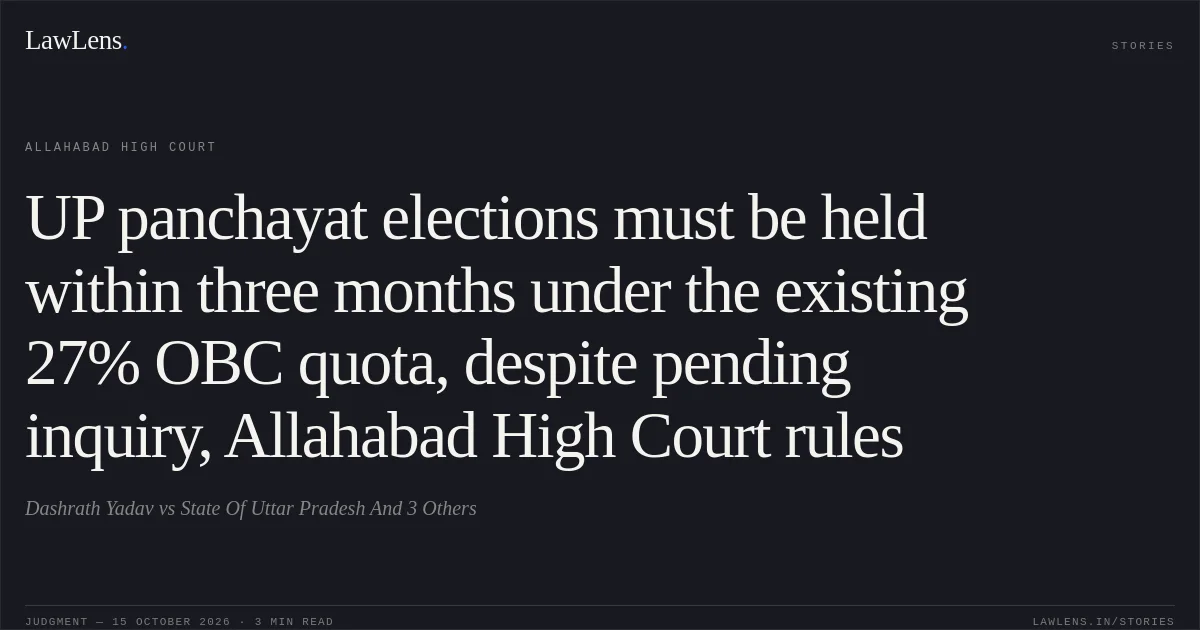
The petitions succeeded insofar as they sought timely Panchayat elections.
The State Government and State Election Commission were directed to take preparatory steps, issue the election programme and complete the elections to village Panchayats within three months, under the existing reservation arrangement, including 27% OBC reservation; the State was to provide necessary logistical assistance.
Source reference: paras. 112–115The Dedicated Commission was directed to continue its inquiry, and the State to consider its recommendations and take any legally required implementation steps.
Source reference: para. 116The challenge to the Government Order appointing outgoing Pradhans as Administrators, and the challenges to Sections 12(3-A) and 12-BB(3), were rejected.
Source reference: paras. 109, 117Acts & Sections Cited
1 provisions across 1 statute referred to in this judgment. Each provision opens on LawLens.
Maharashtra Zilla Parishads and Panchayat Samitis Act, 19611
Original Court PDF
Dashrath YadavvsState Of Uttar Pradesh And 3 Others
Click to open original judgment
Original judgment, available to read, download and summarize on LawLens.in