Facts
The 51 applicants are serving or retired officials (Inspectors, Superintendents, and Assistant Commissioners) from the Central Board of Indirect Taxes and Customs (CBIC)
Source reference: p. 1-5Following the IVth and Vth Central Pay Commission recommendations, the Government issued an Office Memorandum (OM) dated 21.04.2004, upgrading the pay scales for Inspectors and Superintendents
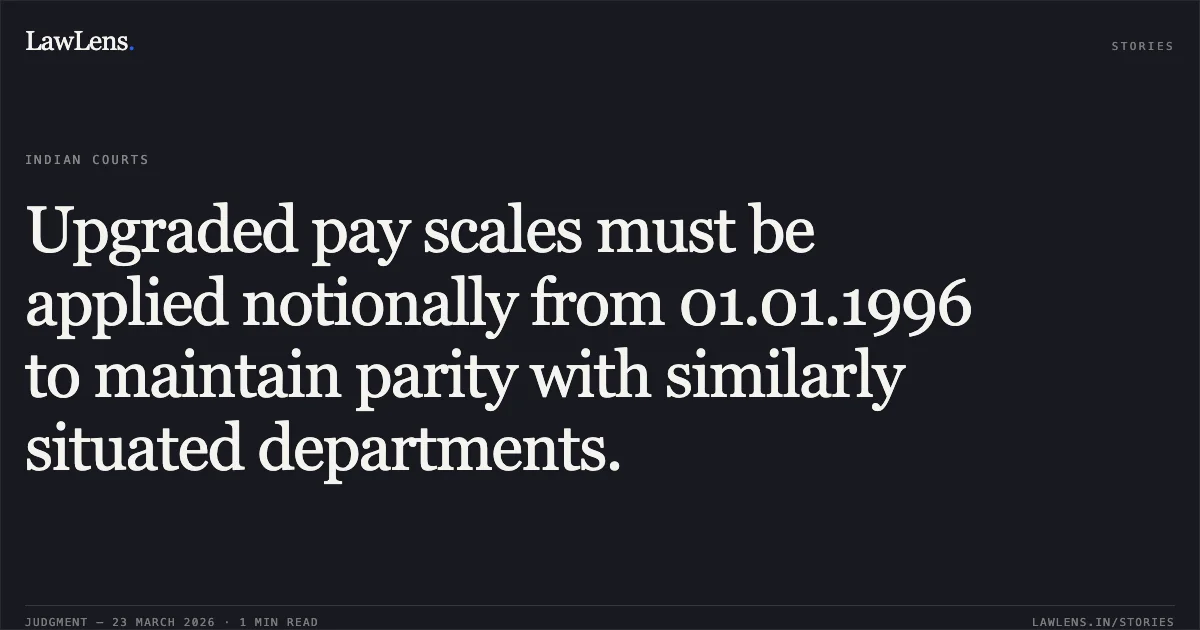
Source reference: p. 10, para 12While the government granted these upgraded scales to similarly situated cadres in the Railway and Postal Accounts notionally from 01.01.1996, it made the benefits for CBIC officials effective only from the date of the order, i.e., 21.04.2004
Source reference: p. 7-8, para 6The applicants submitted representations seeking parity in the effective date of implementation, which were either rejected or left pending
Source reference: p. 8-9, para 8They approached the Tribunal to seek notional pay fixation from 01.01.1996 and actual arrears from 21.04.2004
Source reference: p. 7, para 2Issues
Whether the prospective application (w.e.f. 21.04.2004) of the upgraded pay scales for CBIC officials was arbitrary and discriminatory compared to other departments that received the benefit notionally from 01.01.1996
Source reference: p. 11, para 13; p. 18, para 24Whether the applicants are entitled to notional pay fixation from 01.01.1996 and actual arrears from 21.04.2004 based on established judicial precedents and the "similarly situated" principle
Source reference: p. 18, para 25-26Law Applied
Equality under Article 14 of the Constitution, which mandates that similarly situated employees must be treated equally regarding pay benefits
Source reference: p. 18, para 24The Court relied on the doctrine of judicial discipline and precedents from S.I. Rooplal v. Lt. Governor of Delhi (2000), stating that coordinate benches must follow earlier judgments on the same point
Source reference: p. 16, para 20The Court further applied the "similarly situated" rule derived from Amrit Lal Berry v. Collector of Central Excise (1975) and Inder Pal Yadav v. Union of India (1985), which hold that when a legal principle is settled by a court, the benefit must be extended to all similarly placed employees regardless of whether they were parties to the original litigation
Source reference: p. 17, para 21Reasoning
The Tribunal reasoned that the respondents had already acknowledged the parity between the applicants and the Organized Accounts Cadre in their own internal assessments
Source reference: p. 12, para 13It found no "intelligible differentia" or administrative justification for granting notional benefits from 01.01.1996 to other departments while restricting CBIC officials to a prospective date (21.04.2004)
Source reference: p. 12, para 13The Tribunal noted that the 5th Pay Commission's recommendations were intended to be effective from 01.01.1996; therefore, any subsequent correction of an anomaly or upgradation stemming from that Commission should relate back to that date on a notional basis
Source reference: p. 18, para 25It further observed that the Union of India had already implemented the 1996 notional date for other officials following directions from the Kolkata High Court and a Special Anomaly Committee
Source reference: p. 14-15, para 14-15Consequently, denying the same benefit to the applicants would constitute a discriminatory practice
Source reference: p. 18, para 24Holding
The Tribunal allowed the Original Application and quashed the impugned order dated 21.04.2004 to the extent that it limited the actual benefits to a prospective date
It held that the applicants are entitled to the revised/upgraded pay scales on a notional basis with effect from 01.01.1996 and actual benefits (including arrears) from 21.04.2004
Source reference: p. 19, para 27The respondents were directed to refix the pay/pension and pay the arrears with applicable interest within three months
Source reference: p. 19, para 27Acts & Sections Cited
1 provisions across 1 statute referred to in this judgment. Each provision opens on LawLens.
Administrative Tribunals Act, 19851
Original Court PDF
Bhrigu nath yadavvsCentral Goods and Services Tax (CGST)
Click to open original judgment
Original judgment, available to read, download and summarize on LawLens.in