Facts
On 29 September 2000, Amin Kasam Sama was travelling in truck No. GJ-2T-6046, allegedly as a labourer engaged to unload fertilizer. While the truck was returning near Khavda Road, the driver attempted to avoid stray buffaloes, lost control, and the truck overturned, causing Sama grievous injuries resulting in complete paraplegia and 100% functional disability.
Source reference: pp.2–4; paras. 2.1–2.2Sama initially filed a claim under Section 163A of the Motor Vehicles Act, 1988, but the claim was held not maintainable and was remanded for adjudication under Section 166. The Motor Accident Claims Tribunal held the truck driver solely negligent and awarded Rs.10,74,000 with interest at 9% per annum. It treated Sama’s income as Rs.5,000 per month, awarded Rs.9,00,000 towards future loss of income, Rs.24,000 towards attendant charges, Rs.75,000 towards medical expenses, Rs.50,000 towards pain and suffering, and Rs.25,000 towards loss of enjoyment of life.
Source reference: pp.3–5; paras. 2.3, 3.2–3.3The insurer appealed, disputing negligence and contending that Sama was an unauthorised passenger in breach of the policy conditions. Sama filed a cross-appeal seeking enhancement. During the proceedings, he died on 1 February 2016, and his parents and brother were substituted as his legal representatives.
Source reference: pp.1, 9; paras. 1, 7Issues
Whether the insurer could avoid liability on the ground that the injured claimant was an unauthorised passenger and that the insured vehicle’s policy conditions had been breached?
Source reference: pp.14–17; paras. 12–13Whether the Tribunal had correctly assessed the claimant’s income, future loss of income, attendant charges, medical expenses, and conventional compensation?
Source reference: pp.18–24; paras. 18–27Whether the legal representatives of an injured claimant who died during the pendency of the proceedings could pursue enhancement, and, if so, to what extent?
Source reference: pp.17–18, 21–23; paras. 14–17, 22–26Law Applied
The Court applied Sections 166 and 173 of the Motor Vehicles Act, 1988: Section 166 governs claims based on fault liability, while Section 173 provides the statutory appeal against an award of the Claims Tribunal.
Source reference: pp.1, 3; paras. 1, 2.3The insurer bears the burden of proving a policy breach or that the claimant was an unauthorised passenger; an unsupported defence, absent rebuttal evidence from the owner or driver, is insufficient.
Source reference: pp.14–17; paras. 12–13For compensation, the Court applied the principles governing functional disability, future prospects, multiplier assessment, and attendant expenses.
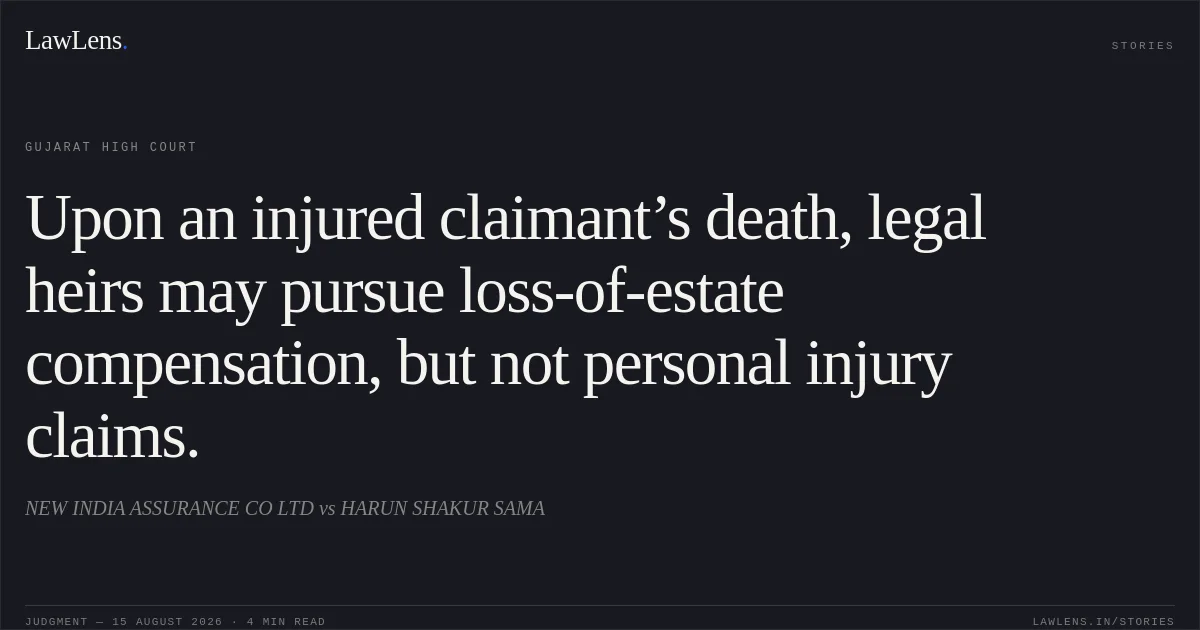
Source reference: pp.12–18, 21–23; paras. 10, 15–17, 22, 25–26It relied on Kajal v. Jagdish Chand, (2020) 4 SCC 413, for computation of attendant charges; Kahlon @ Jasmail Singh Kahlon, (2022) 13 SCC 494, and the subsequent decisions in Meena v. Prayag Raj and Dhanalal alias Dhanraj v. Nasir Khan, AIR 2025 SC 5046, for the principle that, upon the injured claimant’s death during proceedings, the legal representatives may pursue compensation forming part of the deceased’s estate, but cannot ordinarily pursue personal claims for pain, suffering, or loss of enjoyment of life.
Source reference: pp.12–18, 21–23; paras. 10, 15–17, 22, 25–26The Court also applied the 40% addition for future prospects applicable to a young self-employed claimant.
Source reference: p.19; para. 19Reasoning
The Court upheld the finding of negligence and insurer liability because the claimant consistently stated that he had boarded the truck as a labourer to unload fertilizer and had remained in the vehicle while returning. The FIR and the written submissions of the owner and driver supported the claimant’s presence for that purpose. Since the insurer did not examine the driver or owner, it failed to establish that the claimant was merely an unauthorised passenger or that the policy had been breached.
Source reference: pp.14–17; paras. 12–13On quantum, the Court found the Tribunal’s reduction of the claimant’s proved monthly income from Rs.9,000 to Rs.5,000 to be based on conjecture. Considering the evidence regarding labour work and milk sales, it fixed the income at Rs.7,500 per month.
Source reference: p.18; para. 18It added 40% for future prospects, resulting in a monthly income of Rs.10,500, and rejected the Tribunal’s one-third deduction because the case concerned permanent injury rather than death.
Source reference: p.19; para. 19Given the claimant’s complete paraplegia and 100% functional disability, the Court adopted a multiplier of 16 and awarded Rs.20,16,000 for future loss of income.
Source reference: p.20; para. 21Applying Kajal, the Court enhanced attendant charges to Rs.2,500 per month for each of two attendants, multiplied by 12 and 16, resulting in Rs.9,60,000. Medical and special-diet expenses were enhanced to Rs.1,00,000.
Source reference: pp.21–22; paras. 22–24However, consistently with Kahlon, the Court declined to enhance compensation for pain, shock and suffering or loss of enjoyment of life, treating those heads as personal to the deceased claimant, although it left the Tribunal’s existing awards of Rs.50,000 and Rs.25,000 undisturbed.
Source reference: pp.22–24; paras. 25–26Holding
The insurer’s appeal challenging liability was rejected, and the finding that the original opponents were jointly and severally liable was affirmed.
The claimant’s cross-appeal was partly allowed. Total compensation was enhanced from Rs.10,74,000 to Rs.31,51,000, comprising Rs.20,16,000 for future loss of income, Rs.9,60,000 for attendant charges, Rs.1,00,000 for medical expenses and special diet, Rs.50,000 for pain and suffering, and Rs.25,000 for loss of enjoyment of life.
Source reference: p.24; para. 27The enhanced amount of Rs.20,77,000, with interest at 9% per annum from the date of filing of the claim petition until realization, was directed to be deposited within eight weeks. The Tribunal was directed to release and apportion the amount among the legal heirs after verification and to examine any court-fee liability.
Source reference: p.25; para. 28Acts & Sections Cited
4 provisions across 1 statute referred to in this judgment. Each provision opens on LawLens.
Motor Vehicles Act, 19884
Original Court PDF
NEW INDIA ASSURANCE CO LTDvsHARUN SHAKUR SAMA
Click to open original judgment
Original judgment, available to read, download and summarize on LawLens.in