Facts
Qwik Supply Chain Private Limited (“Applicant”) and CRPL Infra Private Limited (“Respondent”) executed a Cold Storage Facility Service Agreement dated 27 April 2021 containing an arbitration clause.
Source reference: paras. 1–5, 31–32The clause required amicable settlement for 30 days and thereafter permitted either party to issue a Request for Arbitration; it also prescribed the constitution of a three-member tribunal and provided that, if the responding party failed to nominate its arbitrator within 30 days, the arbitrator nominated by the requesting party would act as sole arbitrator.
Source reference: paras. 1–5, 31–32The parties subsequently executed amendment agreements concerning additional storage facilities and service-provider details, while preserving the remaining terms of the principal Agreement.
Source reference: para. 6Following a complaint and FIR concerning missing crates and pallets, the Respondent acknowledged a shortage allegedly caused by theft and expressed willingness to compensate certain losses through adjustments from its monthly service bills.
Source reference: para. 7The Applicant later demanded Rs. 76,67,613/- towards the alleged loss and invoked arbitration on 24 June 2024, nominating its arbitrator. The Respondent did not nominate an arbitrator in response, instead stating that it intended to approach the MSME Facilitation Council.
Source reference: para. 7Subsequently, on 26 August 2024, the Respondent independently invoked arbitration and nominated another arbitrator. The Applicant objected to that nomination and filed the present application under Section 11 of the Arbitration and Conciliation Act, 1996 (“Arbitration Act”).
Source reference: para. 7Issues
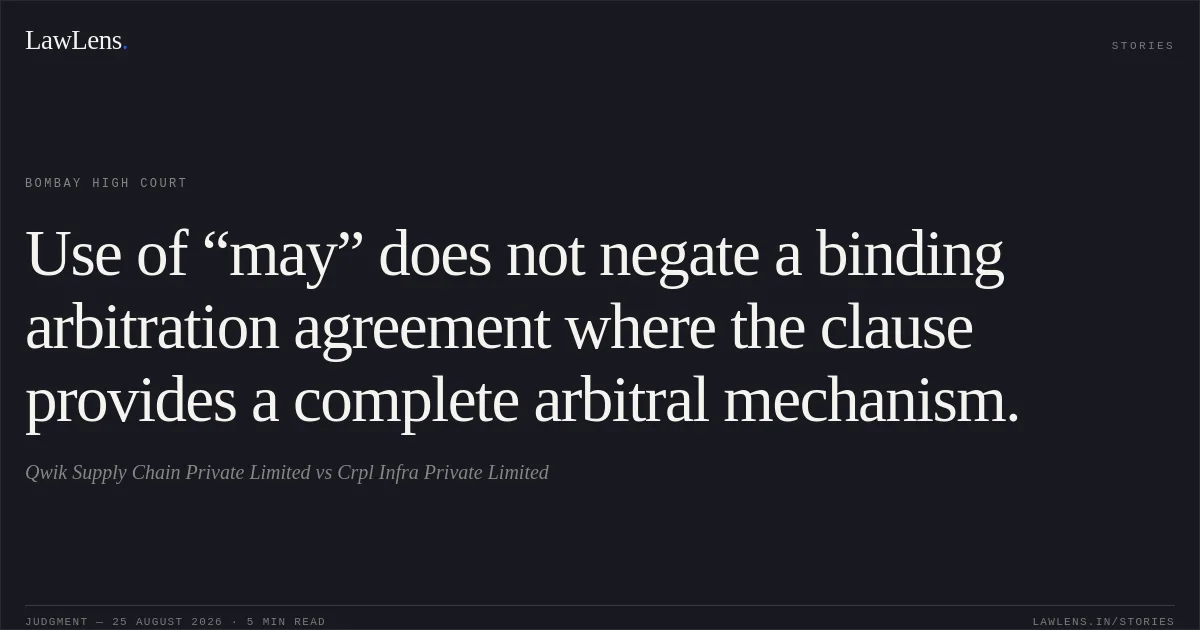
Whether Clause 19 constituted a binding arbitration agreement despite providing that either party “may” refer the dispute to arbitration.
Source reference: paras. 20–23, 29–30Whether the arbitration clause in the principal Agreement continued to govern disputes arising under the subsequent amendment agreements.
Source reference: para. 24Whether the Respondent’s MSME registration and proposed recourse to the Micro and Small Enterprises Facilitation Council under Section 18 of the Micro, Small and Medium Enterprises Development Act, 2006 (“MSMED Act”) barred the Applicant’s Section 11 application.
Source reference: paras. 25–27Whether the allegations of theft, the non-joinder of alleged perpetrators or owners of the goods, and related questions of ownership and liability rendered the dispute non-arbitrable or defeated the Section 11 application.
Source reference: para. 28Whether the Respondent’s later independent invocation of arbitration displaced the contractual consequence arising from its failure to nominate an arbitrator within 30 days of the Applicant’s Request for Arbitration.
Source reference: paras. 31–34Law Applied
Section 7 of the Arbitration Act requires a concluded intention to submit disputes to arbitration; the use of the word “may” is not conclusive, and the arbitration clause must be read as a whole to determine whether further consent after the dispute arises is required, applying Jagdish Chander v. Ramesh Chander, (2007) 5 SCC 719.
Source reference: paras. 20–22Under Section 11, the Court’s examination is ordinarily limited to the existence of an arbitration agreement, while detailed jurisdictional and arbitrability objections may be considered by the tribunal under Section 16, as explained in Ajay Madhusudan Patel v. Jyotrindra S. Patel, (2025) 2 SCC 147.
Source reference: para. 29The Court distinguished Alchemist Hospitals Ltd. v. ICT Health Technology Services India Pvt. Ltd. and BGM and M-RPL-JMCT (JV) v. Eastern Coalfields Ltd., where the clauses did not demonstrate a concluded agreement to arbitrate.
Source reference: paras. 21–23Under the MSMED Act, Chapter V may override an independent arbitration agreement where the statutory requirements are satisfied and an eligible supplier makes a reference under Section 18 concerning an amount due under Section 17; however, MSME registration alone is insufficient, and eligibility as a “supplier” and the statutory nature of the claim must be established, applying Mahakali Foods (P) Ltd.
Source reference: paras. 25–27A contractual arbitration proceeding concerning civil liability is not rendered non-arbitrable merely because the same facts may also involve criminal allegations.
Source reference: para. 28Under the agreed appointment mechanism, failure to nominate an arbitrator within the stipulated 30-day period triggers the contractual consequence that the requesting party’s nominee acts as sole arbitrator.
Source reference: paras. 31–33Reasoning
The Court held that Clause 19, read in its entirety, manifested a concluded agreement to arbitrate. The word “may” merely gave either party the option to commence the agreed arbitral process after the amicable-settlement period; it did not require fresh mutual consent.
Source reference: paras. 20–23, 29–30The detailed provisions concerning the Request for Arbitration, nomination periods, constitution of the tribunal, seat, language, and final and binding nature of the award confirmed a binding arbitration mechanism.
Source reference: paras. 20–23, 29–30The amendment agreements altered only limited contractual matters and did not terminate, replace, or expressly exclude Clause 19; consequently, the arbitration agreement continued to govern the parties’ contractual relationship.
Source reference: para. 24The Respondent’s MSME registration did not, by itself, oust the Court’s Section 11 jurisdiction. No actual reference under Section 18(1) had been shown, and the Applicant’s compensation claim for lost crates and pallets was not conclusively established at this stage to be an amount due under Section 17.
Source reference: paras. 25–27The applicability of the MSMED Act and the Respondent’s eligibility were therefore left open.
Source reference: paras. 25–27The FIR and alleged theft concerned possible criminal liability of third parties, whereas the proposed arbitration concerned the Respondent’s contractual civil liability for the alleged loss; questions of ownership, necessary parties, maintainability, and liability could be determined by the tribunal.
Source reference: para. 28Since the Respondent failed to nominate an arbitrator within 30 days of the Applicant’s Request for Arbitration dated 24 June 2024, the agreed consequence had already arisen. Its later independent notice dated 26 August 2024 could not retrospectively displace that consequence or avoid the contractual time limit.
Source reference: paras. 31–33Holding
The Court allowed the Section 11 application and appointed Mr. Vikramjit Grewal, Advocate, as the sole arbitrator to adjudicate disputes arising under the principal Agreement and the amendment agreements.
The appointment was made subject to the disclosure requirements under Section 12 of the Arbitration Act.
Source reference: para. 35(iii)The Court clarified that the sole arbitrator could determine all questions concerning jurisdiction, arbitrability, maintainability, applicability of the MSMED Act, ownership, liability, and quantum, and that the Court’s observations were only prima facie findings for the Section 11 stage.
Source reference: paras. 34, 35(iv)–(v)The seat and venue were fixed at Mumbai, the proceedings were to be conducted in English, fees were to be determined under the Fourth Schedule unless otherwise agreed, and the application was disposed of without an order as to costs.
Source reference: para. 35Acts & Sections Cited
8 provisions across 2 statutes referred to in this judgment. Linked provisions open on LawLens.
Arbitration and Conciliation Act, 19965
Micro, Small and Medium Enterprises Development Act, 20063
Original Court PDF
Qwik Supply Chain Private LimitedvsCrpl Infra Private Limited
Click to open original judgment
Original judgment, available to read, download and summarize on LawLens.in
![Courts will not interfere with transfers absent mala fides or violation of statutory rules.. M Ramya vs EMPLOYEES STATE INSURANCE CORPORATION (ESIC). CAT - ['Chennai']. LawLens](/stories/thumbnails/courts-will-not-interfere-with-transfers-absent-mala-fides-or-violation-of-statutory-rules-a6845e9ca6f548fca284c51c8351957f.webp)
![Courts cannot direct one-time recruitment age relaxation absent authority in the governing rules or advertisement.. UT OF PUDUCHERRY vs M ANDAL. CAT - ['Chennai']. LawLens](/stories/thumbnails/courts-cannot-direct-one-time-recruitment-age-relaxation-absent-authority-in-the-governing-895d78fde47143e2a8ed0207c4b6a44f.webp)
![A review cannot correct an allegedly erroneous decision absent an error apparent on the record.. Ajit Kumar Jha vs RAILWAY BOARD. CAT - ['Delhi']. LawLens](/stories/thumbnails/a-review-cannot-correct-an-allegedly-erroneous-decision-absent-an-error-apparent-on-the-re-8ac952fd4eba470c92f7da20af72a220.webp)