Facts
The appellant, a tube-well operator with over 20 years of service, applied for the Voluntary Retirement Scheme (VRS) on 09.10.1997, allegedly under the impression that he could purchase the tube-well
Source reference: para. 3-4Realizing no such purchase scheme existed, he withdrew his VRS application via letters dated 12.12.1997 and 09.07.1998
Source reference: para. 5Despite the withdrawal, the respondent authorities accepted his VRS on 02.12.1998
Source reference: para. 6The appellant challenged this acceptance in the High Court. While the initial Single Judge order in 2009 favored the appellant, the matter was remanded by a Division Bench in 2015
Source reference: para. 7-8Upon remand, the learned Single Judge dismissed the petition on 03.03.2016, noting that the appellant had received and utilized retirement benefits totaling ₹5,81,202/-, albeit "under protest"
Source reference: para. 9, 19The appellant’s legal heirs pursued this Letters Patent Appeal following his death
Source reference: para. 2Issues
1. Whether an employee is entitled to withdraw a voluntary retirement application before its formal acceptance by the employer
Source reference: para. 25-262. Whether the acceptance and utilization of retirement benefits "under protest" estops an employee from challenging the validity of the retirement under the principle of "approbate and reprobate"
Source reference: para. 39-42Law Applied
The court applied the principle from Balram Gupta v. Union of India, which establishes that a notice for voluntary retirement can be withdrawn at any time before it becomes effective
Source reference: para. 25, 28However, this is qualified by the doctrine of "approbate and reprobate" as elucidated in Bank of India v. O.P. Swarnakar, which holds that employees who accept and utilize ex-gratia payments or benefits under a contractual VRS scheme cannot later resile from the arrangement
Source reference: para. 20, 30The court further relied on Punjab National Bank v. Virender Kumar Goel, asserting that the utilization of deposited benefits constitutes an act that precludes the employee from challenging the cessation of the jural relationship
Source reference: para. 31, 42Reasoning
The court observed that while the appellant had technically withdrawn his VRS application before the respondents formally accepted it on 02.12.1998, his subsequent conduct was determinative
Source reference: para. 24, 26The respondents argued, and the court accepted, that the appellant had received a total of ₹5,81,202/- in retirement benefits and utilized these funds for personal use
Source reference: para. 19, 32The court distinguished the present case from precedents where funds were merely deposited but not utilized
Source reference: para. 31Although the appellant claimed the funds were accepted "under protest," the court held that the act of utilization created a "Golden Handshake" effect, terminating the employer-employee relationship
Source reference: para. 34, 42The court rejected the applicability of the Delhi High Court’s view in Kuldip Gandotra, prioritizing the Supreme Court's stance that an employee cannot simultaneously enjoy the financial fruits of a retirement scheme and challenge its validity
Source reference: para. 42-43Holding
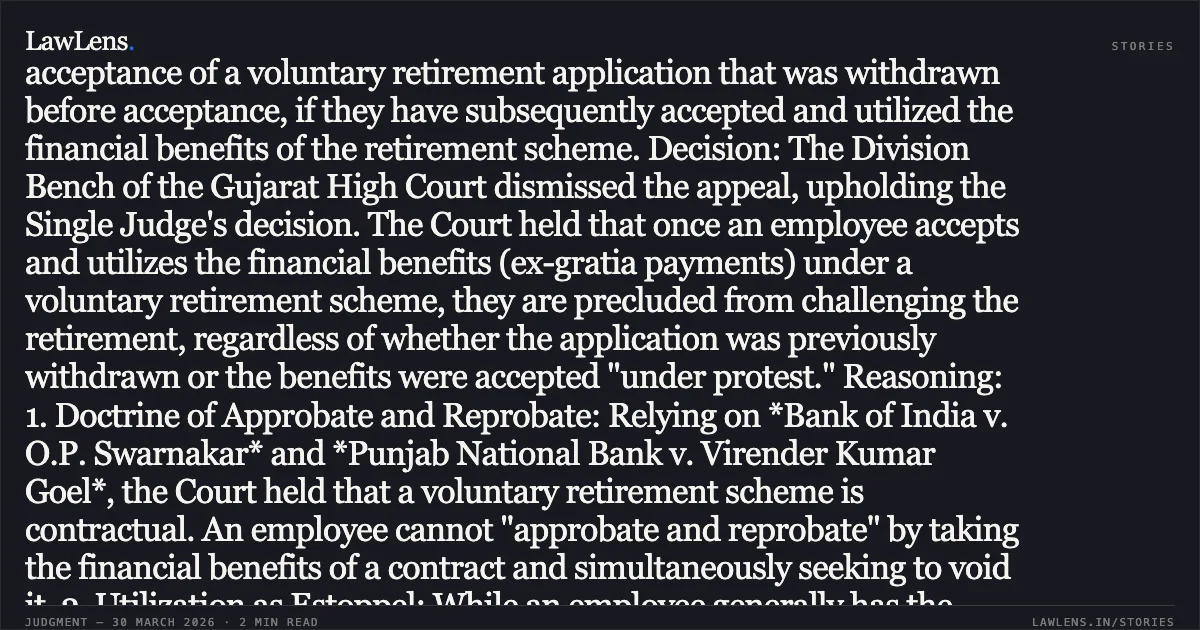
The High Court dismissed the Letters Patent Appeal and upheld the judgment of the learned Single Judge
The court held that because the appellant had utilized the retirement benefits, he was legally barred from resiling from the Voluntary Retirement Scheme, regardless of the prior withdrawal of his application
Source reference: para. 42No further relief or reinstatement was granted
Source reference: para. 44Original Court PDF
KARSANBHAI JIVABHAI CHAMARvsEXECUTIVE ENGINEER
Click to open original judgment
Original judgment, available to read, download and summarize on LawLens.in


