01Facts
The applications arose from the same matrimonial dispute.
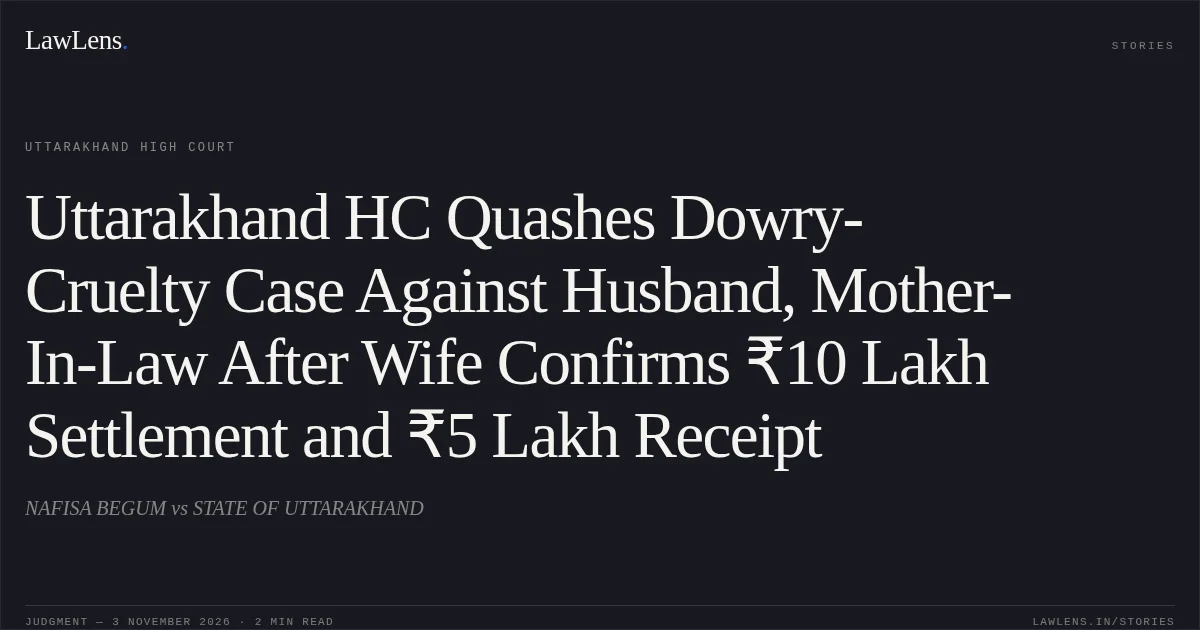
The husband and his mother-in-law were charge-sheeted for offences under Sections 498-A and 323 of the Indian Penal Code and Sections 3/4 of the Dowry Prohibition Act; the Magistrate took cognizance and summoned them in Criminal Case No. 9599 of 2024.
¶ 5The applicants sought quashing of the charge-sheet, the cognizance/summoning order dated 24 December 2024, and the criminal proceedings.
¶ 6During the proceedings, the husband and respondent no. 2 reached a settlement to separate, including an agreed permanent-alimony payment of ₹10,00,000, of which ₹5,00,000 had been paid.
¶ 7Respondent no. 2 affirmed the settlement and stated that she did not wish to pursue the prosecution.
¶ 7–902Issues
i.Whether the High Court could use its inherent jurisdiction under Section 528 of the BNSS to quash non-compoundable offences arising from a matrimonial dispute after the parties settled it.
¶ 14–16ii.Whether the settlement and respondent no. 2’s consent justified quashing the charge-sheet, cognizance order, and proceedings against both applicants.
¶ 13, 16–1703Law Applied
Section 528 of the BNSS preserves the High Court’s inherent power to make orders necessary to give effect to the BNSS, prevent abuse of the process of a court, or secure the ends of justice.
¶ 14–15That jurisdiction is distinct from statutory compounding and may be exercised to quash non-compoundable offences in appropriate cases involving predominantly private or matrimonial disputes, where the settlement is genuine and continuation of the prosecution would serve no meaningful purpose.
¶ 14–15Applying Gian Singh v. State of Punjab, (2012) 10 SCC 303, and Narinder Singh v. State of Punjab, (2014) 6 SCC 466, the Court noted that such relief may be appropriate where the possibility of conviction is remote and the circumstances justify quashing.
¶ 14–15Provisions in the judgment · 4 · Linked ones open on LawLens
Indian Penal Code, 1860 Section 323
Dowry Prohibition Act, 1961 Section 3Section 4
Bharatiya Nagarik Suraksha Sanhita, 2023 Section 528
04Reasoning
The Court found that the prosecution arose from matrimonial discord and that the parties had voluntarily settled their differences and agreed to separate.
¶ 9, 13Respondent no. 2 appeared before the Court, affirmed the settlement, acknowledged receipt of ₹5,00,000, and expressly declined to pursue the criminal proceedings; the settlement also addressed permanent alimony and withdrawal of related cases.
¶ 9, 13Given the private and matrimonial nature of the dispute and the voluntary settlement, the Court concluded that continuing the prosecution would serve no fruitful purpose and would amount to an abuse of process.
¶ 14, 16It therefore considered the case suitable for exercising its inherent jurisdiction despite the offences being non-compoundable.
¶ 14, 1605Holding
The Court allowed both applications and quashed, qua the applicants, the charge-sheet, the cognizance/summoning order dated 24 December 2024, and the proceedings in Criminal Case No. 9599 of 2024.
¶ 17The joint compounding applications and any pending applications were disposed of accordingly.
¶ 18–19Original Court PDF
NAFISA BEGUMvsSTATE OF UTTARAKHAND
Click to open original judgment
Original judgment, available to read, download and summarize on LawLens.in