01Facts
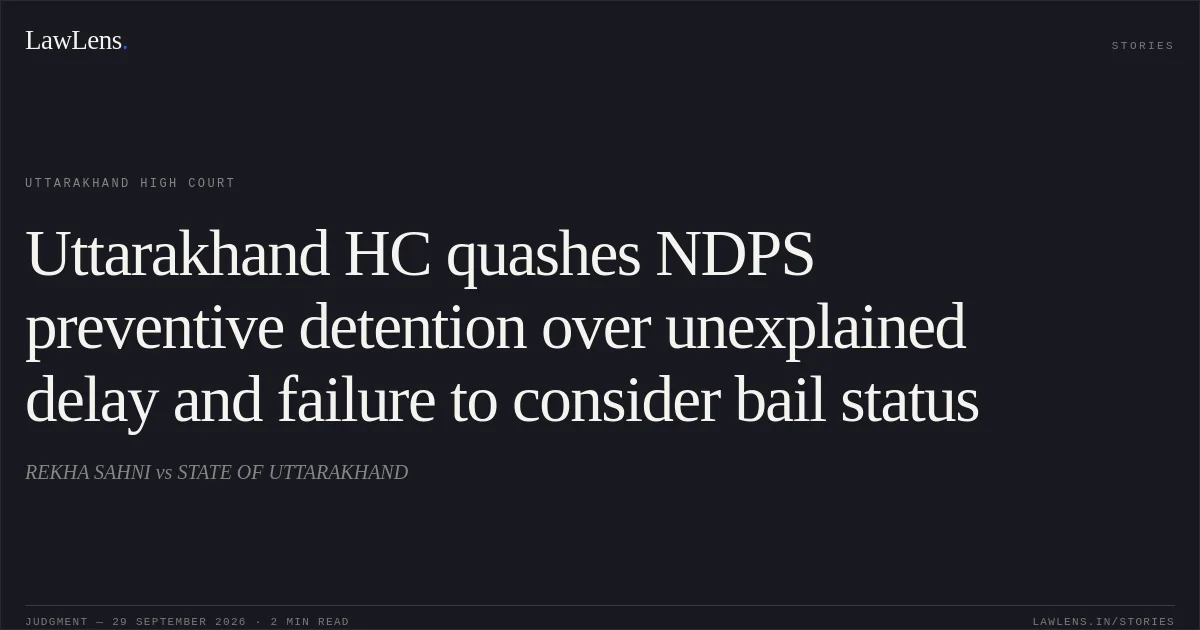
The petitioner challenged her preventive detention under Section 3(1) of the Prevention of Illicit Traffic in Narcotic Drugs and Psychotropic Substances Act, 1988 (“PIT NDPS Act”).
¶ 2–13The State relied on ten NDPS cases registered against her between 2021 and 2024; the last FIR was registered on 16 July 2024.
¶ 2–13The Senior Superintendent of Police proposed detention on 24 December 2025, and the detention order was passed on 17 April 2026.
¶ 2–13The petitioner argued that the delays were unexplained and that the detaining authority had not considered her bail status.
¶ 2–13The State relied on her criminal history and disputed the relevance of the petitioner’s cited precedent, Raees v. State of Uttarakhand.
¶ 2–1302Issues
i.1. Whether the delay between the last FIR and the detention proposal rendered the proposal stale and, if so, what effect followed.
¶ 14(i)ii.2. Whether the further delay of approximately four months in passing the detention order could be justified by an imminent necessity for preventive detention.
¶ 14(ii)iii.3. Whether the detaining authority’s failure to consider that the petitioner was on bail in the relevant criminal cases vitiated the detention order.
¶ 14(iii)03Law Applied
Under Section 3(1) of the PIT NDPS Act, preventive detention requires a valid subjective satisfaction and is an exceptional measure; there must be a live and proximate link between the detenu’s past conduct and the need for detention.
¶ 17, 20–23Unexplained delay may snap that link.
¶ 17, 20–23Material facts bearing on detention—including whether the person is on bail—must be placed before and considered by the detaining authority; their omission or non-consideration may vitiate the order.
¶ 28Where ordinary criminal law provides adequate means to address the concern, preventive detention should not be used to circumvent the criminal process or bail orders.
¶ 30, 32The Court also relied on its decision in Raees v. State of Uttarakhand concerning unexplained delay and the requirement of an imminent necessity for detention.
¶ 21Provisions in the judgment · 9 · Linked ones open on LawLens
Narcotic Drugs and Psychotropic Substances Act, 1985 Section 8Section 19Section 20Section 21Section 24Section 29Section 37
Prevention of Illicit Traffic in Narcotic Drugs and Psychotropic Substances Act, 1988 Section 3
Code of Criminal Procedure, 1973 Section 41
04Reasoning
The last FIR predated the proposal by about seventeen months, and the detention order followed the proposal by nearly four months.
¶ 15–24The State offered no satisfactory explanation for either interval and identified no fresh prejudicial activity establishing an immediate need for detention.
¶ 15–24The Court therefore held that the live and proximate link had been snapped.
¶ 15–24Although the proposal recorded that the petitioner was on bail, neither the satisfaction order nor the detention order showed that the detaining authority considered that fact.
¶ 25–33The State did not allege misuse of bail or show that it had sought cancellation of bail; the failure to consider this relevant material independently vitiated the order.
¶ 25–3305Holding
The Court answered all three issues in the petitioner’s favour.
¶ 34–38It held that the unexplained delays, absence of a live and proximate link, and non-consideration of the petitioner’s bail status rendered the subjective satisfaction unsustainable.
¶ 34–38The detention order dated 17 April 2026 was quashed, the habeas corpus petition was allowed, and the detenu was directed to be released forthwith unless required in connection with another case.
¶ 34–38Original Court PDF
REKHA SAHNIvsSTATE OF UTTARAKHAND
Click to open original judgment
Original judgment, available to read, download and summarize on LawLens.in